The Embassy Guard Who Spied for Russia – Caught on Hidden Camera
Watch on YouTube Subscribe to Faded Pin
A security guard at the British Embassy in Berlin spied for Russia for years – until a joint MI5, Metropolitan Police and German police sting caught him on hidden camera. This documentary tells the true story of David Smith, built on the judge's sentencing remarks: the documents he photographed at night, his letters to Russian military attachés, the fake Russian informant "Dmitry", the fake GRU officer "Irina", and the 2023 Old Bailey sentence of 13 years and 2 months.
▶ Full story, transcript and sources: https://fadedpin.vercel.app/stories/british-embassy-berlin-spy-david-smith
På svenska
Ambassadvakten som spionerade för Ryssland – fångad på dold kamera
En vakt vid den brittiska ambassaden i Berlin spionerade i flera år för Ryssland – tills en gemensam operation av MI5, Londonpolisen och tysk polis fångade honom på dold kamera. Dokumentären bygger på domarens straffmätning: dokumenten han fotograferade på natten, breven till ryska militärattachéer, den falska ryske informatören "Dmitrij", den falska GRU-officeren "Irina" och domen 2023 på 13 år och 2 månader.
Türkçe
Rusya İçin Casusluk Yapan Elçilik Görevlisi – Gizli Kamerada
Berlin'deki İngiliz Büyükelçiliği'nde güvenlik görevlisi olarak çalışan David Smith yıllarca Rusya için casusluk yaptı; ta ki MI5, Londra polisi ve Alman polisinin ortak operasyonu onu gizli kamerayla yakalayana kadar. Belgesel, hâkimin karar gerekçesine dayanıyor: gece fotoğrafladığı belgeler, Rus askerî ataşelerine yazdığı mektuplar, sahte Rus muhbir "Dmitry", sahte GRU subayı "Irina" ve 2023'te verilen 13 yıl 2 aylık hapis cezası.
Chapters
- 0:00A camera filming a camera
- 0:54The man at the gate
- 2:10A change of heart
- 2:47After hours
- 3:55The videos
- 4:56Letters to the Russians
- 6:18Suspicion
- 6:57"Dmitry"
- 8:12What it meant
- 8:45"Irina"
- 9:28The arrest
- 10:27In court
- 11:36The cost
- 12:22The sentence
- 12:57Watched
The full story
A security guard sits in a small room at the British Embassy in Berlin.
In front of him are the monitors of the embassy's security cameras. On the screen is a recording from earlier in the week. A visitor, walking through the building.
The guard lifts his phone, and films the screen. He zooms in on the visitor's face.
What he doesn't know is that another camera is filming him.
And the man on the screen was sent to catch him.
This is the story of David Smith. The guard who spied.
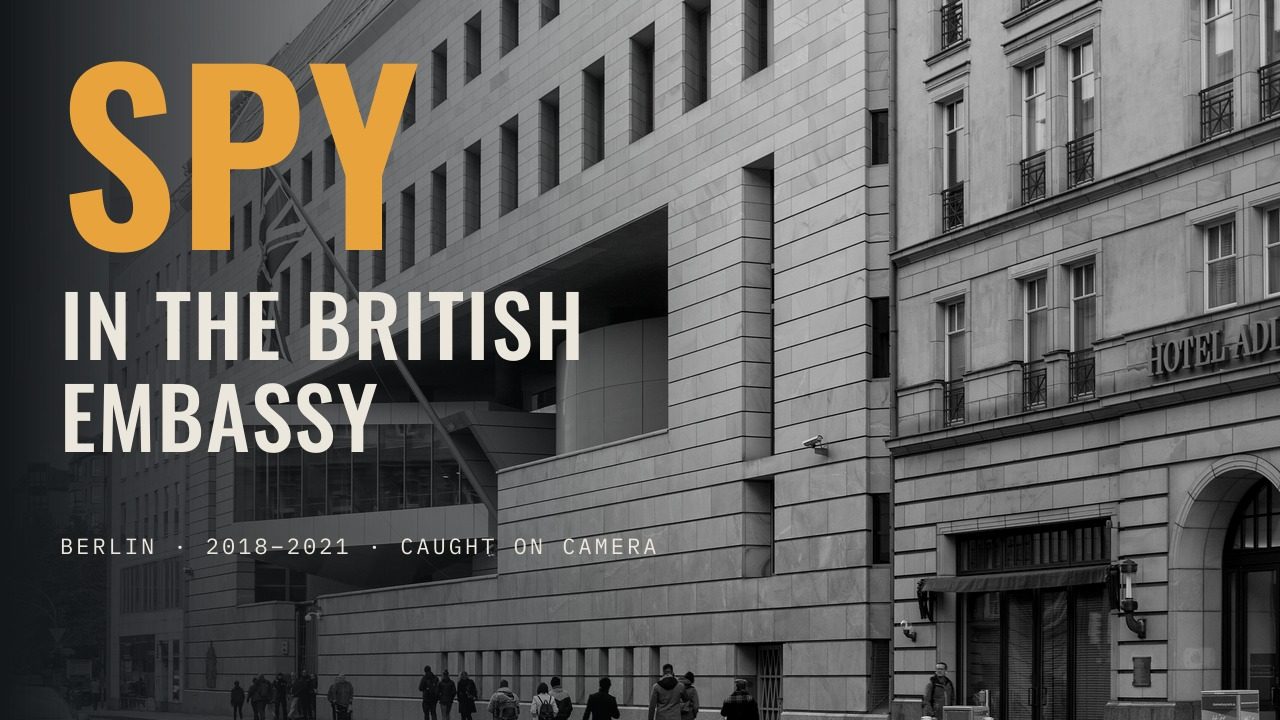
The British Embassy in Berlin stands on Wilhelmstraße, just around the corner from the Brandenburg Gate.
A short walk away, on the grand boulevard of Unter den Linden, stands the embassy of the Russian Federation.
For decades, this part of Berlin sat right on the line between East and West. The Berlin Wall ran only a few hundred metres away. When the Cold War ended, both countries built their embassies here again, almost within sight of each other.
David Smith was born in nineteen sixty-four, in Paisley, in Scotland. He served for twelve years in the Royal Air Force. Later, he moved to Germany, and settled in Potsdam, just outside Berlin.
In twenty sixteen, he started work as a security guard at the British Embassy.
A guard sees everything. He knows who comes and goes. He knows where every office is, which doors lock at night, and when the building is empty.
He is trusted with the building, and with the people inside it.
According to the court, somewhere in those years, Smith's views changed.
Colleagues heard him criticise Britain, and Germany, where he lived. They had the impression that he was more sympathetic to Russia, and to President Putin.
In court, Smith himself admitted that, at one point while working at the embassy, he had supported the Russian-backed rebels in the Donbas region of Ukraine.
The judge would later find that these feelings were the direct cause of everything that followed.
In twenty eighteen, Smith began to collect information he had no right to see.
He did it at night. After his colleagues had gone home, he walked through the offices of the embassy, with his phone or a camera.
He photographed documents left on desks and in areas closed to the public. Sometimes, he opened private desk drawers to find more.
Some of the documents were clearly marked secret. One was a sensitive report to the British Prime Minister, Boris Johnson, from members of his own cabinet.
Others were less secret, but in some ways more dangerous. They showed the names of embassy staff. Their photographs. Their personal details.
At home, Smith copied the pictures onto his computer and other storage devices. Some of the files with personal details of embassy staff were hidden in a folder whose name suggested it held nothing but his holiday photos.
In twenty twenty, he went further. He began to film.
He walked through the parts of the embassy where the public could never go, and made careful, methodical videos.
He filmed the nameplates on the office doors. The personal details of the people who worked inside. Documents left on desks.
And often, at the end of a clip, he turned the camera to the window, and filmed the view outside.
The judge said that could only have had one purpose. With the view from each window, anyone watching the videos could work out exactly where in the building each room was.
It was, in effect, a map of the embassy. And of the people in it.
In May twenty twenty, Smith began to pass his material on.
He wrote an anonymous letter to General Sirov, a military attaché at the Russian Embassy, a short walk from his own workplace. With it, he sent a booklet from the British Embassy. It listed the people who worked there, with some of their contact details, and a description of what each of them did.
In the letter, he promised that more would follow.
In November twenty twenty, he wrote again. This time to Major General Chukhrov, another Russian military attaché.
He sent an update on people who had newly arrived at the embassy. And he enclosed photographs of embassy staff, on which he had written their personal details by hand.
The judge told him he had put those people at maximum risk.
The court could never establish how often Smith was in contact with the Russians. There was no direct evidence of the other meetings. But the judge was sure that, at some point in twenty twenty, Smith had set up regular contact with someone at the Russian Embassy. And that the Russians paid him.
Smith thought he was invisible.
He wasn't. By late twenty twenty, or early twenty twenty-one, the British authorities already suspected him.
They did not arrest him straight away. They let him keep working, and they watched.
Britain's security service, MI5, the counter-terrorism police in London and German police began to plan an operation. They wanted to see what Smith would do, if he was handed something truly valuable.
So they decided to give him a Russian.
On the fifth of August, twenty twenty-one, a man arrived at the British Embassy. He called himself Dmitry.
Smith was led to believe that Dmitry was a Russian who had turned against his own country, and wanted to pass secret documents to the British.
In reality, Dmitry worked for the British. He was part of the trap.
Smith was asked to escort Dmitry into the building, where he met a member of the embassy staff.
Dmitry had brought a document in Russian. Smith was asked to photocopy it. He made an extra copy, and kept it for himself.
Dmitry was then given a new SIM card for his phone, so that he could contact the British again. Smith was asked to throw away the packaging. He kept it. The packaging carried the new phone number.
And over the next two days, Smith sat in front of the security monitors, pulled up the camera recordings of Dmitry's visit, and filmed them with his phone. He zoomed in on Dmitry's face, so that it could be clearly seen.
A copy of the document. The number of his new phone. A clear picture of his face.
If Dmitry had really been a Russian passing secrets to Britain, those three things could have exposed him.
The judge said it was impossible to know what would have happened to him.
But every move Smith made in that room was recorded. The embassy's cameras showed Dmitry. And a hidden camera showed Smith, filming Dmitry.
The investigators had one more test.
On the ninth of August, a woman approached Smith at a tram stop.
She called herself Irina. She said she worked for Russian military intelligence, the GRU. Somebody, she told him, was passing on information that was damaging to Russia. Could he help?
Smith was cautious. In the hidden camera recording later played in court, he said he would need to speak to someone first.
He did not know who Irina really was. She was another undercover officer. And this meeting was being filmed too.
The next day, the tenth of August, twenty twenty-one, Smith left work early.
German police officers were waiting for him in Potsdam. He was arrested that afternoon.
In his home, they found embassy material, and eight hundred euros in cash. On his devices were the videos of the embassy's offices, the photographs of staff, and the footage of Dmitry's face.
In April twenty twenty-two, Germany extradited him to Britain. He was arrested when he landed at Heathrow, and charged under the Official Secrets Act.
In November twenty twenty-two, at the Old Bailey in London, Smith pleaded guilty to eight offences under the Official Secrets Act.
But he disputed why he had done it.
He said he had been depressed, and felt badly treated at work. He said he had only wanted to embarrass the embassy, and that he had never done it for money. He said the Russians already had most of the information anyway.
So the judge, Mr Justice Wall, held a special hearing to decide which version was true. Smith gave evidence.
The judge did not believe him.
He found that Smith had acted out of anti-British feelings, to help Russia and damage Britain. He found that Smith had been paid by the Russians. Not life-changing sums, but enough to save up eight hundred euros, and to live without dipping into his bank account as he once had.
And he found that Smith had lied to him, under oath.
The headlines focused on the secret report to the Prime Minister. But the judge saw the greatest damage elsewhere.
By taking the personal details of embassy staff, Smith had put every one of them at greater risk. They had to be told that their security had been compromised. Some of them, and their families, lived with real anxiety because of it.
The embassy had to rebuild its security procedures. By the time of the sentencing, that had cost British taxpayers eight hundred and twenty thousand pounds.
Smith had been hired to protect these people. Instead, he had drawn a map that led to them.
On the seventeenth of February, twenty twenty-three, in a sentencing broadcast on television, the judge gave David Smith thirteen years and two months in prison.
The judge said he had seen no real remorse. When he was asked about the danger to others, Smith had talked about the effect on himself and his family.
Under British rules, he will be released after serving half of his sentence, and then remain on licence until the full term ends.
In the end, the operation that caught him was built on a simple idea.
Smith was ready to expose the people he was supposed to protect. So the investigators gave him someone new to expose. A fake Russian, walking straight through his door.
He did exactly what they expected. He made the copy. He kept the number. He filmed the face.
For three years, David Smith watched everyone in the embassy.
He never noticed that, in the final months, someone was watching him.
Sources and credits
Sources
- Mr Justice Wall, R v David Smith, sentencing remarks, Central Criminal Court, 17 February 2023 (Courts and Tribunals Judiciary)
- Crown Prosecution Service, statement on the conviction and sentence of David Smith
- Court reporting: PA Media (via STV, Jersey Evening Post), Reuters (via Cyprus Mail), AFP (via Gulf News, Gulf Times), Al Jazeera, Vice, ITV News
Photographs and maps
- Covert camera images — Metropolitan Police (where shown)
- The British Embassy and Wilhelmstraße; the Russian Embassy, Unter den Linden; the Brandenburg Gate — Wikimedia Commons contributors, CC BY-SA 3.0 / 4.0, CC0, public domain
- The Old Bailey — Geograph Britain and Ireland, CC BY-SA 2.0; Grand Hall — CC0
- Potsdam trams — Wikimedia Commons, CC BY-SA 4.0
- Map: US Army Map Service, "Berlin–Potsdam, Germany and Vicinity" 1:125,000, public domain
Related stories on Faded Pin:
- The Catalina Affair: https://youtu.be/G5SFJw4qk_I
- Whiskey on the Rocks: https://youtu.be/0bQj8mZV8sI