The Catalina Affair: Sweden's Secret Spy Plane — Baltic Sea, 1952
Watch on YouTube Subscribe to Faded Pin
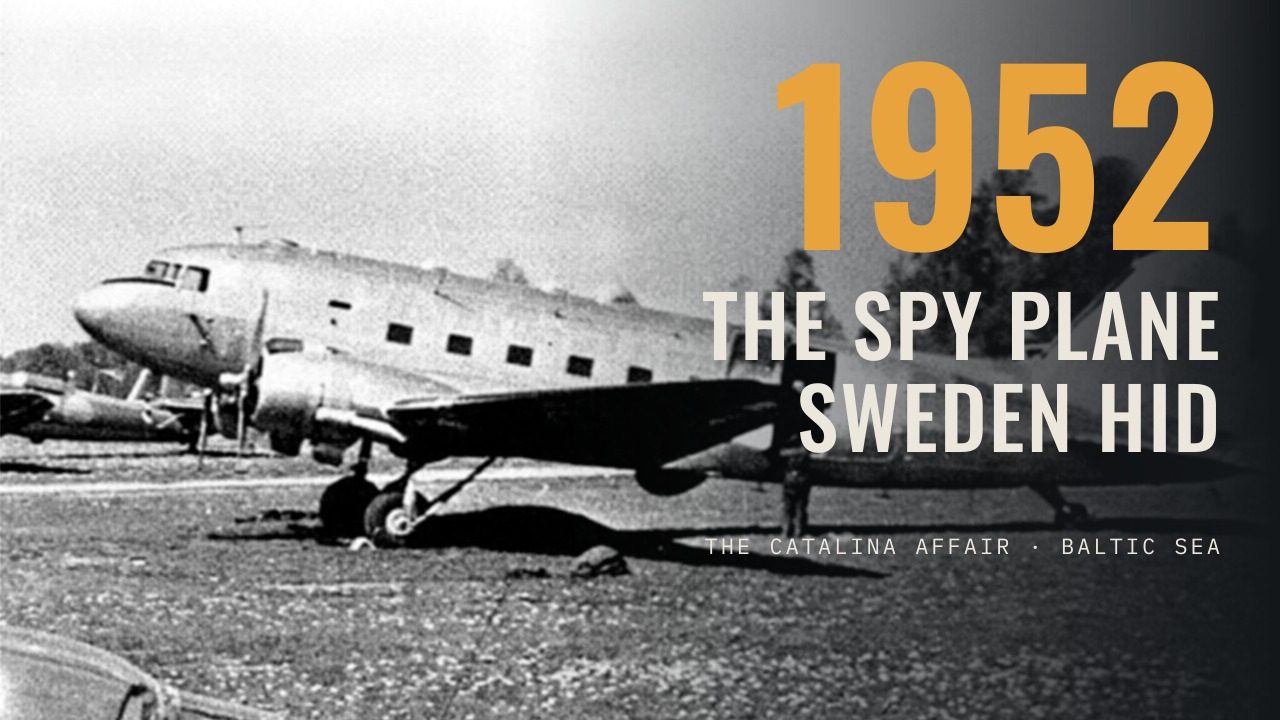
The Catalina Affair: on 13 June 1952, a Swedish Air Force DC-3 named Hugin disappeared over the Baltic Sea with eight men on board. Officially it was on a training flight. In reality it was a secret signals-intelligence mission — and a Soviet MiG-15 had shot it down. Three days later, Soviet fighters also shot down a Swedish Catalina searching for survivors. This documentary tells how neutral Sweden kept the truth from the public and the families for almost forty years, how the Soviet Union finally admitted the attack in 1991, and how the wreck was found on the seabed in 2003.
▶ Full story, transcript and sources: https://fadedpin.vercel.app/stories/catalina-affair-swedish-dc-3-shot-down-1952
På svenska
Catalinaaffären: Sveriges hemliga spaningsplan — Östersjön, 1952
Catalinaaffären: den 13 juni 1952 försvann flygvapnets DC-3 Hugin över Östersjön med åtta man ombord. Officiellt var det en övningsflygning. I själva verket var det ett hemligt signalspaningsuppdrag – och en sovjetisk MiG-15 hade skjutit ner planet. Tre dagar senare sköt sovjetiskt jaktflyg också ner en svensk Catalina som letade efter överlevande. Dokumentären berättar hur det neutrala Sverige höll sanningen hemlig för allmänheten och de anhöriga i nästan fyrtio år, hur Sovjetunionen till slut erkände 1991, och hur vraket hittades på havsbotten 2003.
Chapters
- 0:0011:23
- 0:59Neutral Sweden, secret flights
- 2:04How the flights worked
- 3:35The crew
- 4:1113 June 1952
- 5:48The search and the cover story
- 6:35The Catalina
- 7:46Notes and silence
- 8:531991
- 10:46The search for the wreck
- 12:08Remembering
- 12:33A neutral country's secret
The full story
At twenty-three minutes past eleven in the morning, on the thirteenth of June, nineteen fifty-two, a radio operator at an air base near Stockholm heard a short call from an aircraft over the Baltic Sea.
The call was cut off. The operator called back. Again and again. There was no answer.
The aircraft was a Swedish Air Force DC-3, with eight men on board. Officially, it was on a training flight.
It was not.
For the next fifty-one years, nobody knew exactly where it was. And for almost forty years, the Swedish state did not tell the families what their husbands, fathers and sons had really been doing that morning.
In nineteen fifty-two, Sweden was neutral. It had stayed out of the Second World War, and it was not a member of NATO.
But across the Baltic Sea lay the Soviet Union. Estonia, Latvia and Lithuania had been taken over, and along their coasts the Soviets were building a chain of radar stations to guard the sea and the air.
Sweden wanted to know what those radars could see. So, in secret, it listened.
The listening was done by the FRA, the National Defence Radio Establishment. And from early nineteen fifty-one, it was also done from the air.
In nineteen forty-nine, the Air Force had bought two Douglas DC-3 aircraft. They were rebuilt in Västerås and filled with radio receivers, with places for five operators. The two planes were given names from Norse mythology: Hugin and Munin. The two ravens of the god Odin, who fly over the world and bring back what they see.
The flights followed a pattern. The DC-3 flew east of the island of Gotland, north and south, at about four and a half thousand metres. It stayed on the Swedish side of the middle line between Sweden and the Soviet coast. A flight lasted around three and a half hours.
There was no radar to guide it, and almost no navigation equipment. The navigator used a clock, a compass and careful calculation.
On board, the operators recorded the signals of Soviet radars, especially new ones that had not been seen before.
From Sweden, the listeners could follow the Soviet radar stations along the Baltic coast, and even the reports they sent to each other. The flights were meant to find something more: the new radar systems that the Soviets were building to guide their fighter planes.
As far as anyone knows, Soviet fighters had never come close to the DC-3 before. But Swedish investigators later concluded that the Soviet air defence must have known about the flights. The same kind of aircraft, the same routes, the same height and speed, flight after flight.
What the Swedish public did not know was that this was not only a Swedish secret. Much of the equipment came from Sweden's Western friends, the United States and Britain, and much of what was collected was shared with them.
On the morning of the thirteenth of June, nineteen fifty-two, Hugin had a crew of eight. Three men from the Air Force, and five from the FRA.
Their names were Alvar Älmeberg, the pilot. Gösta Blad, the navigator. Herbert Mattson, the flight engineer. And the five signals men: Carl-Einar Jonsson, Ivar Svensson, Erik Carlsson, Bengt Book and Börje Nilsson.
Most of them came from Stockholm.
At about nine in the morning, Hugin took off from Bromma airport in Stockholm. It was the twenty-first flight of its kind that year. The sky over Sweden was completely clear. Further east, over the sea, there was cloud.
Every twenty minutes, the crew reported their position in a secret code. They flew towards Gotska Sandön, a small island north of Gotland, then south, and then turned north again.
At around eleven o'clock, they reported their position: forty-seven kilometres east of the island of Fårö. It was the last position they would ever send.
By then, the DC-3 was inside the coverage of Soviet radar. A Soviet MiG-15 jet fighter was approaching from the south-east.
The fighter was being guided from the ground, by a regional air defence command. The DC-3 was flying north, well on the Swedish side of the middle line. Below it, there was a thick layer of cloud.
The fighter attacked from behind, with its cannons. According to the Swedish investigators, the Soviet pilot probably did not even identify the aircraft by sight before he fired.
At twenty-three minutes past eleven, the radio operator at the air base heard that short call, and then nothing.
When the wreck was finally found, decades later, the clock in the cockpit had stopped at eleven twenty-eight and forty seconds.
When the expected position report did not come, Sweden started searching. Aircraft and ships went out east of Gotska Sandön.
That same evening, the Air Force issued a press release. The DC-3, it said, had disappeared during "a navigation flight in connection with training in telegraphy".
Only a handful of people knew the truth.
On the fifteenth of June, the searchers found one thing. A rubber life raft from the DC-3. It had been damaged by shell splinters, while it was still packed in its bag.
On the morning of the sixteenth of June, three days after the DC-3 vanished, two Swedish Catalina flying boats took off from the air base at Hägernäs, near Stockholm. Their job was to search for survivors.
Over the open sea, two Soviet MiG-15 fighters found one of them. They opened fire.
The Catalina was a slow, unarmed rescue aircraft. Its pilot managed to put it down on the water. Nearby was a West German cargo ship, the Münsterland. Its crew pulled the Swedish airmen out of the sea. Some of them were injured. But all of them survived.
Photographs of the Swedish crew in their life rafts, with the Catalina sinking behind them, appeared in the newspapers. Sweden was shocked. Angry crowds gathered outside the Soviet embassy in Stockholm.
And that is why the whole story became known as the Catalina affair. Not the DC-3 affair. The rescue plane that was shot down could be talked about openly. The spy plane that disappeared could not.
Sweden and the Soviet Union exchanged diplomatic notes. The Soviet government said that it knew nothing about the DC-3. As for the Catalina, Moscow claimed that it had violated Soviet territory.
A Swedish accident commission concluded that the DC-3 had crashed after being fired on in the air by other aircraft. But whose aircraft, where, and what had happened to the crew, nobody could say.
And the official story stayed the same. A training flight.
For the families, this meant years of not knowing. Their men had not been declared heroes. They had not even been officially missing on a dangerous mission. They had disappeared on a routine training flight, and that was all anyone would tell them.
Then the Soviet Union began to fall apart.
In November nineteen ninety-one, the Soviet Ministry of Defence issued a statement. The Swedish aircraft, it said, had been shot down by a Soviet fighter over the open sea, one hundred to one hundred and ten kilometres north-west of the Latvian town of Ventspils. The crew had in all probability been killed. No reason for the attack was given.
A former Soviet officer, Fyodor Shinkarenko, admitted that he had given the order.
In Sweden, a government inquiry was set up. It made contact with Russian authorities, opened archives and exchanged documents. Its report, in nineteen ninety-two, was the most complete account so far. And in time, after pressure from the families, Sweden also confirmed what the DC-3 had really been doing.
In nineteen ninety-three, the Soviet fighter pilot who had shot down the DC-3 was interviewed again. He said the Swedish plane's left engine was burning, its landing gear was down, and its door was open. He said it turned west, and flew, still under control, down into the clouds.
This was not what he had said before. Earlier, he had claimed that he saw a crew member jump out with a parachute, and that the whole aircraft was on fire. Now he denied both.
Had the DC-3 dived into the clouds on purpose, to escape more fire? Or was it losing height because of the damage? Nobody could tell. No Soviet search for the crew or the wreck had ever been seen.
So the crew had been alive after the attack, at least for a short time. But where had they come down?
Some people would not give up. In the late nineteen-nineties, a former Air Force pilot, Anders Jallai, began a private search, together with the historian Carl Douglas and the marine survey company Marin Mätteknik.
On the tenth of June two thousand and three, almost exactly fifty-one years after the DC-3 disappeared, their sonar found it. It lay about one hundred and twenty-five metres down, around fifty-five kilometres east of Fårö. In international waters.
Later that summer, the same team also found the wreck of the Catalina.
The members of the search team were later awarded the King's Medal for their work.
On the nineteenth of March two thousand and four, the Swedish Navy lifted the DC-3 from the seabed. To keep everything together, the mud around the wreck was frozen and lifted with it.
The investigators found bullet holes that matched the cannons of a MiG-15. And they found the cockpit clock, stopped at eleven twenty-eight and forty seconds.
They also found the remains of some of the crew. Using DNA, four of the eight men were identified. The other four were never found.
In Stockholm, at the old naval cemetery on Djurgården, a memorial stone carries the names of the eight men of the DC-3.
And since May two thousand and nine, what is left of Hugin has been on display at the Swedish Air Force Museum in Linköping. A broken aircraft. And next to it, the story that was kept secret for so long.
The Catalina affair is often told as a story about Soviet aggression. And it was. Two unarmed Swedish aircraft were shot down over international waters, and eight men were killed.
But it is also a story about a neutral country with a secret. About a state that chose to protect that secret, even from the families of the men who died for it.
The two ravens of Odin flew out every day to see the world, and came back to tell what they had seen.
One morning in June nineteen fifty-two, one of them did not come back. And for half a century, Sweden did not say why.
Sources and credits
Sources
- Christer Lokind, "50 år sedan DC-3:an försvann", FlygvapenNytt 1/2002 (Swedish Armed Forces)
- Försvarsmakten, Haverirapport 79001 (2007)
- Rapport från DC 3-utredningen, Ds 1992:5
- Aeroseum, "The Catalina Affair"
- Wikipedia: Catalinaaffären / Catalina affair (incl. Dagens Nyheter 2003, National Geographic 2003)
Photographs and maps
- Tp 79 "Hugin" at F 8 Barkarby, 1951 — Herman Allwin, public domain (PD-Sweden-photo)
- The Catalina after the forced landing, 16 June 1952 — Pressens Bild, public domain (PD-Sweden-photo)
- Outside the Soviet embassy, Stockholm, 16 June 1952 — public domain (PD-Sweden-photo)
- The DC-3 wreck at the Swedish Air Force Museum — Wikimedia Commons, CC BY-SA 3.0
- Tp 47 Catalina 47001 (museum aircraft) — Wikimedia Commons, public domain
- Memorial, Galärvarvskyrkogården — Wikimedia Commons, CC BY-SA 3.0 / 4.0
- Map: NASA Earth Observatory, Blue Marble Next Generation, public domain
Related stories on Faded Pin:
- Whiskey on the Rocks: https://youtu.be/0bQj8mZV8sI
- Vasili Arkhipov: https://youtu.be/nZPLAUkhgr8
Related stories