Whiskey on the Rocks: The Real Story of Soviet Submarine U 137
Watch on YouTube Subscribe to Faded Pin
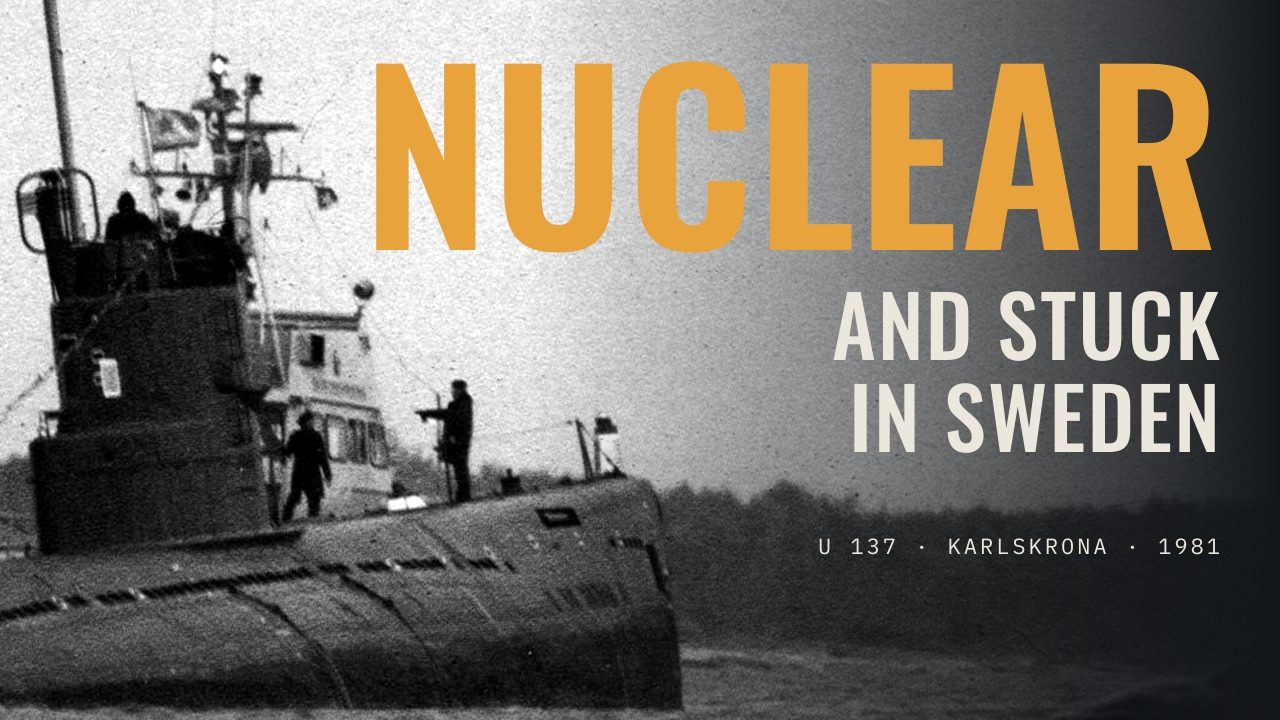
Whiskey on the Rocks: on the evening of 27 October 1981, the Soviet submarine U 137 ran aground at Torumskär in Gåsefjärden, about 10 km from Sweden's Karlskrona naval base – almost certainly carrying nuclear weapons. For ten days, neutral Sweden stood between two superpowers. This documentary tells the real story behind the Cold War crisis, 45 years later.
▶ Full story, transcript and sources: https://fadedpin.vercel.app/stories/u-137-whiskey-on-the-rocks-1981
Why was a Soviet Whiskey-class submarine deep inside a Swedish military zone? What did the Swedish radiation measurements show? Why did Prime Minister Thorbjörn Fälldin order the armed forces to "hold the border"? And what do the newly declassified Swedish documents suggest?
På svenska
U 137 – sanningen om Whiskey on the Rocks
Whiskey on the Rocks: på kvällen den 27 oktober 1981 gick den sovjetiska ubåten U 137 på grund vid Torumskär i Gåsefjärden, en mil från örlogsbasen i Karlskrona – med stor sannolikhet med kärnvapen ombord. I tio dagar stod det neutrala Sverige mellan två supermakter. Den här dokumentären berättar den verkliga historien, 45 år senare.
Chapters
- 0:00A submarine on the rocks
- 0:53A cold sea
- 1:59The grounding at Torumskär
- 3:09The fishermen's discovery
- 4:00"Hold the border"
- 5:07The interrogation
- 6:07Nuclear weapons on board?
- 7:28Release
- 7:59What really happened?
- 9:11The declassified files
The full story
On a cold October morning in nineteen eighty-one, a fisherman in southern Sweden saw something that should not exist.
A submarine. Not Swedish. Sitting on the rocks, in plain view, a few kilometres from one of Sweden's most important naval bases.
He went home, and later mentioned it to a neighbour.
Within hours, the whole world was watching this small corner of the Baltic Sea. And inside the stranded submarine, there were almost certainly nuclear weapons.
The world would remember it by a nickname. Whiskey on the Rocks.
In nineteen eighty-one, the Cold War was heating up again. The Soviet Union had invaded Afghanistan. Poland was in crisis. NATO and the Warsaw Pact were deploying new nuclear missiles in Europe.
The Baltic Sea sat right on the front line. The Soviet Baltic Fleet sailed from bases in today's Estonia, Latvia, Lithuania and Kaliningrad.
Sweden was officially neutral. But neutrality only works if you can defend it. Sweden had a large navy, coastal artillery hidden in its granite islands, and secret naval bases.
The most important was Karlskrona, on the southeast coast. And rumours had been growing for years: foreign submarines were secretly entering Swedish waters.
In nineteen eighty, the navy had hunted a suspected submarine near Utö, in the Stockholm archipelago. Nothing was proven.
Then, one autumn night, the proof ran aground.
The boat was a Soviet diesel submarine of the type NATO called "Whiskey". It had been built in Leningrad, and entered service in nineteen fifty-seven. Its number was one hundred and thirty-seven, so the Swedes called it U 137.
On board were around fifty-six men. The commander, Captain Gushchin, was young. He had taken command only that February.
On the evening of the twenty-seventh of October, U 137 was travelling on the surface, with its diesel engines running. Then it hit the rocks of Torumskär, at the entrance to a bay called Gåsefjärden.
This was not open sea. It was a narrow, rocky passage inside a Swedish military protection zone, about ten kilometres from the Karlskrona naval base.
The crew ran the engines at full power to break free. Nothing happened.
People living on the nearby islands heard the roar in the darkness. They assumed it was a Swedish navy exercise. And they went to bed.
The next morning, fishermen from the island of Sturkö saw the submarine on the rocks.
When the report reached the navy, officers could hardly believe it. A Soviet submarine, right there? They sent a boat to check, almost expecting a mistake.
There was no mistake. U 137 sat high on the granite, its tower clearly visible.
The news spread fast. By the evening, it was on Swedish radio and in the papers. Soon, journalists from all over the world were flying to Karlskrona.
And a very difficult question landed on the desk of Prime Minister Thorbjörn Fälldin. What do you do when a nuclear superpower's warship is stuck on your doorstep?
The Soviet Union asked to rescue the submarine itself. Sweden said no. The Foreign Ministry protested to the Soviet ambassador.
Then Soviet warships began to gather in the Baltic, outside Swedish waters.
Fälldin gave the armed forces a short, clear order: hold the border. Do not let foreign ships reach the submarine.
This was a small neutral country standing up to a superpower. Swedish coastal artillery aimed its guns. Swedish ships and aircraft watched every move.
Rolf Lindén, then head of operations in the coastal artillery, later remembered one moment of extreme tension. He called it the longest seconds of his life.
No shots were fired. But for several days, the Baltic was one wrong decision away from a real clash.
Sweden insisted on one thing before any release: it would question the submarine's commander.
After long negotiations, Captain Gushchin was brought aboard the Swedish torpedo boat Västervik. The interrogation took place right there, in the bay. It lasted about six hours.
His explanation was simple. The navigation equipment had failed. The crew had become lost in bad weather. It was an accident.
Many Swedes did not believe it. To reach that spot, the submarine had to pass through a difficult route among rocks and shallows. How do you get lost so precisely?
The Soviet side answered with its own question. What spy, it asked, travels on the surface, with lights on and noisy diesel engines that can be heard from far away?
Both sides had a point. And both sides were hiding something.
While the diplomats talked, Swedish scientists worked quietly in the bay. From a boat beside the submarine, they measured the radiation coming through the hull.
Near one of the torpedo tubes, they found signs of uranium. That pointed to one thing: nuclear warheads.
On the fifth of November, Thorbjörn Fälldin went in front of the press. He said the submarine carried nuclear weapons, with a probability bordering on certainty.
It was a shocking statement. A Soviet submarine, almost certainly armed with nuclear torpedoes, had been sitting inside a Swedish military zone for over a week.
Years later, the submarine's political officer, Vasily Besedin, wrote a book about those days. He confirmed that there were nuclear torpedoes on board. And he wrote that the crew had been ready to blow up the submarine if Swedish forces tried to take it.
On the afternoon of the fifth of November, Swedish tugs pulled U 137 off the rocks.
The next day, Swedish naval ships escorted it out through the archipelago to the edge of Swedish waters. There, it was handed over to the waiting Soviet fleet, and sailed east.
The crisis had lasted about ten days.
U 137 went back to the Soviet fleet, and a few years later, it was scrapped.
For more than four decades, Swedes have argued about U 137.
Was it a spy mission that went wrong? Was it testing Swedish defences? Or was it really a navigation error, as Moscow always claimed?
According to Besedin, the submarine had already had problems earlier on its voyage. Near the Danish island of Bornholm, it got caught in a fishing trawl, which damaged some of its navigation equipment.
U 137 also changed Sweden. It was a wake-up call for the navy and the whole country. Through the nineteen-eighties, Sweden hunted foreign submarines again and again, and thousands of possible sightings were reported.
But few of those cases were ever confirmed. Later research has suggested that some of the intrusions may have been made by Western submarines. And that Sweden's ability to tell a submarine from other noises was weaker than people thought.
U 137 remains the one case nobody can deny. It sat on the rocks for the whole world to see.
Now, forty-five years later, the story is moving again.
Sweden has declassified documents about the incident. A former employee of Sweden's signals intelligence service, Michael Fredholm, has studied them, and spoke to Swedish television.
His conclusion is surprising. According to Fredholm, the documents paint a different picture from the one Sweden believed at the time. He argues that Sweden's own actions created a conflict that did not really exist, and that this increased the risks instead of reducing them.
One grey submarine. One rocky islet. Ten days that put a neutral country between two superpowers.
And a question that still has no final answer: what was U 137 doing in Gåsefjärden?
Sources and credits
Sources
- Wikipedia, "Soviet submarine S-363" and (Swedish) "U 137"; "Swedish submarine incidents"
- Swedish Supreme Court, NJA 1987 s. 90 (the grounding site and the salvage)
- SVT Nyheter, "Ubåtsmän förberedde sin död" and "U-båtsjakter vi minns"
- Sveriges Radio, "When the Cold War washed up on Sweden's shores"
- Ragnar Hellborg (Lund University), "U 137 med kärnvapen"; UPI, 5 November 1981
- Riksdagen, motion 1988/89:Fö205
- Visit Karlskrona; Marinmuseum visitor guide; Verkkouutiset (declassified documents, Michael Fredholm)
- Vasily Besedin, "Inifrån U137" (2009)
Photographs and maps
- U 137 aground in Gåsefjärden, October 1981 — public domain (CC0)
- U 137 with a Swedish escort, 1981 — Marinmuseum (Swedish Naval Museum), CC BY 4.0
- Soviet Whiskey-class submarines — US Navy, public domain
- Memorial at the grounding site — Wikimedia Commons, CC BY-SA 3.0
- Thorbjörn Fälldin, Växjö 1972 — CC BY 2.0
- Gåsefjärden and Karlskrona naval base today — Wikimedia Commons, CC BY / CC BY-SA
- Maps: US Army Map Service, 1:500,000 sheet "Karlskrona" and 1:1,000,000 sheet "Berlin" (1959), public domain. Route lines are schematic.
Related stories on Faded Pin:
- The Catalina Affair: https://youtu.be/G5SFJw4qk_I
- Vasili Arkhipov: https://youtu.be/nZPLAUkhgr8
Related stories