Vasili Arkhipov: The Man Who Said No to Nuclear War — Cuba, 1962
Watch on YouTube Subscribe to Faded Pin
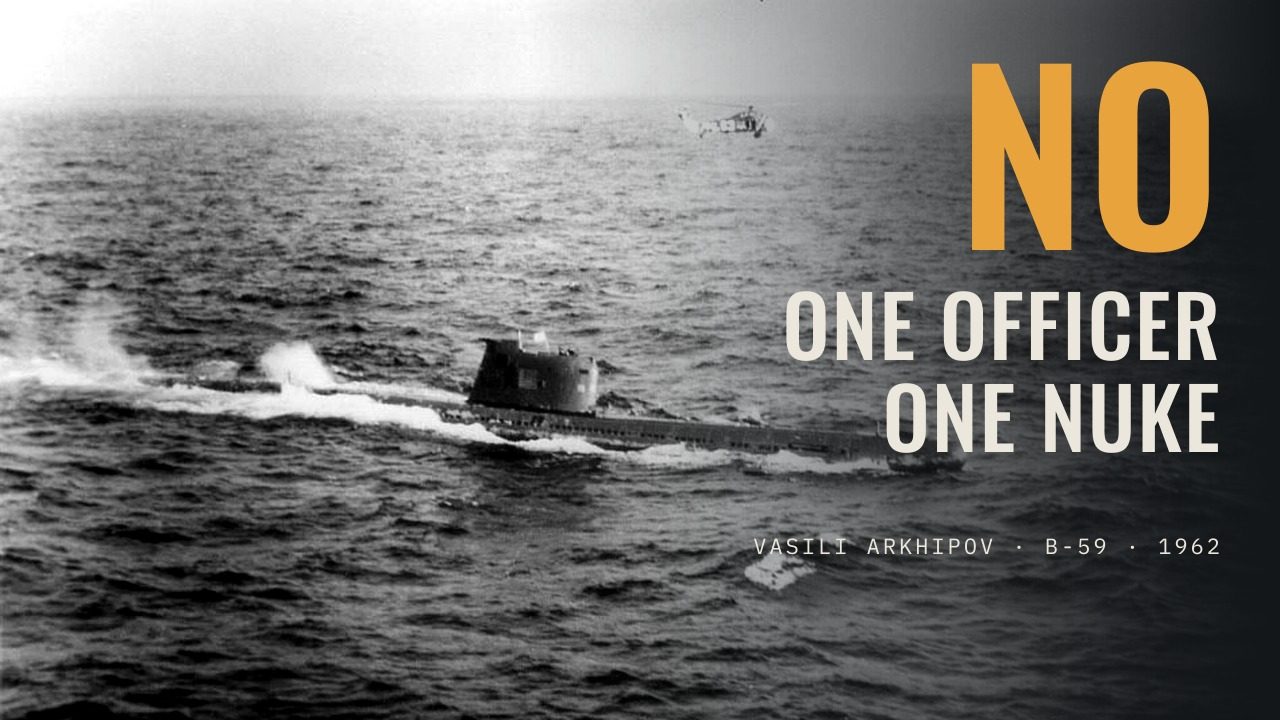
Vasili Arkhipov was a Soviet naval officer aboard submarine B-59 during the Cuban Missile Crisis. On 27 October 1962 — Black Saturday — US destroyers dropped signalling depth charges on the submarine, which, unknown to the Americans, carried a nuclear torpedo. According to men who were aboard, the exhausted captain ordered it made ready, and Arkhipov talked him out of it. This documentary tells the story from the documents and the participants' own accounts — and is honest about what we still do not know.
▶ Full story, transcript and sources: https://fadedpin.vercel.app/stories/vasili-arkhipov-b-59-cuban-missile-crisis
På svenska
Vasilij Archipov: Mannen som sa nej till kärnvapenkrig — Kuba, 1962
Vasilij Archipov var sovjetisk sjöofficer ombord på ubåten B-59 under Kubakrisen. Den 27 oktober 1962 – "Svarta lördagen" – fällde amerikanska jagare signalsjunkbomber över ubåten, som utan amerikanernas vetskap bar en kärnvapentorped. Enligt män som var ombord beordrade den utmattade kaptenen att den skulle göras klar, och Archipov fick honom att ändra sig. Dokumentären bygger på dokument och deltagarnas egna berättelser – och är tydlig med vad vi fortfarande inte vet.
Chapters
- 0:00The submarine that came up
- 1:01Who he was
- 1:54Four submarines to Cuba
- 2:59The long voyage
- 3:43The quarantine
- 5:29Black Saturday
- 6:16Inside B-59
- 7:20Three officers
- 8:35Surfacing
- 9:31The other submarines
- 10:26After the crisis
- 11:44The story comes out
- 12:38What we really know
- 13:48Remembering
The full story
On the evening of the twenty-seventh of October, nineteen sixty-two, a Soviet submarine rose to the surface of the Atlantic, north of Cuba.
It came up in the middle of American warships. Searchlights. Helicopters. Planes flying low over its tower.
Below the surface, in the hours before, something had happened inside that submarine. Something that the men who were there would keep quiet about for almost forty years.
According to them, the submarine carried a nuclear torpedo. Its captain believed a war had started. And one officer on board said no.
His name was Vasili Arkhipov. And many people now believe he may have saved the world.
Vasili Aleksandrovich Arkhipov was born in nineteen twenty-six, in a village near Moscow.
He went to naval school, and at nineteen he was already at sea, on a minesweeper in the last weeks of the Second World War. After the war he became a submarine officer.
In nineteen sixty-one he was the executive officer, the second in command, of a new nuclear submarine called K-19. In July of that year, at sea, its reactor began to fail. Men went into the reactor area to repair it with their hands. Eight of them died within weeks from radiation. Arkhipov was exposed too.
So when he went to sea again a year later, Vasili Arkhipov already knew very well what nuclear power could do to the human body.
In the autumn of nineteen sixty-two, the Soviet Union was secretly sending nuclear missiles to Cuba, ninety miles from the United States.
As part of the plan, four Soviet submarines left their base on the Kola Peninsula, in the far north of Russia, on the night of the first of October. Their names were B-4, B-36, B-130 and B-59.
They were Foxtrot-class submarines. Diesel-electric boats. Under water, they ran on batteries. To recharge those batteries, they had to come up to the surface, or close to it.
Arkhipov was the chief of staff of the whole brigade. He sailed on B-59, the flagship. Its captain was Valentin Savitsky.
Each of the four submarines carried twenty-two torpedoes. And each carried one special one. A torpedo with a nuclear warhead, roughly as powerful as the bomb that destroyed Hiroshima.
The voyage was long, and it went wrong in many small ways.
The submarines were built for cold northern seas. Now they were going south, into warm tropical water. Inside, the temperature rose. Crew members later described more than forty-five degrees Celsius in the compartments, and even more near the engines. The air was full of carbon dioxide and diesel fumes. Fresh water was short. Men fainted at their posts.
And there was another problem. To stay hidden, the submarines spent most of their time deep under water. From down there, it was very hard to talk to Moscow. Messages came late, or not at all.
On the twenty-second of October, President John F. Kennedy told the world that the United States had found Soviet missiles in Cuba. He announced a naval blockade, which he called a quarantine, around the island.
On B-59, radio operators listened to American broadcasts. They heard Kennedy's speech.
The US Navy now hunted the Soviet submarines with destroyers, aircraft carriers and patrol planes. The Americans did not want to sink them. On the twenty-third of October, the Defence Secretary, Robert McNamara, ordered the Navy to signal to the submarines instead. Small practice depth charges, about the size of hand grenades, would be dropped into the water. The message was simple: come up and identify yourself.
Washington sent a description of these signals to Moscow. But years later, the Soviet submarine commanders said that the message never reached them.
So, deep under the sea, they had no idea what the explosions meant.
In the White House, President Kennedy knew this was the weak point. On the twenty-fourth of October, his advisers discussed what would happen if a Soviet submarine refused to come up. His brother Robert later wrote that those few minutes were the time of greatest worry to the President.
The American ships carried nuclear depth charges too. But the orders were clear: signal, follow, and do not attack.
The twenty-seventh of October nineteen sixty-two is sometimes called Black Saturday. It was the most dangerous day of the crisis.
That morning, an American U-2 spy plane was shot down over Cuba, and its pilot was killed. In Washington and Moscow, leaders feared that the next step could be war.
On the same day, east of Cuba, an American anti-submarine group led by the aircraft carrier USS Randolph found B-59. The destroyer USS Cony made contact. The destroyer USS Beale and others joined. Helicopters and planes circled above.
The destroyers began dropping their signalling charges.
What happened inside the submarine, we know only from the men who were there. Their memories were recorded decades later, and they do not agree on every detail.
One of them was Vadim Orlov, a communications officer. According to Orlov, the explosions came close to the hull, again and again, for hours. It felt, he said, like sitting inside a metal barrel while somebody was constantly blasting it with a sledgehammer.
The batteries were almost empty. The air was getting worse. And there had been no message from Moscow for days. For all the men knew, the war might already have begun above them.
According to Orlov, Captain Savitsky was exhausted, and then furious. He ordered the nuclear torpedo to be made ready.
Orlov remembered his words. "Maybe the war has already started up there. We're going to blast them now. We will die, but we will sink them all."
According to later accounts, on most of these submarines a nuclear launch needed the agreement of two officers: the captain and the political officer.
But B-59 was different. Arkhipov, as the brigade's chief of staff, was on board. And according to these accounts, all three had to agree. Captain Savitsky. The political officer, Ivan Maslennikov. And Arkhipov.
Arkhipov did not agree.
Several men from the submarine later said the same thing in different words. Savitsky gave the order to prepare the torpedo. Arkhipov calmed him down. And in the end, Savitsky changed his mind, and gave a different order. They would surface.
One of the other submarine captains, Ryurik Ketov, said later that the order to prepare the nuclear torpedo never even reached the torpedo officer.
Late that evening, B-59 came up.
Arkhipov described the moment himself, in a talk in Moscow in nineteen ninety-seven. When the submarine broke the surface, he said, it was surrounded by American ships. Planes flew past only twenty or thirty metres above the conning tower. Powerful searchlights lit up the boat. And a plane fired its cannon, more than three hundred shells, he said, into the water close by.
For a moment, he said, the commander could have ordered an emergency dive, and treated it as an attack. "That is war," he said.
But within a couple of minutes, it became clear that the plane was firing past the boat, not at it. Nobody fired at anyone.
The Americans did not know that the submarine below their searchlights carried a nuclear weapon.
B-59 was not the only submarine in trouble.
On B-130, all three diesel engines had broken down, and the boat had to surface where the Americans could see it. Earlier, during the depth-charge signals, its captain, Nikolai Shumkov, had ordered his torpedoes made ready, including the nuclear one. The officer responsible for the special weapon warned him that it could not be armed without permission from headquarters. Shumkov later said he would never have used it, "because we would go up with it if we did."
B-36, under Captain Aleksei Dubivko, tried every trick to escape. It changed speed and depth, and released false targets. In the end, with its batteries and its crew exhausted, it too had to come up. When it surfaced, the crew took turns going out on deck, just to breathe fresh air.
The next morning, the twenty-eighth of October, Nikita Khrushchev announced that the Soviet Union would remove its missiles from Cuba. The crisis began to end.
B-59 was ordered home. So were the other submarines. Of the four, three had been forced to the surface by the American Navy. Only one, B-4, had escaped.
Back in the Soviet Union, the story of what happened on B-59 was not told. Not in the newspapers. Not in history books. The men who were there kept quiet.
Arkhipov stayed in the navy. In the nineteen-seventies he became a rear admiral and the head of a naval academy, and later a vice admiral. He retired in the nineteen-eighties, and lived quietly outside Moscow.
He died on the nineteenth of August, nineteen ninety-eight, of kidney cancer. Some believe it was linked to the radiation he received on K-19.
His wife, Olga, later described him as an intelligent and polite man, and very calm. She said he once burned their old love letters, because he believed that keeping them would bring bad luck.
Only after his death did the wider world learn his name.
In October two thousand and two, on the fortieth anniversary of the crisis, American, Russian and Cuban veterans and historians met in Havana. That same autumn, Vadim Orlov's account of the night on B-59 became public. Robert McNamara, who had been the American Defence Secretary in nineteen sixty-two, said that nuclear war had come much closer than anyone had thought.
Thomas Blanton, the director of the National Security Archive in Washington, put it in one sentence. A man called Vasili Arkhipov, he said, saved the world.
In two thousand and seventeen, Arkhipov's family received the first Future of Life Award, for what he did on that night.
But it is worth being careful.
Arkhipov himself, in his one public talk, never used the word "nuclear" about that night. He did not describe his own role.
He gave that talk in nineteen ninety-seven, after a Russian journalist had written that a Soviet submarine had almost fired a nuclear torpedo in nineteen sixty-two. Arkhipov was upset by that article. His talk was meant to give the official, careful version of events. Even so, historians who read it closely say that between the lines, it confirms that something extraordinary happened that night. Russian documents about the submarine operation are still secret. And some historians, like Sergey Radchenko, have pointed out that the famous story rests mainly on memories told many years later.
What is certain is this. Four submarines went to Cuba with nuclear torpedoes. Their crews were cut off, overheated and exhausted. And on the most dangerous day of the Cold War, American ships dropped explosives on one of them, without knowing what it carried.
Several men who were on board remembered the same thing. That in the dark and the heat, a captain reached for the most terrible weapon he had. And that a quiet officer, who had already seen what radiation does to men, talked him out of it.
Vasili Arkhipov never became famous. Most people have still never heard his name.
But every year, on the twenty-seventh of October, a small number of people around the world remember the man who, on a hot night under the sea, decided not to start the end of the world.
Sources and credits
Sources
- National Security Archive, "The Submarines of October" (Electronic Briefing Book 75, 2002)
- National Security Archive, "The Underwater Cuban Missile Crisis at 60" (Briefing Book 808, 2022) — incl. Vasili Arkhipov's 1997 presentation
- Svetlana Savranskaya, "New Sources on the Role of Soviet Submarines in the Cuban Missile Crisis", Journal of Strategic Studies 28:2 (2005)
- Vadim Orlov, recollections (2002); Ryurik Ketov, interview (2012)
- Serhii Plokhy, Nuclear Folly (2021)
- The Boston Globe, 13 October 2002; The Guardian (2012, 2017)
Photographs and maps
- Submarine B-59 on the surface, 1962 — U.S. Navy, National Archives 428-N-711200, public domain
- U.S. Navy and White House photographs, 1959–1964 — public domain (incl. Cecil Stoughton and Robert L. Knudsen, White House)
- Interior of the Foxtrot-class museum submarine B-39, Maritime Museum of San Diego — Wikimedia Commons, CC BY-SA 3.0 / CC BY 3.0
- Map: NASA Earth Observatory, Blue Marble Next Generation, public domain
Related stories on Faded Pin:
- Whiskey on the Rocks: https://youtu.be/0bQj8mZV8sI
- The Catalina Affair: https://youtu.be/G5SFJw4qk_I
Related stories