The True Story Behind "Stockholm Syndrome" (Norrmalmstorg 1973)
Watch on YouTube Subscribe to Faded Pin
Stockholm syndrome comes from a bank vault. In August 1973, a robber took four employees hostage at Kreditbanken on Norrmalmstorg in Stockholm. For six days, Sweden watched the siege live on television – and when it ended, the hostages defended the men who had held them. This documentary tells the true story of the Norrmalmstorg robbery, and asks whether Stockholm syndrome is even real.
▶ Full story, transcript and sources: https://fadedpin.vercel.app/stories/norrmalmstorg-robbery-stockholm-syndrome-1973
Who were Jan-Erik Olsson and Clark Olofsson? Why did hostage Kristin Enmark call Prime Minister Olof Palme from the vault? Who coined the term – and why do Enmark and many experts say the label is wrong?
På svenska
Norrmalmstorgsdramat – sanningen om Stockholmssyndromet
Stockholmssyndromet föddes i ett bankvalv. I augusti 1973 tog en rånare fyra anställda som gisslan på Kreditbanken vid Norrmalmstorg. I sex dagar följde Sverige dramat direkt i tv – och när det var över försvarade gisslan de män som hade hållit dem fångna. Är syndromet ens verkligt?
Chapters
- 0:00A nation watching a bank
- 0:53Thursday morning at Kreditbanken
- 2:08The demands: Clark Olofsson
- 3:14Live on television
- 3:49The call to Olof Palme
- 4:36Inside the vault
- 5:42Tear gas
- 6:41Naming a syndrome
- 7:34"I became the Stockholm syndrome"
- 8:33What remains
The full story
In August nineteen seventy-three, millions of Swedes sat in front of their televisions, watching a bank.
Inside its vault, four employees were being held at gunpoint. Outside, police marksmen lay on the rooftops.
On the sixth day, the police finally broke in. And when the hostages came out, they did something nobody expected. They defended the men who had held them captive.
From that week came a phrase the whole world now knows. Stockholm syndrome.
But what really happened inside that vault? And is the syndrome even real?
Norrmalmstorg is a square in the heart of Stockholm, close to the Royal Opera and the city's banks and shops.
On the morning of Thursday, the twenty-third of August, nineteen seventy-three, it was an ordinary working day. At Kreditbanken, one of Sweden's large banks, the staff had just opened for customers.
Then a man walked in carrying a submachine gun. He fired it, and shouted in English that the party had begun.
His name was Jan-Erik Olsson, known as Janne. He was in his early thirties, a convicted criminal who was out of prison on leave.
Customers ran for the doors or threw themselves to the floor. Within minutes, police surrounded the building.
Olsson kept four bank employees as hostages: Birgitta Lundblad, Elisabeth Oldgren, Kristin Enmark and Sven Säfström.
Kristin Enmark was twenty-three.
Olsson's demands were simple, and enormous.
Three million kronor. Weapons. A getaway car. And one more thing: he wanted the police to bring him a prisoner named Clark Olofsson.
Clark Olofsson was already one of the most famous criminals in Sweden. A bank robber and a serial prison escaper, he was almost a celebrity. The press loved him.
To calm the situation, the government agreed. Olofsson was driven from Norrköping prison to Stockholm, and walked into the bank.
Now there were two criminals inside.
Olofsson started talking. To the hostages, to the police, and to the press. He presented himself as the reasonable one, the man who could keep everyone alive.
Inside the bank, the robbers and their four hostages moved into the bank's vault.
The siege became a media event like Sweden had never seen. The country followed it live on television.
Crowds gathered behind the police barriers. Reporters called the bank, and the robbers and hostages answered. Marksmen watched every window.
And the timing could hardly have been worse. A national election was only weeks away. The Prime Minister, Olof Palme, was in a close race.
Then the phone rang in the Prime Minister's office.
Kristin Enmark called Olof Palme from inside the vault.
She was not calling to beg for rescue. She was calling to complain about the police.
She told Palme she was not afraid of the robbers. She trusted them. What she feared was that the police would storm the vault and get everyone killed.
She asked him to let the robbers leave, and to let the hostages go with them.
Palme refused. The state would not let armed criminals drive away with hostages.
Days passed. The vault was small, cold and airless. The hostages slept on the floor.
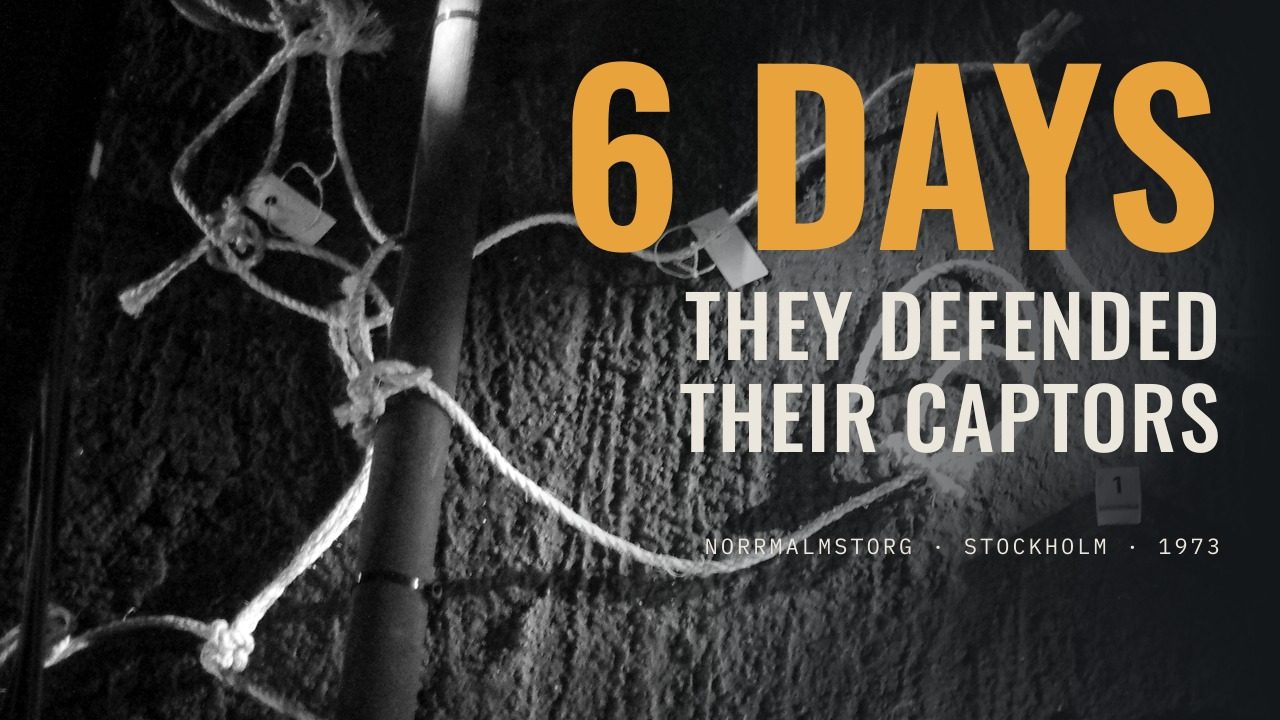
Olsson was unpredictable. He threatened to kill the hostages. At one point, the hostages were made to sit with nooses around their necks, so that any attack with gas would strangle them.
Olofsson was different. He was calm. He talked. To Kristin Enmark, he seemed like protection from Janne.
The police, meanwhile, often seemed like the bigger danger. On the fourth day, officers drilled a hole into the vault from the floor above. Olsson fired up through it, and a police officer was hit.
One of the advisers to the police was the psychiatrist Nils Bejerot. From the vault, Kristin Enmark criticised him openly.
To the hostages, the authorities were not rescuers. They were the unknown.
The police chose a slow and dramatic solution. Through the holes in the ceiling, they prepared to pump in gas.
On the evening of the twenty-eighth of August, the police released tear gas into the vault. Soon, Olsson and Olofsson gave up.
And then came the moment that would travel around the world.
The police told the hostages to come out first. They refused. They were afraid the robbers would be shot if they left them behind.
As the robbers were led away, two of the women called out to the police not to hurt them.
Six days had ended. No one had died.
The country wanted an explanation. Why would hostages side with their captors?
Nils Bejerot, the psychiatrist who had advised the police, gave it a name: the Norrmalmstorg syndrome. Abroad, it soon became the Stockholm syndrome.
The idea was simple. Under extreme stress, hostages may form an emotional bond with their captors, and turn against the people trying to save them.
The term spread fast. It was used for kidnappings, for cults, for abusive relationships. Films and songs borrowed it.
But the man who named it was the same man Kristin Enmark had criticised from inside the vault.
Many years later, Kristin Enmark wrote a book. Its title, in English, is I Became the Stockholm Syndrome.
For decades, she has said that she did what she had to do to stay alive. The robbers were close, and she could talk to them. The police were far away, and she felt they ignored her. So she was more afraid of the police than of the men with the guns.
Some researchers and writers agree with her. They argue that the label was a way of not listening to the women, as if they had fallen under a spell, instead of thinking for themselves.
After the robbery, Enmark and Olofsson stayed in contact for years.
Stockholm syndrome has never been an official psychiatric diagnosis. Today, many experts see it less as an illness, and more as a story told about the victims.
Jan-Erik Olsson was sentenced to ten years in prison. Clark Olofsson was acquitted on appeal for the robbery, but spent much of his life behind bars for other crimes. He became the subject of books, films and a television series. He died in June twenty twenty-five, at the age of seventy-eight.
The bank is gone. Shoppers and tourists cross Norrmalmstorg every day without knowing what happened there.
But the six days in the vault left something behind. A phrase that is used in every language, about people who were never really asked what they felt.
Maybe the real lesson of Norrmalmstorg is not about hostages at all. It is about who gets to tell the story.
Sources and credits
Sources
- Wikipedia, "Norrmalmstorg robbery", "Norrmalmstorgsdramat" (Swedish), "Stockholm syndrome", "Clark Olofsson"
- Sveriges Radio, "The Stockholm Syndrome"
- The Local Sweden, "Where does the term 'Stockholm Syndrome' come from?" and "Clark Olofsson dies aged 78"
- The New European, "The bank robbery that created Stockholm syndrome, 50 years on"
- History.com, "Stockholm Syndrome"; Euronews, "Stockholm syndrome 50 years on"
- SVT Kultur, "Stockholmssyndromet ur gisslans perspektiv"
- Kristin Enmark, "Jag blev Stockholmssyndromet"
Photographs and maps
- The former Kreditbanken building and Norrmalmstorg today — Wikimedia Commons contributors, CC BY-SA 2.0 / 3.0, CC BY 2.0, CC0
- Norrmalmstorg around 1920 — public domain
- The nooses from the vault — Staffan Vilcans, CC BY-SA 2.0
- Olof Palme, 1974 — Anefo / Nationaal Archief, CC0
- Map: central Stockholm, Nordisk familjebok (1917), public domain
Related stories on Faded Pin:
- The Embassy Guard Who Spied for Russia – Caught on Hidden Camera: https://youtu.be/Tt9j_Pst5yE
- Why Did the MS Estonia Sink? The Final Answer After 31 Years: https://youtu.be/QCOIAzFag8M
Related stories