Why Did the MS Estonia Sink? The Final Answer After 31 Years
Watch on YouTube Subscribe to Faded Pin
Why did the MS Estonia sink? On 28 September 1994, the ferry Estonia sank in a Baltic storm on her way from Tallinn to Stockholm. 852 people died; 137 survived. This documentary tells the story of that night, the 1997 investigation, the military transports revealed in 2004, the 2020 discovery of a hole in the hull – and what the December 2025 final report concluded.
▶ Full story, transcript and sources: https://fadedpin.vercel.app/stories/ms-estonia-sinking-1994
We separate the official findings from the claims: the bow visor failure, the 1995 agreement that made the wreck a grave, the prosecution of the documentary filmmakers, and the collision theories that some still hold.
På svenska
Varför sjönk Estonia? Det slutliga svaret efter 31 år
Varför sjönk Estonia? Natten till den 28 september 1994 sjönk färjan Estonia i en storm på väg från Tallinn till Stockholm. 852 människor omkom; 137 överlevde. Dokumentären berättar om natten, haverikommissionens rapport 1997, de militära transporterna som avslöjades 2004, hålet i skrovet 2020 – och vad slutrapporten i december 2025 kom fram till.
Chapters
- 0:0001:00, 28 September 1994
- 0:54A ship for a new country
- 1:41The storm
- 2:27Minutes
- 3:27The rescue
- 4:26The official answer
- 5:14Questions that would not go away
- 6:28The hole in the hull
- 7:21The final report
- 8:23The grave in the sea
The full story
Shortly after one o'clock in the morning, on the twenty-eighth of September, nineteen ninety-four, passengers on a Baltic ferry heard a loud metallic bang from the front of the ship.
A crew member checked. The warning lights showed nothing wrong.
Less than an hour later, the ship was gone.
Of the nine hundred and eighty-nine people on board, only one hundred and thirty-seven survived. It was one of Europe's worst peacetime disasters at sea since the Second World War.
For more than thirty years, one question has refused to go away. Why did the Estonia sink?
In nineteen ninety-four, Estonia had been independent again for only three years. After decades inside the Soviet Union, the small Baltic country was opening up to the West.
The ferry Estonia was a symbol of that new freedom. Every night, she sailed between Tallinn and Stockholm, carrying tourists, families, business travellers and trucks.
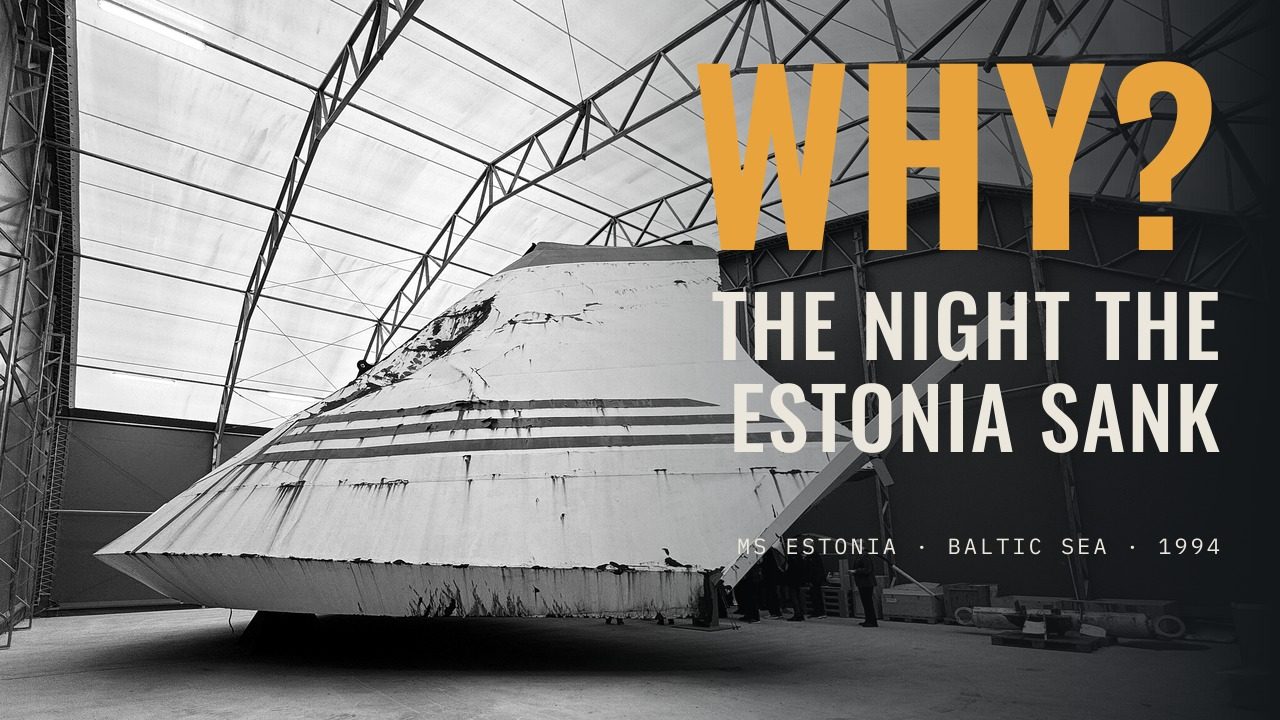
Her bow was built like a giant mouth. The front section, called the bow visor, lifted upward in port, so that cars and trucks could drive straight onto the car deck, through a ramp behind it.
It was a fast, practical design. It also had a weakness that very few passengers ever thought about.
On the evening of the twenty-seventh of September, the Estonia left Tallinn for Stockholm. On board were nine hundred and eighty-nine people. Most were Swedish or Estonian.
The weather was bad, and getting worse. A storm moved across the northern Baltic. The waves grew high, and the ship pushed on through the night.
Many passengers went to their cabins. Others stayed in the bars and the nightclub.
Around one in the morning, the first metallic bang echoed through the bow.
A crew member was sent to look. He checked the indicator lights for the ramp and the visor. They showed no problem.
But the noises continued.
Not long after one o'clock, the locks holding the bow visor failed. The visor tore loose. As it went, it pulled open the ramp behind it.
Now the car deck was open to the sea.
Water rushed in. The ship began to lean heavily to starboard, to the right.
Below decks, people woke to a world tipping sideways. Corridors became walls. Stairs became almost impossible to climb. Survivors later described water pouring down from stairwells and from decks above.
On the bridge, the crew sent a distress call. Mayday.
Only those who reached the outer decks had any real chance. They jumped into the cold, dark water, or tried to reach life rafts in the storm.
Just twenty-eight minutes after the distress call, the Estonia disappeared from the radar screens of the ships nearby.
Ferries and rescue helicopters from Finland and Sweden raced to the area. In the darkness and the storm, they pulled people from the water and from the life rafts.
By morning, one hundred and thirty-seven people had been saved. Most of them were young men, strong enough to fight their way up, and survive the cold.
Eight hundred and fifty-two people died. More than five hundred of them were Swedish. Most of the others were Estonian. Victims came from many other countries too.
Most of the dead were never recovered. They are still inside the ship, or lost at sea.
The wreck lies on the seabed in international waters, about forty kilometres south of the Finnish island of Utö.
Estonia, Finland and Sweden set up a joint investigation commission. In nineteen ninety-seven, it published its final report.
The cause, it said, was the bow visor. Its locks could not hold against the waves that night. When the visor broke away, it opened the ramp, flooded the car deck, and the ship capsized.
The countries then made an unusual decision. The wreck would not be raised. Instead, it was declared a grave. Under an international agreement from nineteen ninety-five, diving to the wreck was banned for citizens of the countries that signed it.
For many relatives, this felt like a wall. Their loved ones were down there, and nobody was allowed to look.
Over the years, doubts grew. How could such a big ship sink so quickly? Why was no one held responsible?
Then, in two thousand and four, a former Swedish customs officer said on Swedish television that he had been told to let certain vehicles onto the Estonia without inspection, in September nineteen ninety-four.
The Swedish government ordered an inquiry. In two thousand and five, it confirmed that the Swedish armed forces had used the Estonia to carry military equipment twice that month, on the fourteenth and the twentieth of September.
The inquiry said the cargo was electronic equipment, and not explosive. And it said there was no such cargo on the night the ship sank.
For some, that answer closed the case. For others, it was proof that the full story had never been told.
In September twenty twenty, a documentary shook Scandinavia again.
The filmmakers had sent an underwater robot down to the wreck. Their images showed a large, previously unknown hole in the starboard side of the hull.
The pictures raised a terrible question. Had something hit the ship?
The documentary led directly to a new official investigation by Estonia, Sweden and Finland.
But the filming also had a price. The journalist and the diver behind it were prosecuted in Sweden for violating the peace of the grave. They were first acquitted, then convicted. A court of appeal later doubled their fines.
The case became a debate about two rights. The right of the dead to rest, and the right of the public to know.
The new investigation took years. Experts carried out several surveys at the wreck, interviewed survivors, and in twenty twenty-three, even raised the car ramp from the seabed.
In December twenty twenty-five, the three countries published their final report.
The holes in the hull, they concluded, were caused by contact with the seabed. Not by a collision, and not by an explosion. They found no reason to reopen the original investigation.
But the investigators went further than in nineteen ninety-seven. They concluded that the Estonia had not been seaworthy. Its bow structure had never been properly inspected, and its certificate should not have been issued.
Not everyone accepts these findings. Some independent experts and relatives still argue that the ship collided with something. The official investigators say there is no evidence of that.
Today, the Estonia still lies on the bottom of the Baltic Sea. Most of the victims are still inside her.
In Stockholm and in Tallinn, memorials carry their names. Every year, on the twenty-eighth of September, people come to lay flowers.
The official story is now clearer than ever. A weak bow, a storm, and a ship that should not have been sailing.
But for many of the families, the deepest question was never only technical. It was why nobody stopped her.
Eight hundred and fifty-two people. One night. And a grave that nobody may enter.
Sources and credits
Sources
- Wikipedia, "Sinking of the MS Estonia"
- Swedish Accident Investigation Authority (SHK) with OJK and OTKES, final report, 16 December 2025
- Reuters / Baird Maritime, "Final report confirms bow failure sank Estonia ferry"; Shippax; ERR News
- Yle; IIMS; Sveriges Radio; The Baltic Times (2023 interim report)
- Government Offices of Sweden, inquiry on defence material on MS Estonia (2005)
- SVT Nyheter on the trial of the documentary filmmakers
- Eesti.ca, "Remembering the MS Estonia"
Photographs and maps
- The same ship as Viking Sally (1980s) and as Silja Star — Wikimedia Commons, CC BY-SA 4.0 / CC0
- The recovered bow visor at Muskö — CC BY 4.0; the bow visor today, 2025 — CC BY-SA 4.0
- Model of the Estonia and of her bow — Estonian Maritime Museum, CC BY-SA 4.0
- The Estonia memorial, Djurgården, Stockholm — CC BY-SA 2.0 / 3.0
- Map: US Army Map Service, 1:1,000,000 sheet "Stockholm–Riga" (1953), public domain. Route lines are schematic.
Related stories on Faded Pin:
- Whiskey on the Rocks: https://youtu.be/0bQj8mZV8sI
- The Great Molasses Flood: https://youtu.be/yZ7p4hJE1d4
Related stories