The Great Molasses Flood: The Sticky Wave That Killed 21 — Boston, 1919
Watch on YouTube Subscribe to Faded Pin
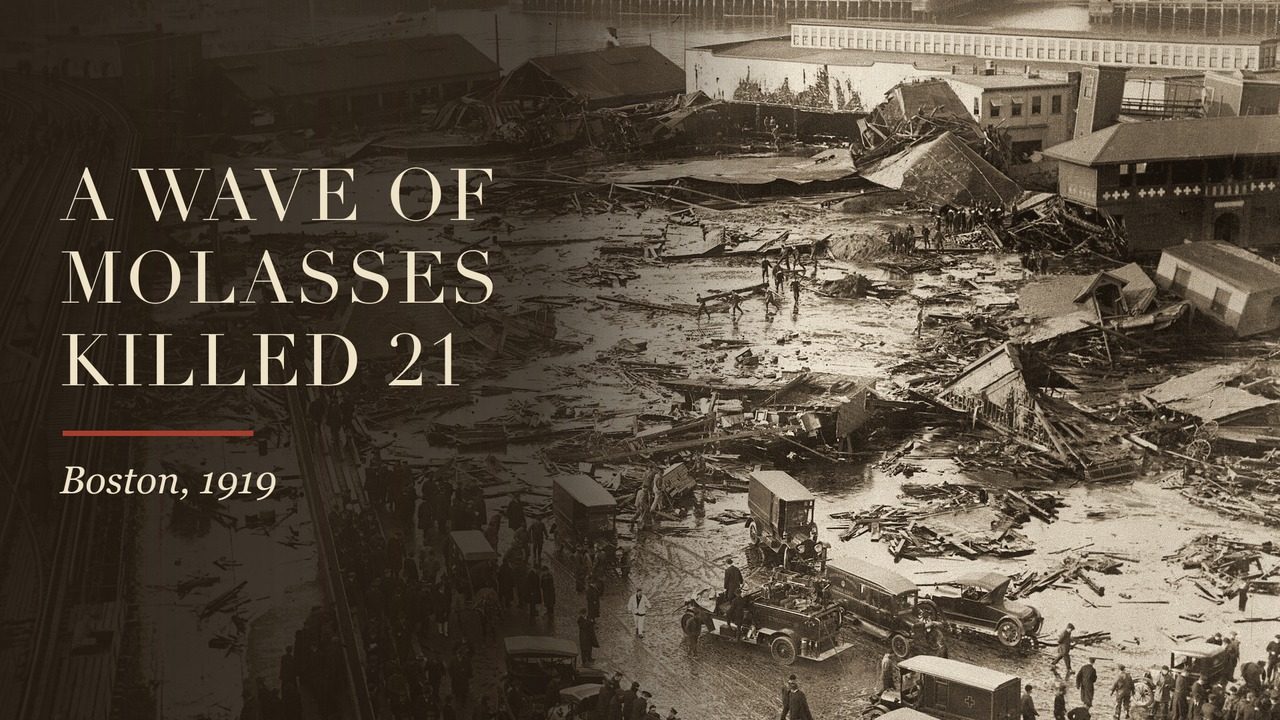
On 15 January 1919, a giant steel tank on Boston's waterfront burst. More than two million gallons of molasses swept through the streets of the North End in a wave taller than a house, moving faster than anyone could run. Twenty-one people died. This is the story of the Great Molasses Flood — the warning signs, the wave, the people it killed, and the court case that showed it never should have happened.
▶ Full story, transcript and sources: https://fadedpin.vercel.app/stories/great-molasses-flood-boston-1919
På svenska
Melassfloden i Boston: Den klibbiga vågen som dödade 21 människor (1919)
Den 15 januari 1919 brast en enorm ståltank vid Bostons hamn. Mer än två miljoner gallon melass forsade genom gatorna i North End i en våg högre än ett hus, snabbare än någon kunde springa. Tjugoen människor dog. Det här är historien om den stora melassfloden – varningstecknen, vågen, människorna den dödade och rättegången som visade att den aldrig borde ha hänt.
Chapters
- 0:00A warm day in January
- 1:03Why molasses?
- 1:58The tank
- 2:56The warning signs
- 3:2415 January 1919
- 3:56The wave
- 4:57The victims
- 6:39The rescue
- 7:17The cold
- 8:22The days after
- 9:16Who was to blame?
- 10:15The trial
- 11:09What changed
- 11:45The next day
- 12:12Today
The full story
It was lunchtime in Boston. A Wednesday in the middle of January, nineteen nineteen. And for once, it was a warm day.
Children were playing in the streets. Workers were eating lunch outside. Horses stood waiting in front of their wagons near the harbour.
Then, from the waterfront, people heard a deep rumble.
A few seconds later, a wave came rolling down the streets of the North End. It was taller than a house. It knocked over buildings. It bent steel.
And it wasn't water. It was molasses. Thick, brown, sugary syrup. More than two million gallons of it.
Twenty-one people died. This is the story of the Great Boston Molasses Flood, and of why nobody stopped it.
Today, molasses sounds like something for baking. A spoonful in your gingerbread.
A hundred years ago, it was an industrial product. Molasses, the dark syrup left over when sugar is refined, could be fermented and turned into alcohol. Not only alcohol to drink, but industrial alcohol, which was used to make explosives.
During the First World War, explosives were in huge demand. And one company that turned molasses into alcohol was the United States Industrial Alcohol Company, through a subsidiary called Purity Distilling.
Ships brought the molasses into Boston Harbor. It was pumped into a giant steel tank on Commercial Street, right on the waterfront. From there, it went by pipeline to a distillery across the river, in Cambridge.
The tank was built around nineteen fifteen. It was fifty feet tall, about fifteen metres, and about ninety feet across. When full, it held more than two million gallons. That's almost nine million litres.
It stood in the North End, one of the most crowded neighbourhoods in Boston. Many of the families who lived there were immigrants. Their homes were just a few metres away. So was a fire station, and a city yard where men worked with paving stones. Above the street ran the tracks of the elevated railway.
The man in charge of building the tank was the company's treasurer, Arthur Jell. He was not an engineer.
According to the later investigation, the tank was never properly tested. The contract recommended filling the new tank with water to check for leaks. Jell put in only about six inches.
And the tank leaked. From the start.
Molasses seeped out through the seams, leaving dark streaks on the steel. People in the neighbourhood noticed. The tank made groaning noises when it was filled.
The company's answer was not to fix it. It was to paint it.
The tank was painted brown. The same colour as molasses. That way, the leaks were harder to see.
The winter of nineteen nineteen had been cold. But in the middle of January, the weather changed suddenly. The temperature climbed from well below freezing to about five degrees Celsius, around forty degrees Fahrenheit.
For Boston in January, it felt like spring. People unbuttoned their coats and went outside.
The tank was nearly full.
On Wednesday, the fifteenth of January, at about half past twelve, it burst.
Witnesses described a rumble, then a crash. The steel walls of the tank split apart. Rivets shot out of the seams.
More than two million gallons of molasses poured out at once.
It came out as a wave. Accounts of its height vary. Some said fifteen feet. Others said forty. Either way, it was taller than the buildings nearby.
It moved at around thirty-five miles an hour. Fifty-five kilometres an hour. Faster than any person can run.
The wave hit the elevated railway and knocked down one of its supports. It crushed wooden houses. It swept wagons, horses and people off their feet. It slammed into the fire station, Engine thirty-one, and smashed part of it off its foundations.
In just a few minutes, several blocks of the North End were flooded with thick, brown syrup, in some places more than half a metre deep.
Molasses doesn't behave like water. It's heavy and sticky. Once it catches you, it is very hard to get out.
Most of the people who died that day did not drown in the usual sense. They suffocated. The molasses filled their mouths and noses, and they could not breathe.
Two of the dead were children. Pasquale Iantosca and Maria Di Stasio were both ten years old. They were near the base of the tank when it burst.
George Layhe was a firefighter at Engine thirty-one. He was inside the station when the wave hit. He was found in the wreckage.
Peter Shaughnessy was eighteen. He drove a wagon for a living.
Bridget Clougherty was sixty-five. She was at home when the wave hit. Her house collapsed on top of her.
Her son Stephen, who was thirty-four, survived that day. But he never recovered from it. In December, he died in a mental hospital. His family always counted him among the victims.
Thomas Noonan was forty-three, a dock worker.
John Seiberlich was sixty-nine, a blacksmith in the city yard next to the tank.
Michael Sinnott, a messenger for the city, was the oldest of them, in his late seventies.
Many of the dead were working men from that city yard: labourers, blacksmiths, paving workers, who had been eating their lunch when the tank burst.
They were not soldiers. They were not in a war. They were simply at work, or at home, on a warm winter day.
The first to arrive were young sailors.
A training ship, the USS Nantucket, was docked nearby. Its cadets ran into the streets and waded into the molasses, pulling out anyone they could find.
Police came. Firefighters came. The Red Cross set up an emergency hospital. Soldiers and sailors joined in.
But the rescuers struggled too. They sank into the syrup. Their boots stuck. Every step took enormous effort.
And as the afternoon went on, something made it even worse.
When the sun went down, the temperature dropped back below freezing.
Molasses is very sensitive to temperature. When it's warm, it flows. When it's cold, it becomes thick, almost like glue.
In twenty sixteen, a team of scientists studied the disaster. Among them were the fluid dynamics expert Nicole Sharp, and Jordan Kennedy, a researcher at Harvard. They looked at weather records, old maps and eyewitness accounts. And they tested real molasses in the laboratory.
They found that as the evening cooled, the molasses could have become four times thicker, or more.
People who were stuck in it were now trapped. The rescuers could hardly reach them. And the scientists concluded that many of the victims died because they simply could not get out.
The search went on for days. Many bodies were so covered in syrup that they were almost impossible to recognise.
Some victims were not found for a long time. Several had been swept into the harbour. The last of them, Cesare Nicolo, was pulled from the water almost four months later.
In the end, twenty-one people were dead. About a hundred and fifty were injured. And many horses, which had been standing in the street in front of their wagons, were killed too.
The cleanup took weeks. Workers sprayed the streets with seawater from fireboats and covered the syrup with sand. Molasses was carried all over the city, on shoes, on clothes, on the seats of streetcars.
For years afterwards, people in the North End said that on hot summer days, you could still smell it.
Now came the question: who was responsible?
The company had an answer ready. It said the tank had not failed. It had been blown up.
This was a time of fear in America. There had been bombings by anarchists, and many people feared more. And since the alcohol from the tank was used for explosives, the company argued, anarchists must have planted a bomb.
It was a convenient story. If the tank had been destroyed by a bomb, the company was not to blame.
But more than a hundred people, survivors and families of the dead, took the company to court.
The case was handled by a court-appointed auditor, Colonel Hugh Ogden. It became one of the longest civil cases in the history of Massachusetts.
For years, he listened to witnesses. Engineers, scientists, workers, neighbours.
And the evidence piled up. The tank had leaked from the start. It had never been properly tested. The man in charge of building it was not an engineer. Its warning signs had been ignored, and painted over.
In the end, Ogden rejected the bomb theory completely. The tank had not been blown up. It had simply failed, because it was not built to be safe.
The company had to pay. In total, about six hundred and thirty thousand dollars, a huge sum at the time, was paid out to the victims and their families.
The case had consequences far beyond Boston.
Before the disaster, there was little to stop a company from building a huge structure without a qualified engineer. After it, new rules began to appear. Engineers and architects had to check and sign off on designs before they could be built.
Every time you walk past a large tank, a bridge or a tall building today, and you trust that someone has checked the calculations, you are seeing part of the legacy of those twenty-one people in Boston.
There is one more strange detail in this story.
The tank burst on the fifteenth of January, nineteen nineteen. The very next day, the United States ratified the amendment that would bring Prohibition, the ban on alcohol.
Within a year, alcohol would become illegal to make and sell in America. The business the tank was built for was about to change completely.
Today, the place where the tank stood is a park, with a baseball field for children. Next to it, a small plaque tells the story of what happened there.
Most people who walk by don't notice it. And many people, even in Boston, have never heard of the day the city was flooded with molasses.
When people hear about the Great Molasses Flood for the first time, they often laugh. A wave of syrup sounds like a cartoon.
But for the families in the North End, there was nothing funny about it. It was a disaster caused by a company that cut corners, ignored warnings, and painted over a problem instead of fixing it.
Twenty-one people paid the price.
Sources and credits
Sources
- Wikipedia, "Great Molasses Flood" (main reference: Stephen Puleo, Dark Tide, 2004)
- Boston.com, "'There was no escape from the wave': These are the 21 victims of the Great Boston Molasses Flood" (2019, quoting the Boston Post, 1919)
- Northeastern University News; Mass Moments, "January 15, 1919"; American Ancestors (Vita Brevis), "The Great Molasses Flood"
- APS News, "Physics and the Boston Molasses Flood"; Nicole Sharp & Jordan Kennedy study (2016) via Christian Science Monitor / Live Science
- Boston Daily Globe, Boston Post and New York Times, 16 January 1919
Photographs
- City of Boston Archives / Boston Elevated Railway Company, January 1919 — public domain
- Boston Public Library, 15 January 1919 — public domain
- American Red Cross, January 1919 — public domain
- The Bostonian Society (the tank before 1919) — public domain
- USS Nantucket — National Photo Company Collection, Library of Congress — public domain
- Boston Transit Commission, 1912 — public domain; Commercial Street — City of Boston Archives, CC BY 2.0
- Boston Elevated map, 1905 — Internet Archive Book Images, no known restrictions
- Newspapers: Boston Daily Globe, Boston Post, New York Times (1919) — public domain
- Map: Faded Pin · © OpenStreetMap contributors (ODbL)
Related stories on Faded Pin:
- Why Did the MS Estonia Sink? The Final Answer After 31 Years: https://youtu.be/QCOIAzFag8M
- Poon Lim: https://youtu.be/F3-PmgTQoO4
Related stories