Kyshtym 1957: The Soviet Nuclear Disaster Kept Secret for 30 Years
Watch on YouTube Subscribe to Faded Pin
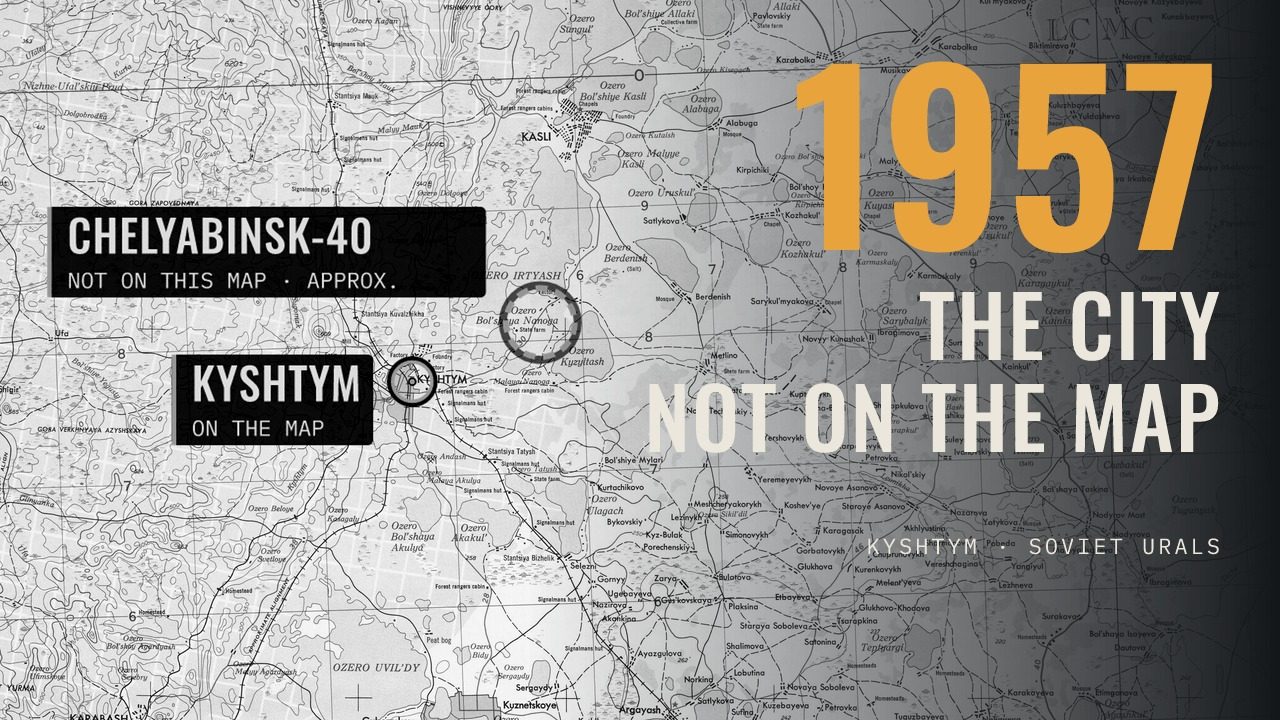
The Kyshtym disaster was a nuclear accident at the secret Soviet plutonium plant Mayak, in the southern Urals, on 29 September 1957. A tank of radioactive waste whose cooling had failed dried out and exploded, and a radioactive cloud drifted hundreds of kilometres to the north-east. About 10,000 people were moved out — a week later, without being told why. The plant's city, Chelyabinsk-40, was not on any map, so the disaster was named after the nearest town that was. This is the true story of the explosion, the cover-up, and the exiled scientist who first told the world.
▶ Full story, transcript and sources: https://fadedpin.vercel.app/stories/kyshtym-1957-soviet-nuclear-disaster
Chapters
- 0:00Not on any map
- 0:56The race for the bomb
- 1:49The waste
- 2:3029 September 1957
- 3:15The cloud
- 3:56The evacuation
- 4:37Officially, nothing happened
- 5:35Zhores Medvedev
- 6:29The truth comes out
- 7:21The town next door
The full story
In the autumn of nineteen fifty-seven, in the southern Ural Mountains of the Soviet Union, there was a city that did not appear on any map.
On the twenty-ninth of September, something exploded inside the secret factory next to it. A cloud of radioactive dust rose into the sky and drifted away to the north-east, over villages, forests and lakes.
The people who lived under that cloud were not told what had happened. Neither was anyone else in the world, for nearly twenty years.
Because the secret city could not be named, the disaster was eventually named after the nearest town that could: Kyshtym.
In nineteen forty-five, the United States dropped two atomic bombs on Japan. The Soviet leadership decided that the Soviet Union had to have its own bomb, as quickly as possible.
To make a bomb, they needed plutonium. And to make plutonium, they needed reactors, and a plant to separate the plutonium from the used nuclear fuel.
They built it in the southern Urals, near the city of Chelyabinsk. It was called Mayak, which means "lighthouse". Next to it, a new town was built for the workers and their families. For decades it had no proper name, only a code: Chelyabinsk-40. Today it is called Ozyorsk.
The town was closed. It did not appear on maps. The people who lived there could not tell anyone where they worked.
Mayak worked in a hurry. The first Soviet atomic bomb was tested in nineteen forty-nine, and production went on at full speed after that.
Separating plutonium leaves behind huge amounts of highly radioactive liquid waste. At first, some of it was simply released into a river near the plant. Later, the most dangerous waste was stored in large tanks, under heavy concrete lids, with cooling systems to stop it from heating up.
Radioactive waste produces heat on its own, all the time. If the cooling stops, the waste gets hotter and hotter.
In nineteen fifty-seven, the cooling system on one of those tanks failed. It was not repaired.
Slowly, the liquid inside the tank heated up and dried out. What was left behind was a layer of dry chemical salts, mixed with radioactive material. And those salts could explode.
On the afternoon of Sunday, the twenty-ninth of September, nineteen fifty-seven, they did.
It was a chemical explosion, not a nuclear one. But it was enormous, with the force of dozens of tonnes of TNT. It blew the heavy concrete lid off the tank, and threw a huge amount of radioactive material into the air.
Most of the radioactive material fell back down around the plant. But around a tenth of it was carried up into the sky, and the wind took it away, to the north-east.
The cloud travelled for hundreds of kilometres. As it went, it dropped radioactive dust on everything below: fields, forests, lakes, and villages. The long, narrow strip of land it contaminated later became known as the East Urals Radioactive Trace.
The people who lived in that strip were not told that anything had happened.
About a week after the explosion, the authorities began moving people out of the villages closest to the plant. They were not told why.
Over the following months, and in some places almost two years, around ten thousand people were moved out of the contaminated area. More than twenty villages were emptied.
In nineteen sixty-eight, part of the area was turned into a nature reserve, the East Urals Nature Reserve. In practice, it was a closed zone, where people were not allowed to go.
Officially, nothing had happened. The Soviet Union said nothing about the explosion, at home or abroad.
But rumours began to reach the West. And according to later research, the American Central Intelligence Agency knew about the accident from at least nineteen fifty-nine. It did not make what it knew public either.
Less than two weeks after Kyshtym, on the tenth of October, nineteen fifty-seven, there was a serious fire at a nuclear reactor at Windscale, in England. Two of the world's first big nuclear accidents had happened, a few days apart. Only one of them was talked about.
The story finally came out in nineteen seventy-six, from a Soviet scientist living in exile in London, Zhores Medvedev.
Medvedev was a biologist who had clashed with the Soviet authorities. In nineteen seventy, he had been held in a psychiatric hospital for his writing, and in nineteen seventy-three, while working in London, he was stripped of his Soviet citizenship. In an article for the British magazine New Scientist, he mentioned a nuclear disaster in the Urals in the late nineteen fifties.
Many Western experts did not believe him. According to accounts of the time, the chairman of the United Kingdom Atomic Energy Authority, Sir John Hill, called it "rubbish", and "a figment of the imagination".
Medvedev kept digging, and gathered evidence from what had been published in the Soviet Union itself. In nineteen seventy-nine, he published a book about it, called Nuclear Disaster in the Urals.
It was only at the end of the nineteen-eighties, as the Soviet Union opened up, that the government began to release its own documents about the accident. More than thirty years after the explosion, the people of the region could finally find out what had happened to them.
How many people were harmed is still uncertain. Different studies give very different numbers, partly because the region had already been contaminated before nineteen fifty-seven, by waste released into the river. What is clear is that thousands of people were exposed to radiation without being told.
Today, the accident is rated at level six on the international scale for nuclear events. Only two accidents have ever been rated higher: Chernobyl and Fukushima.
The city that was not on any map is still there, and so is the plant. Ozyorsk is still a closed town.
And the disaster that happened there still carries the name of the town next door, because for more than thirty years, the real name could not be spoken.
Sources and credits
Sources
- Wikipedia, "Kyshtym disaster" and "Zhores Medvedev" (and the sources cited there)
- Norwegian Radiation Protection Authority, "The Kyshtym accident, 29th September 1957"
- Napier et al., dose estimates for radiation-exposed populations in the Southern Urals (PMC, 2023)
- Journal of Radiological Protection, focus issue on the 60th anniversary of Kyshtym and Windscale (2017)
- Encyclopaedia Britannica, "Kyshtym disaster"
Maps and photographs
- Map: U.S. Army Map Service, Western Siberia 1:250,000, NN 41-1 Chelyabinsk (1955), public domain — Chelyabinsk-40 does not appear on it; its position is marked approximately
- Kyshtym and Ozyorsk today — Wikimedia Commons, CC0 / public domain
- Zhores Medvedev, 2005 — Wikimedia Commons, CC BY 4.0
Related stories on Faded Pin:
- Vasili Arkhipov: https://youtu.be/nZPLAUkhgr8
- Whiskey on the Rocks: https://youtu.be/0bQj8mZV8sI
Related stories