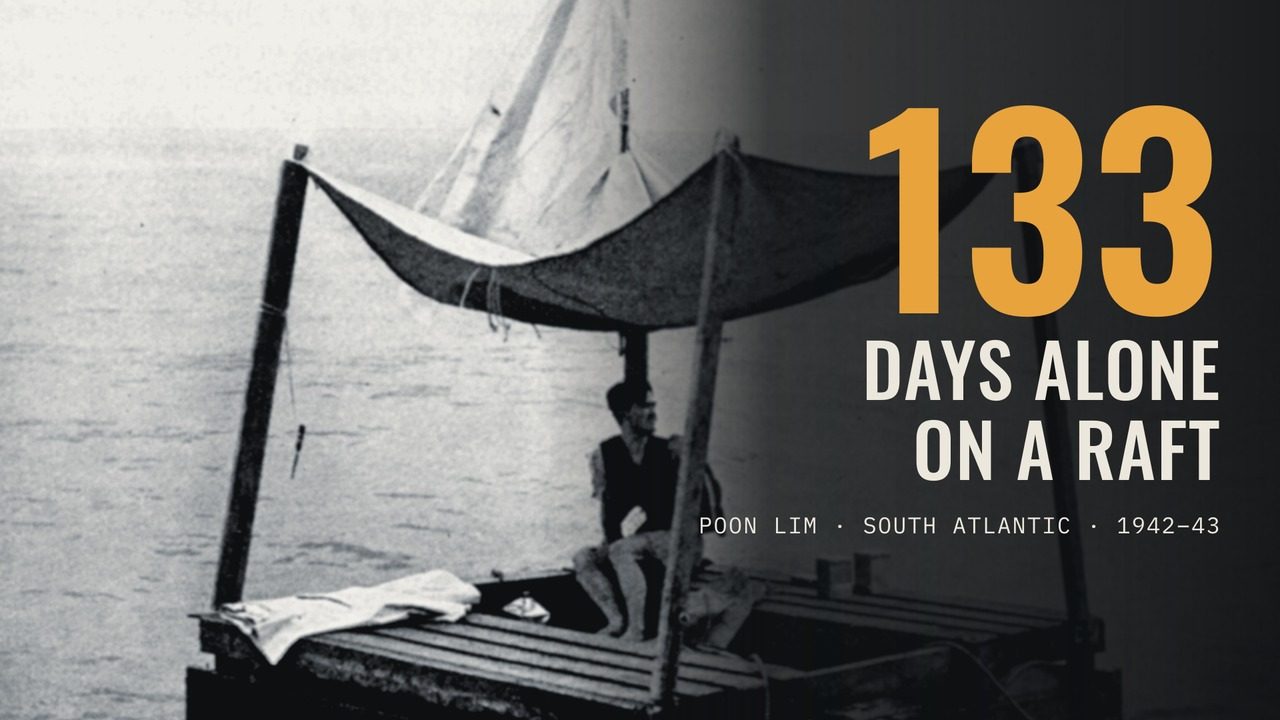
Poon Lim: 133 Days Alone on a Raft — South Atlantic, 1942–43
Watch on YouTube Subscribe to Faded Pin
On 23 November 1942, the British merchant ship Benlomond was torpedoed by the German submarine U-172 in the South Atlantic and sank in about two minutes. Of more than fifty men on board, one survived: Poon Lim, a 24-year-old steward from Hainan, China, who could barely swim. He found an empty wooden raft — and stayed alive on it, alone, for 133 days, catching fish with a hook made from a torch wire, until three Brazilian fishermen found him off the coast of Pará.
▶ Full story, transcript and sources: https://fadedpin.vercel.app/stories/poon-lim-133-days-alone-on-a-raft
På svenska
Poon Lim: 133 dagar ensam på en flotte – Sydatlanten 1942–43
Den 23 november 1942 torpederades det brittiska handelsfartyget Benlomond av den tyska ubåten U-172 i södra Atlanten och sjönk på ungefär två minuter. Av mer än femtio män ombord överlevde en: Poon Lim, en 24-årig steward från Hainan i Kina, som knappt kunde simma. Han hittade en tom träflotte – och höll sig vid liv på den, ensam, i 133 dagar, tills tre brasilianska fiskare hittade honom utanför Parás kust.
Chapters
- 0:00133 days
- 0:50Poon Lim
- 1:31The sinking
- 2:59The raft
- 3:57The first weeks
- 4:51Learning to survive
- 5:48Ships that passed
- 6:35The planes and the submarine
- 7:27The middle months
- 8:36The shark
- 9:43Rescue
- 10:49After
- 11:49A new life
The full story
Imagine a wooden raft. About two and a half metres on each side. No engine. No sail. No oars worth the name.
Now imagine you are alone on it. In the middle of the Atlantic Ocean. In the middle of a world war.
And imagine that it is not one day. Not one week. Not even one month.
It is a hundred and thirty-three days.
One man did exactly this. He couldn't swim well. He was not a soldier. He was a ship's steward, who served meals to the officers. His name was Poon Lim.
Poon Lim was born in nineteen eighteen, on Hainan, a large island off the southern coast of China.
Like many young men from the coast, he went to sea. The British merchant fleet hired thousands of Chinese sailors to work in its kitchens, engine rooms and cabins. The work was hard, the pay was low, but it was a living.
By nineteen forty-two, China had been at war with Japan for years. And the ocean had become a battlefield too.
Poon Lim was twenty-four. He signed on as a steward on a British cargo ship called the Benlomond.
In the Second World War, cargo ships were the lifeline of Britain. They carried food, fuel and weapons across the oceans. And German submarines, the U-boats, hunted them.
Ships often sailed in convoys, protected by warships. But not all of them. The Benlomond was sailing alone, heading across the South Atlantic for the Americas.
By the end of nineteen forty-two, U-boats had sunk hundreds of Allied merchant ships. Merchant sailors had one of the most dangerous jobs of the whole war. Many of them were not even soldiers. They were cooks, stewards, engine men and deckhands.
One of the most successful German submarines in those waters was U-one-seventy-two, commanded by Captain Lieutenant Carl Emmermann. In its short career, it would sink twenty-six ships.
On the twenty-third of November, nineteen forty-two, U-one-seventy-two found the Benlomond.
Two torpedoes hit the ship. The Benlomond sank in about two minutes.
There was no time to launch the lifeboats properly. Poon Lim managed to grab a life jacket. Then he was in the water.
He looked around. The ship was gone. There were more than fifty men on board. As far as he could see, he was the only one still alive.
For about two hours, he floated in the waves, holding on to his life jacket.
Then he saw something. A wooden life raft, one of the ship's, drifting empty on the sea. He swam to it and pulled himself on board.
It was a simple square of wood, about eight feet across. But it had been stocked for emergencies.
There was a container holding about forty litres of fresh water. Tins of biscuits. Hard, dry ship's bread. Chocolate. A kind of dried meat paste called pemmican. Lime juice. A few flares to signal for help. And an electric torch.
It was enough for a few people for a little while. For one man, if he was careful, it could last a long time.
Poon Lim thought he would be rescued soon. The ship would be missed. Someone would come looking.
But nobody came.
He began to ration everything. A few sips of water. A few bites of biscuit. Morning and evening.
He used the canvas on the raft as a roof, to protect himself from the sun. In the tropics, the sun was the first enemy. It burned his skin and dried his body.
Days turned into weeks. He fired his flares when he thought he saw something. He shouted until his voice gave out.
Somewhere in those weeks, Christmas came. Around his thirty-third day on the raft. A week later, the year nineteen forty-three began. He had no way of knowing either.
And slowly, he understood the truth. Nobody was searching for him. In the middle of a war, one lost sailor on a raft was not a priority. If he wanted to survive, he would have to do it himself.
The first thing he needed was a way to catch food.
He took apart the electric torch. Inside it, there was a piece of wire. He bent it into the shape of a fish hook.
He used crumbs of biscuit as bait, and a piece of rope as a line. He waited. And one day, something bit.
The wire hook was weak, and it bent. So he found something better. He worked a nail loose from the boards of the raft itself, and shaped it into a stronger hook. Now he could catch bigger fish.
He ate the fish raw. Some of it he cut into strips and dried in the sun, so it would keep.
The second thing he needed was water. The supply on the raft would not last forever. So he spread the canvas cover to catch the rain, and let it run into his container.
When it rained, he drank. When it didn't, he waited.
Then, one day, he saw a ship.
A cargo ship, close enough to see him. Close enough, he believed, for the crew to see a man waving his arms and shouting.
The ship did not stop. It kept going, and disappeared over the horizon.
It happened more than once. Later in his life, Poon Lim said he believed some of those crews did not stop because he was Chinese.
We will never know what the men on those ships saw, or what they thought. But for the man on the raft, the result was the same. He was alone again.
Some weeks later, he heard engines in the sky.
They were aircraft of the United States Navy, on patrol. They saw him. One of them flew low and dropped a marker into the water, to show the rescuers where he was.
For the first time in weeks, Poon Lim had real hope.
And then the weather turned. A storm swept in, with rain and high waves. When it was over, the marker was gone, and the raft had drifted somewhere else.
Nobody came back for him.
And then something even stranger happened.
A submarine surfaced near his raft. A German submarine. The same kind of vessel that had sunk his ship.
The crew looked at him, the lonely man on the raft. And they left him there.
By now his supplies were running out. Every meal had to come from the sea.
He became an inventive fisherman. He kept a small store of dried fish. And he noticed that the fish and the seaweed attracted birds.
Seabirds would land on the raft or fly close to it. Poon Lim learned to wait, completely still, and grab them when they came close enough. He ate the meat, and dried what he could not eat right away.
He also made himself a knife, from a piece of a tin can.
He knew that if he lay still for months, his body would waste away. So, on calm days, he tied a rope to himself and to the raft, slipped into the water, and swam around it.
It was dangerous. There were sharks in the water. But he kept doing it.
The sharks were a constant presence. They were drawn by the blood of the fish he caught.
At one point, when his water was running dangerously low, Poon Lim decided to fight back. He went after a shark himself.
He managed to catch one, and drag it onto the raft. There was a violent struggle on that small wooden square. In the end, he killed it.
He cut it open, and drank the blood from its liver, because he had nothing else to drink.
He had no calendar. He had no clock. But he kept count of the days.
Week after week, the currents carried his raft slowly west, across the Atlantic. He had no idea where he was. He only knew that, one day, he would either reach land or die.
He thought about his family. He thought about home. And he kept doing the small things that kept him alive. Fish. Rain. Birds. Swim. Sleep.
Day one hundred. Day one hundred and ten. Day one hundred and twenty.
He did not know it, but he had crossed almost the entire ocean.
The currents had carried him towards the coast of South America, towards the mouth of one of the largest rivers on Earth: the Amazon.
And on the fifth of April, nineteen forty-three, he saw a boat.
It was a small Brazilian fishing boat, with three fishermen on board. This time, the boat came to him.
They pulled him on board. They gave him food and water. And a few days later, they brought him into the city of Belém, in northern Brazil.
He had been alone on the raft for a hundred and thirty-three days. In that time, the currents had carried him around twelve hundred kilometres, about seven hundred and fifty miles, to the west.
For comparison: a hundred and thirty-three days is more than four months. It is longer than many people stay in one job, or one home. Poon Lim spent it on a few square metres of wood, with the sea on every side.
The doctors could hardly believe it. He had lost about twenty pounds, around nine kilograms. He was weak, sunburned and thin. But he was alive, and he would recover.
His story spread. In Britain, King George the Sixth awarded him the British Empire Medal.
And the Royal Navy did something unusual. It studied what Poon Lim had done, and used his methods in its survival manuals. The torch-wire hook. The rain catcher. The swimming. The dried fish and birds. The lessons of one ship's steward became training for sailors.
The submarine that had sunk his ship did not survive the war. In December nineteen forty-three, after a hunt of twenty-seven hours in the middle of the Atlantic, U-one-seventy-two was sunk by American aircraft and destroyers. Forty-six of its crew were taken prisoner. Thirteen died.
After the war, Poon Lim wanted to start a new life in the United States. But at the time, the US allowed only a tiny number of Chinese immigrants each year.
His case reached Washington. A senator from Washington state, Warren Magnuson, helped him, and Poon Lim was allowed to stay. He later became an American citizen.
He went back to sea, this time on American ships. He married and had a family. He lived in New York.
When people told him that his hundred and thirty-three days alone on a life raft was a world record, he answered simply:
I hope no one will ever have to break that record.
Poon Lim died in Brooklyn, in January nineteen ninety-one. He was seventy-two years old.
More than fifty men went down with the Benlomond. One came back. And he came back not because he was rescued, but because he refused, every single day, for a hundred and thirty-three days, to give up.
Sources and credits
Sources
- Wikipedia, "Poon Lim" and "German submarine U-172"
- uboat.net, Benlomond (ship 2462) and U-172
- Today I Found Out, "The Man on the Raft: The Story of Poon Lim"
- Old Salt Blog, "Poon Lim, Surviving a Record 133 Days at Sea"
- HistoryDefined (via GeoGarage blog), "Surviving 133 days at sea"
Photographs and film
- Poon Lim with Rear Admiral Julius Furer, and receiving a signalling mirror, 1943 — US Navy (National Museum of the U.S. Navy), public domain
- Poon Lim's raft, re-created for US Navy survival training — public domain
- U-172 under attack and its survivors, 13 December 1943 — US Navy, public domain
- Carl Emmermann — public domain
- Universal Newsreel, "Big Convoy to Russia Beats Off Nazis" and "Allied Convoy Battles Axis" (1942) — public domain, via Internet Archive
- Map: Faded Pin · Natural Earth
Related stories on Faded Pin:
- Ada Blackjack: https://youtu.be/yLBXEk9v_1s
- The Great Molasses Flood: https://youtu.be/yZ7p4hJE1d4
Related stories