Lady Be Good: The Bomber Found in the Sahara — Libya, 1943
Watch on YouTube Subscribe to Faded Pin
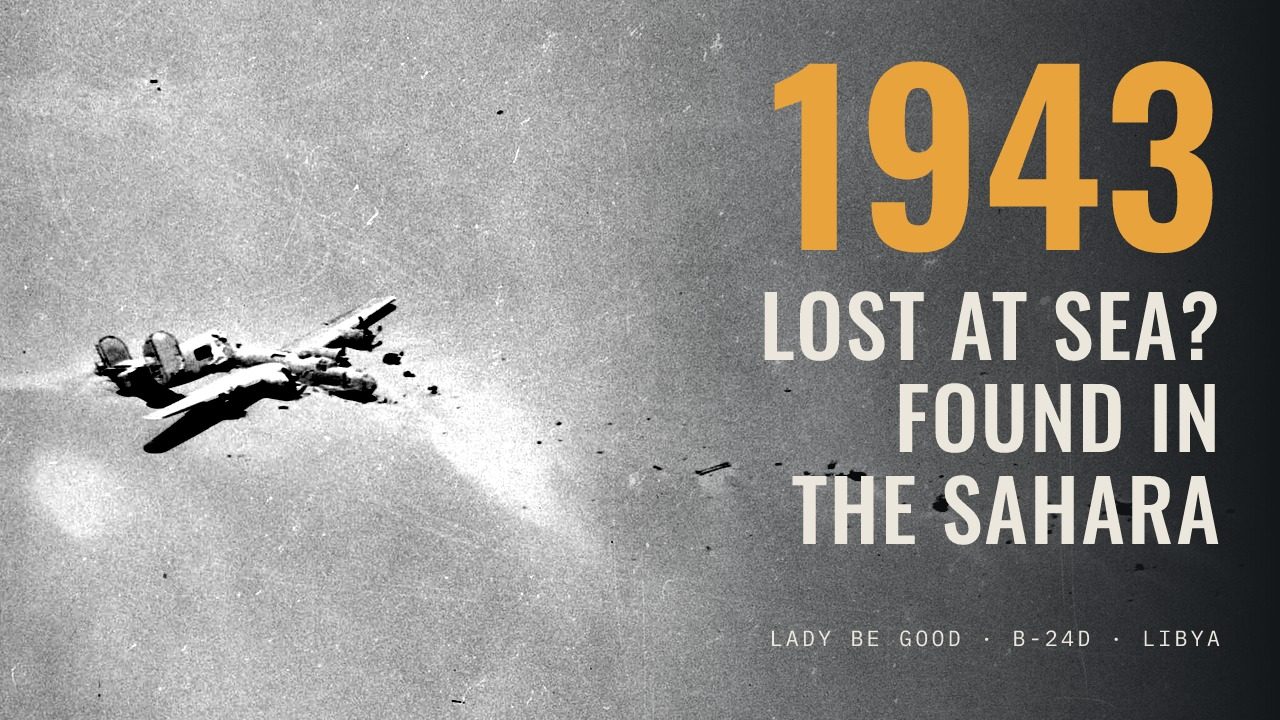
Lady Be Good was an American B-24D Liberator bomber that vanished on 4 April 1943, on her crew's first combat mission from Soluch, Libya, to Naples. Everyone assumed she had come down in the Mediterranean. In 1958, oil surveyors found her in the Calanscio Sand Sea, about 700 km from her base — almost intact, and empty. This documentary tells the true story of the nine-man crew, the navigation mistake that took them over the Sahara in the dark, their walk north through the desert, and the co-pilot's pocket diary that was found with them in 1960.
▶ Full story, transcript and sources: https://fadedpin.vercel.app/stories/lady-be-good-b24-sahara-1943
Chapters
- 0:00Found in the sand sea
- 0:58The crew
- 2:33The mission
- 3:06Lost
- 4:08The jump
- 4:58The walk
- 7:05Three go ahead
- 8:12Missing
- 8:39Found
- 9:43The search
- 10:22The diary
- 11:54Why they kept walking
- 12:18Remembered
The full story
In nineteen fifty-eight, a British oil exploration team was flying over one of the emptiest places on earth, the great sand sea of eastern Libya.
Far below them, in the sand, they saw an aeroplane. A large, four-engined bomber, lying on its belly, broken in two. There was no road, no village and no water for hundreds of kilometres in any direction.
They reported it to the nearest American air base. The Americans had no record of any aircraft lost there.
It would take more than a year, and two large searches, to find out what had happened. And the answer would come, in the end, from a small pocket diary.
In the spring of nineteen forty-three, the war in North Africa was nearly over. American heavy bombers were flying from airfields in Libya, across the Mediterranean, to targets in Italy.
One of those airfields was Soluch, in the desert south of Benghazi.
The B-24 Liberator, built by Consolidated, was one of the main American heavy bombers of the war. It had four engines, a long, narrow wing, and a crew of around ten. It could fly for many hours, far out over the sea, and come back. If its crew could find the way.
One of the bombers at Soluch was a new B-24, serial number forty-one, twenty-four three-oh-one. Her crew called her Lady Be Good.
There were nine men in the crew. The pilot, Lieutenant William Hatton. The co-pilot, Lieutenant Robert Toner. The navigator, Lieutenant D. P. Hays. The bombardier, Lieutenant John Woravka. The engineer, Sergeant Harold Ripslinger. The radio operator, Sergeant Robert LaMotte. And three gunners: Guy Shelley, Vernon Moore and Samuel Adams.
They were young, and they had just arrived. The mission on the fourth of April, nineteen forty-three, would be their first combat mission.
The target was the harbour of Naples, in Italy. The bombers took off in the afternoon, to arrive over Naples in the evening, and fly home across the sea in the dark.
But that day, strong winds and blowing sand swept the airfield. Many of the bombers had trouble, and turned back. Lady Be Good was one of the last to leave. She never caught up with her formation.
According to the National Archives, she turned back before she reached the target. Toner later summed up the day in a single line in his diary: "Things pretty well mixed up."
Now they were alone, flying south over the Mediterranean, in the night, toward Africa.
Shortly after midnight, the radio at Soluch picked up a call from the pilot. Hatton reported that his automatic direction finder was not working. He asked for his position.
What happened next is not certain. One theory is that the crew received a bearing from the ground, but read it the wrong way round. The direction-finding equipment of the time could tell a pilot the line he was on, but not always which end of that line he was at. Another account says the crew simply never got the help they asked for.
Either way, they kept flying. According to later accounts, flares were fired at Soluch to guide the returning bombers home. Lady Be Good flew right over the base, and did not see them.
The crew believed they were still over the sea. In fact, they had already crossed the coast. Below them now, in the darkness, was not water, but desert. And they were flying deeper into it, every minute.
Around two in the morning, the fuel was almost gone. There was only one thing left to do. Believing they were above the sea, the nine men bailed out into the dark.
They landed on hard, stony ground. In the morning, eight of them found each other. Toner wrote: "No one badly hurt, can't find John." John was the bombardier, John Woravka. They never found him.
Without its crew, Lady Be Good flew on by itself, for about twenty-five kilometres. Then it came down on its belly in the sand, and slid to a stop.
None of the eight men knew where the plane had landed. And none of them knew where they were. They thought they were somewhere close to the coast.
They were hundreds of kilometres from it.
They had very little with them. A few rations. Half a canteen of water, for eight men. Toner wrote down the rule they agreed on: "one cap full per day."
They started walking north-west, toward where they believed the sea and help must be. They walked mostly at night, and rested in the heat of the day. As they went, they left a trail behind them: arrows made of parachute cloth, flight boots, pieces of their equipment. Signs for the search planes they were sure would come.
No planes came.
Toner kept a small pocket diary, and every day he wrote a few lines in it. Short, plain lines, by a man who was tired, thirsty and very far from home.
On the second day, he wrote that they rested at half past eleven in the morning, because the sun was too hot to walk. They did not move again until five in the afternoon. Then they walked through the night. Fifteen minutes walking, five minutes resting. Over and over again.
The engineer, Harold Ripslinger, also kept notes. On the same day he wrote: "One teaspoon of water today." And then: "The rest of the boys are doing fine."
On the third day, Toner wrote: "Every one getting weak, can't get very far, prayers all the time." The afternoons were burning hot. The nights were freezing. Nobody could sleep on the hard ground.
On the fourth day, they reached the sand dunes. Walking became even harder. The wind blew sand into their eyes without stopping. "Everybody now very weak," Toner wrote. The radio operator, Robert LaMotte, could hardly see any more. "Everyone else's eyes are bad," Toner added. "Still going N.W."
Ripslinger wrote that day: "Can't hold out much longer without aid. Pray."
Three of the men, Guy Shelley, Harold Ripslinger and Vernon Moore, decided to go ahead on their own, to try to find help and bring it back.
The other five could not go on. Hatton, Toner, Hays, LaMotte and Adams stayed together, in the open desert. They had one parachute left, to make a little shade during the day.
"Not any travel," Toner wrote that Friday. "Still very little water." The nights, he noted, were about thirty-five degrees Fahrenheit. Close to freezing. They had no shelter, except that one parachute.
On Saturday, he wrote that they were still holding prayer meetings, and still watching the sky. "No signs of anything," he wrote. "A couple of birds."
Toner kept writing. On Sunday, the eleventh of April, he wrote that they could make it, if only they had water. There was just enough left, he wrote, to put their tongues to.
The next day, Monday, the twelfth of April, he wrote his last entry. "No help yet, very cold nite."
At Soluch, Lady Be Good was reported missing. Everyone assumed she had come down in the Mediterranean, somewhere on the way home. A search over the sea found nothing.
The war went on, and then it ended. The nine men were listed as missing, presumed lost somewhere at sea.
For fifteen years, nobody looked for them in the desert. Nobody thought there was any reason to.
Then, in nineteen fifty-eight, came the sighting from the air. In early nineteen fifty-nine, a team of oil surveyors drove across the desert, and reached the wreck on the ground.
It was about seven hundred kilometres from Soluch. The bomber had made what the American investigators later called a surprisingly good belly landing, with no one at the controls, and slid for hundreds of metres across the sand.
In the dry desert air, it was remarkably well preserved. According to the investigators, its machine guns could still be fired.
But there was no one inside. No bodies. No parachutes. The crew had left the plane before it ever touched the ground.
The United States Air Force sent teams from Wheelus to search the area. There were search parties on the ground, and search flights in the air, directed from the ground.
Starting from the wreck, they had to guess where the crew had gone. Then, some distance away, they began to find the answer. Along the crew's route, they found what the men had left behind: boots, pieces of parachute, the arrows laid out on the ground, pointing north-west.
But the desert was enormous, and the sand moves. After several months, with their equipment breaking down, the searchers gave up.
In February nineteen sixty, almost seventeen years after the jump, five of the men were found together. Hatton, Toner, Hays, LaMotte and Adams. They lay close to one another, about a hundred and thirty kilometres from where they had landed.
With them was the parachute they had used for shade, and empty canteens. And in Toner's pocket was his diary.
For the first time, the families and the Air Force could read what had happened, day by day, in the young co-pilot's own words.
A few months later, a larger search, called Operation Climax, used aircraft and helicopters to follow the route further north. They found Guy Shelley, and then Harold Ripslinger, alone, tens of kilometres beyond the others. They had walked further than anyone thought was possible, through the dunes, without water.
Ripslinger had also carried his notes with him. His last entry said that they were still struggling to get out of the dunes, and to find water.
That August, oil workers found the bombardier, John Woravka. He was lying on the stony plain north of the wreck, where he had landed. His parachute had never fully opened.
Vernon Moore was never found. Some believe that a British army patrol found and buried his remains in the desert in the nineteen fifties. It has never been confirmed.
Why did they keep walking north-west, instead of going back to the plane? Because they did not know where it was. They had jumped in the dark, and the plane had flown on without them.
If they had found it, they would have had a radio, some water, and shade. But they could not have known. And the coast they were walking toward was hundreds of kilometres away.
At the American air base of Wheelus, in Libya, a stained-glass window was made in memory of the crew. Today it is at the National Museum of the United States Air Force, in Ohio.
One of the bomber's propellers stands in the small town of Lake Linden, in Michigan, the hometown of the radio operator, Robert LaMotte.
In nineteen ninety-four, what was left of Lady Be Good was taken out of the desert, to a Libyan air base.
Many aircraft were lost over the Mediterranean in the Second World War, and were never found. This one was. Not in the sea, but hundreds of kilometres inside the Sahara, where nobody had thought to look.
And because one man kept writing, a few lines a day, we know how the crew of Lady Be Good spent their last days. Together, walking north, helping each other, and still hoping that help would come.
Sources and credits
Sources
- U.S. National Archives, The Unwritten Record: "Lost and Found: The Story of 'Lady Be Good' and Her Crew" (2017)
- National Museum of the United States Air Force, "Lady Be Good" fact sheet
- This Day in Aviation, "4 April 1943" (Bryan Swopes)
- Transcripts of the diaries of Lt. Robert Toner and T/Sgt. Harold Ripslinger (ladybegood.net)
- Richard Davis, "Lady Be Good — Day 8, April 12, 1943" (citing Mario Martinez and Dennis Walker)
Photographs and maps
- U.S. Air Force photographs (public domain): the crew, the wreck as first seen from the air, the crash site 1959–60
- The Lady Be Good stained-glass window from the Wheelus Air Base chapel — National Museum of the USAF, public domain
- NASA astronaut photographs of the Calanscio Sand Sea and Libya (public domain)
- Maps: U.S. Army Map Service, Bengasi-Augila 1:1,000,000 (compiled 1943) and Libya 1:500,000 Sheet 32 Big Cairn (1942), public domain, via University of Texas Libraries
Related stories on Faded Pin:
- Poon Lim: https://youtu.be/F3-PmgTQoO4
- Ada Blackjack: https://youtu.be/yLBXEk9v_1s
Related stories