Mount Pelée 1902: The Man Who Survived in a Prison Cell — Martinique
Watch on YouTube Subscribe to Faded Pin
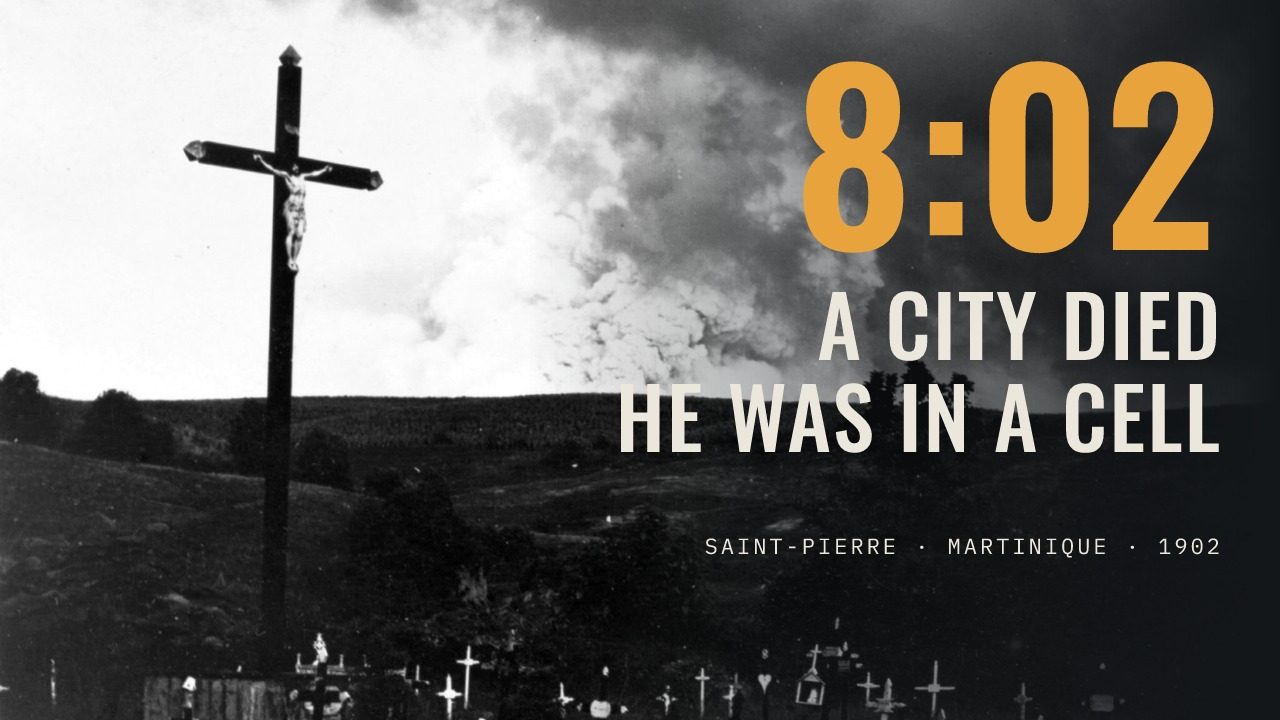
The 1902 eruption of Mount Pelée destroyed the city of Saint-Pierre, Martinique, at 8:02 in the morning on 8 May 1902. A glowing cloud of hot gas and ash — a "nuée ardente" — swept over the city in less than a minute, and by most estimates about 28,000 people died. Days later, rescuers heard a voice from the ruins of the prison: Ludger Sylbaris, also known as Louis-Auguste Cyparis, had survived in a thick-walled stone cell. This is the true story of the warnings, the eruption, the man in the cell — and the legends that grew around him.
▶ Full story, transcript and sources: https://fadedpin.vercel.app/stories/mount-pelee-1902-saint-pierre-ludger-sylbaris
Chapters
- 0:008:02 a.m.
- 0:45Saint-Pierre
- 1:07The warnings
- 1:56The prisoner
- 2:53The glowing cloud
- 3:49In the cell
- 4:31Rescue
- 5:07The legend and the record
- 6:12"The man who lived through Doomsday"
- 6:44Mount Pelée was not finished
- 7:16The smallest room
The full story
At two minutes past eight in the morning, on the eighth of May, nineteen hundred and two, a city on the Caribbean island of Martinique disappeared.
A cloud of burning gas and ash poured down from the volcano above it, and swept through every street in less than a minute. By most estimates, about twenty-eight thousand people died.
A few days later, rescuers searching the ruins heard a voice. It was coming from under the ground, from the city's prison.
Saint-Pierre lay on the north-west coast of Martinique, a French island in the eastern Caribbean. It was a busy port town, with a harbour full of ships.
A few kilometres to the north stood a volcano, Mount Pelée. It had been quiet for a long time. Visitors climbed it, and there was a small lake near the top.
In late April, nineteen hundred and two, the volcano began to wake up. The smell of sulphur drifted down into the city. Ash began to fall. In early May there were explosions from the summit, and ash covered the streets.
On the fifth of May, part of the crater collapsed, and a flood of mud and rock rushed down the valley of the Blanche River, toward the sea. It buried a sugar works on the coast, and the people working there.
Still, the city was not evacuated. Newspapers said that Saint-Pierre was safe. The governor of Martinique, Louis Mouttet, stayed in the city himself. And thousands of people from the surrounding countryside, frightened by the ash, came into Saint-Pierre for safety.
One of the people in Saint-Pierre that week did not have a choice about where to be.
His name was Ludger Sylbaris, though he is also known as Louis-Auguste Cyparis. He was twenty-seven years old, and had been born a few kilometres up the coast. On the second of May, he had been put in prison for wounding a man in a fight. Accounts disagree on the details.
On the seventh of May, he was moved to a cell on his own, as a punishment. It was a small stone room, partly below the ground, with thick walls and no window. The only opening was a narrow grating in the door. It faced away from the mountain.
On the morning of the eighth of May, the telegraph office in Saint-Pierre was sending messages to the island's capital. According to the records, the last message came through at seven fifty-two. Then the line went dead.
At about two minutes past eight, Mount Pelée erupted. A dense, glowing cloud of hot gas, ash and rock rushed down the mountain, toward the city. The scientist who later studied it, Alfred Lacroix, gave this kind of cloud a name that is still used today: nuée ardente. A glowing cloud.
It reached Saint-Pierre in moments, and swept over the whole city in less than a minute. According to estimates, its temperature was more than a thousand degrees. Buildings were flattened. Fires broke out everywhere. Ships in the harbour burned and sank.
Almost everyone in the city was killed, within minutes.
In his cell, Ludger Sylbaris felt it come in through the grating in the door: a blast of terrible heat, and ash.
According to his own account, the heat lasted only a moment. He was badly burned, on his hands, his arms, his legs and his back. But the thick stone walls of the cell had protected him from the worst of it.
He drank what little water he could find, rainwater, through the grating in the door. And he waited, burned and alone, in a city where almost nobody was left alive to hear him.
Three or four days later, a small group of men came down into the ruins from the village of Morne-Rouge, on the slopes of the volcano. In the remains of the prison, they heard someone calling for help.
They dug Sylbaris out, and he was taken away to be treated for his burns.
Very quickly, his story became a legend. He was described as the only person in Saint-Pierre to survive. And he was described as a condemned murderer, waiting to be hanged, who had been saved by the very prison meant to punish him.
Neither of these things was quite true.
He was not the only survivor. At least one other man, Léon Compère-Léandre, survived at the edge of the city, with severe burns. A few others outside the centre of the city survived for a time, most of them very badly burned.
And according to the prison records, Sylbaris was not waiting to be hanged. He was serving a short sentence, which would have ended within a month.
What was true was the cell. Its thick stone walls, the missing window, and the grating that faced away from the mountain had saved his life. The French authorities checked his story, and confirmed that he had been in the prison on the morning of the eruption.
Sylbaris was pardoned. But he had no home and no money to go back to. The city he had lived in no longer existed.
In nineteen hundred and three, he travelled to the United States, and joined the Barnum and Bailey circus, the most famous travelling show in America. He was advertised as the man who lived through Doomsday.
According to later research, he spent his last years in Panama, and died there in nineteen twenty-nine.
Mount Pelée was not finished. On the twentieth of May, another glowing cloud swept over the ruins of Saint-Pierre. At the end of August, another one killed hundreds of people in Morne-Rouge, the village that Sylbaris's rescuers had come from.
Saint-Pierre was rebuilt, but it never became the city it had been. Today, the ruins of the old town still stand among the new houses. Among them is the prison, and a small stone cell, with no window.
Thousands of people in Saint-Pierre had good reasons to feel safe that morning. They had homes, families, and newspapers telling them there was nothing to fear.
The man who survived was the one person who had been shut away, against his will, in the smallest, darkest room in the city.
Sources and credits
Sources
- Boudon, Lajoie et al., "The 1902–1905 eruptions of Montagne Pelée, Martinique: anatomy and retrospection", Journal of Volcanology and Geothermal Research
- Encyclopaedia Britannica, "Mount Pelée"
- Wikipedia, "Ludger Sylbaris" and "1902 eruption of Mount Pelée" (and the sources cited there)
- Forbes (2025); Gizmodo, "The prison cell of 'the man who lived through Doomsday'"
Photographs
- Saint-Pierre before and after the eruption, 1902 — Library of Congress, York Museums Trust and others, public domain
- Mount Pelée in eruption, 1902 (later eruptions, not 8 May) — public domain
- "Le désastre de Saint-Pierre", Le Petit Journal, 1902 — public domain
- Louis-Auguste Cyparis, c. 1902 — public domain
Related stories on Faded Pin:
- Tristan da Cunha: https://youtu.be/BxaplqXhA10
- Halifax Explosion: https://youtu.be/vpJigFVojQ4
Related stories