Tristan da Cunha: The Island That Voted to Go Home — 1961
Watch on YouTube Subscribe to Faded Pin
Tristan da Cunha, one of the most remote inhabited islands on Earth, was evacuated in October 1961 when a new volcano opened beside its only village. All of its roughly 260 people were taken by longboat to Nightingale Island, picked up by a passing Dutch liner, and brought to England, where they were given houses, jobs and schools near Southampton. Two years later, after a vote of 148 to 5, almost all of them went back. This is the true story of the 1961 eruption, the islanders' life in Britain, and their return home.
▶ Full story, transcript and sources: https://fadedpin.vercel.app/stories/tristan-da-cunha-volcano-evacuation-1961
Chapters
- 0:00Everyone left
- 0:51The island
- 1:32The people
- 2:02The ground moves
- 2:38The evacuation
- 3:30Rescue
- 4:06England
- 5:21News from the island
- 6:01The vote
- 6:34Home
- 7:10Still there
The full story
In October nineteen sixty-one, the ground split open behind the only village on one of the most remote inhabited islands in the world.
Within days, every single person who lived there had left. About two hundred and sixty people. They crossed half the world, to England, where newspapers called them the forgotten people from the loneliest island in the world.
They were given houses, jobs, schools, electricity, shops and buses. Everything the modern world had to offer.
Two years later, almost all of them chose to go home.
Tristan da Cunha is a volcanic island in the middle of the South Atlantic Ocean. The nearest city, Cape Town, in South Africa, is about two thousand eight hundred kilometres away. In nineteen sixty-one, there was no airport, and ships came only a few times a year.
The island is almost round, and most of it is one great volcano, Queen Mary's Peak, rising more than two thousand metres out of the sea. On a narrow, flat strip of land on the north-west coast, there is a single village. Its official name is Edinburgh of the Seven Seas. The islanders simply call it the Settlement.
The people of Tristan were descended from a small group of settlers who had made the island their home in the early eighteen hundreds.
They lived by farming and fishing. They kept cattle and sheep, spun their own wool, grew potatoes at a place along the coast called the Potato Patches, and went out to sea in their own wooden longboats. Near the Settlement, a small factory canned the rock lobster caught around the island.
In August nineteen sixty-one, the island began to shake. There were earth tremors, and landslides on the slopes behind the village. Nobody knew what it meant.
On the eighth of October, a large earthquake brought down rocks and earth near the eastern end of the Settlement. The families living there moved in with relatives at the other end of the village.
The next day, the ninth of October, a crack opened in the ground, between the Settlement and the canning factory. And the ground beside it began to rise.
The island's administrator, a British official named Peter Wheeler, called a meeting in the village hall. It was decided that everyone would leave the Settlement that night, and go to the huts at the Potato Patches, a few kilometres along the coast.
By the next day, the rising ground had become something new: a volcanic cone, on the edge of the village.
On the tenth of October, the islanders left Tristan altogether. The island's two fishing boats, the Tristania and the Frances Repetto, carried them across the water to Nightingale Island, a small, uninhabited island nearby, where they spent the night.
They were lucky. A Dutch passenger ship, the Tjisadane, was not far away. She changed course, and on the eleventh of October, she picked up the whole community from Nightingale, and took them to Cape Town.
From Cape Town, the British government brought them to England on the liner Stirling Castle. On the third of November, nineteen sixty-one, the people of Tristan da Cunha stepped ashore at Southampton.
Reporters and photographers were waiting for them. For a while, they were one of the biggest news stories in Britain.
At first, they were housed in an army camp at Pendell, in Surrey. Then, in January nineteen sixty-two, they moved to a former air force base at Calshot, on the south coast of England, near Southampton. The street where they lived was renamed Tristan Close.
The women were given lessons in how to use electric cookers and washing machines. The men found work locally, in a boatyard, in a food factory, and at a motor museum. The children went to the local schools.
But life in England was hard in other ways. The islanders had never been exposed to many of the illnesses that were common in Britain, and many of them fell ill with flu. And the winter of nineteen sixty-two was a very harsh one. And the noise, the traffic, the crowds and the pace of life were very different from anything they had known. One elderly islander was attacked and robbed.
Meanwhile, scientists went back to look at the island. In early nineteen sixty-two, an expedition from the Royal Society, Britain's national academy of science, studied the new volcano.
What they found was good news. The lava had come down next to the village, but the Settlement had survived. According to the island's own history, the lava had destroyed the landing beaches.
Later that year, a small party, including twelve islanders, sailed back to Tristan to see for themselves, and to judge whether the community could live there again.
In December nineteen sixty-two, the islanders in England held a vote. The question was simple: go back to Tristan, or stay in Britain?
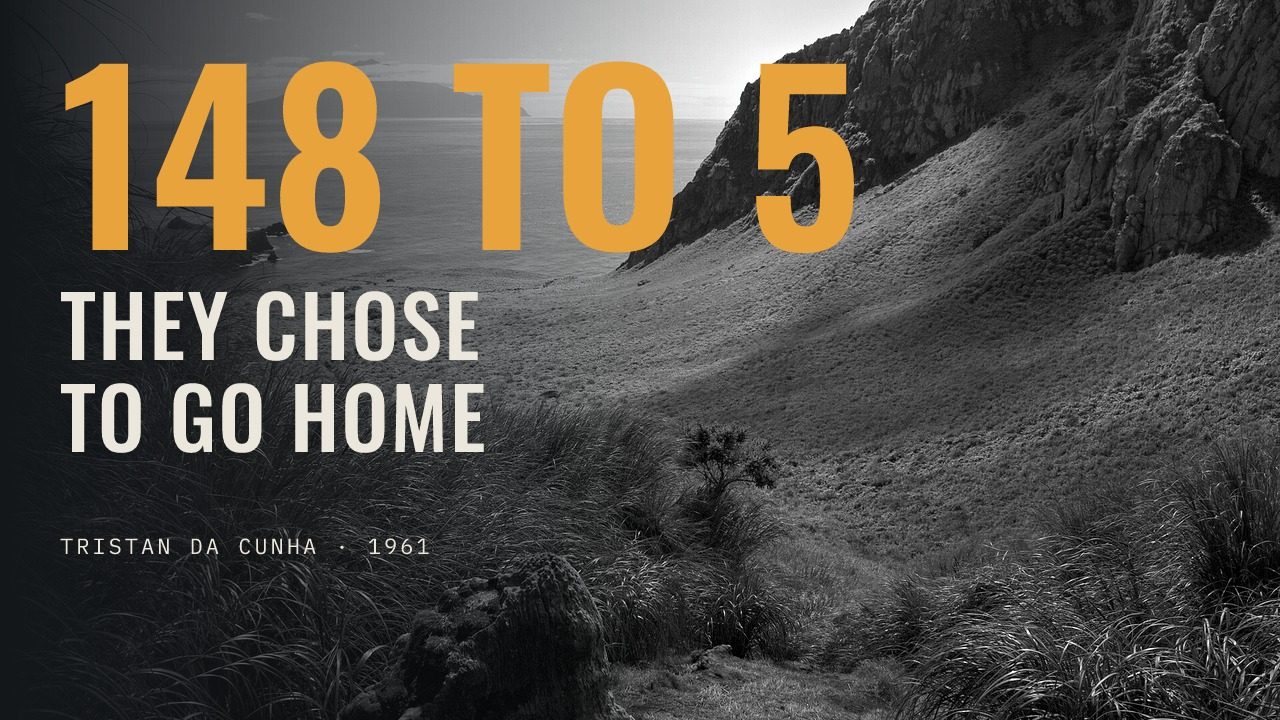
The result was a hundred and forty-eight votes to return, and five to stay.
They had seen the modern world. They had electricity, running water, shops and steady wages. And almost all of them chose to go back to a volcanic island in the middle of the ocean, with no airport, and ships only a few times a year.
In March nineteen sixty-three, an advance party of fifty-one islanders set off to prepare the island for the others.
In October, nearly two hundred more sailed from Southampton, on a Danish ship called the Bornholm. In November nineteen sixty-three, two years after the volcano had driven them away, they landed on Tristan da Cunha again.
Not everyone went back. A few islanders, mostly young women who had married in England, stayed. Their families still live in Hampshire today.
Today, a little over two hundred people live on Tristan da Cunha. The volcano that drove their grandparents away is still there, beside the village, a dark cone of rock.
The people who left in nineteen sixty-one were offered a new life in one of the richest countries in the world. They tried it. And then they decided that the life they already had, on their own island, with their own families, was the one they wanted.
They are still there.
Sources and credits
Sources
- Tristan da Cunha Government & Tristan da Cunha Association, "Tristan da Cunha Volcanic Interlude 1961–1963" (tristandc.com)
- New Forest & Hampshire Waterside history: the Tristan islanders at Calshot (nfhwa.org)
- Wikipedia, "Tristan da Cunha"
Photographs and maps
- Island life, c. 1937 — UK National Archives, CO 1069/777 (no known restrictions)
- Postcard sold for the Tristan relief fund, St Helena, 12 October 1961 — British Library, public domain
- Tristan da Cunha from space — NASA, public domain
- Tristan da Cunha, 2001–2012 — Wikimedia Commons / Flickr, CC BY 2.0 (incl. CTBTO; thumbnail: "View of Tristan da Cunha from Nightingale island", CC BY 2.0)
- Map: Tristan da Cunha, James Imray & Son, 1884 — public domain
Related stories on Faded Pin:
- Annie Edson Taylor: https://youtu.be/J89KI2eSdGQ
- Mehran Karimi Nasseri: https://youtu.be/8kW9piaq2gg
Related stories