Mehran Karimi Nasseri: The Real Man Behind The Terminal — Paris, 1988
Watch on YouTube Subscribe to Faded Pin
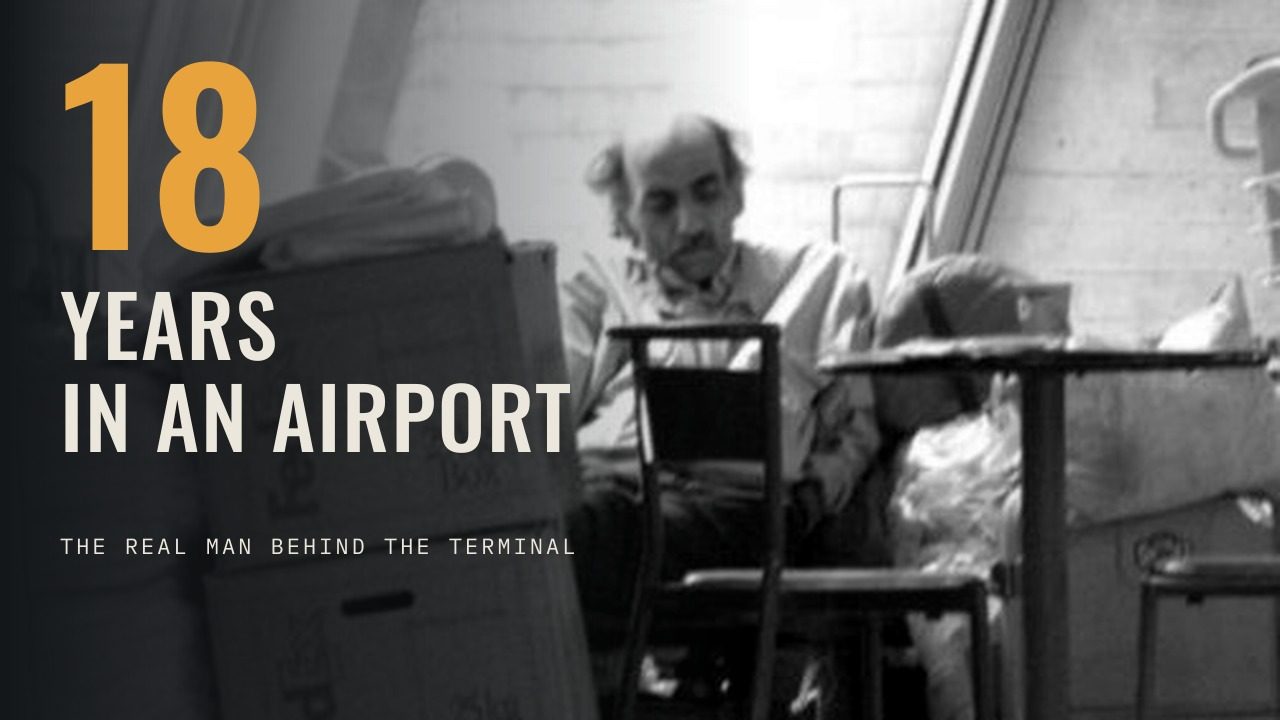
Mehran Karimi Nasseri lived in Terminal 1 of Charles de Gaulle Airport in Paris for eighteen years, from 1988 to 2006 — and his story inspired Steven Spielberg's film The Terminal with Tom Hanks. This documentary tells the real story: an Iranian refugee whose papers disappeared on the way to London, a legal circle no country could break, the bench where "Sir Alfred" read and wrote for years, the papers he finally received in 1999 and refused to sign, how the real story differs from the film, and his return to the airport where he died in 2022.
▶ Full story, transcript and sources: https://fadedpin.vercel.app/stories/mehran-karimi-nasseri-man-who-lived-in-an-airport
Parts of his life story come only from Nasseri himself; where journalists could not confirm them, the video says so.
På svenska
Mehran Karimi Nasseri: Mannen bakom The Terminal — Paris, 1988
Mehran Karimi Nasseri bodde i arton år, 1988–2006, i Terminal 1 på Charles de Gaulle-flygplatsen i Paris – och hans historia inspirerade Steven Spielbergs film The Terminal med Tom Hanks. Dokumentären berättar den verkliga historien: en iransk flykting vars papper försvann på vägen till London, en juridisk ond cirkel, bänken där "Sir Alfred" läste och skrev i åratal, papperen han till slut fick 1999 men vägrade skriva under, hur verkligheten skiljer sig från filmen, och hur han återvände till flygplatsen där han dog 2022.
Chapters
- 0:00The man who stayed
- 1:07An oil town in Iran
- 2:01The story he told
- 2:47Refugee
- 3:191988: the papers disappear
- 4:25The legal maze
- 5:25Life on the bench
- 6:47The way out — and the refusal
- 7:57Hollywood and The Terminal
- 11:40Leaving the bench
- 12:34The return
- 13:08Who was he?
The full story
In an airport, everyone is on the way to somewhere else.
People run for gates. They sleep for an hour on a chair, then they are gone. Nobody stays. An airport is a place you pass through.
But for eighteen years, in Terminal One of Charles de Gaulle Airport in Paris, one man stayed.
He slept on a red plastic bench. He washed in the staff bathrooms. He wrote in his diary every day, with his suitcases always beside him. Thousands of planes left above his head. He did not get on any of them.
His story inspired a Hollywood film with Tom Hanks. But the real story is stranger than the film. Because in the end, the man in the terminal was offered a way out. And he said no.
His name was Mehran Karimi Nasseri.
Mehran Karimi Nasseri was born in nineteen forty-five, in Masjed Soleyman, in south-western Iran.
It was an oil town. The Anglo-Persian Oil Company had found oil there in nineteen-oh-eight, and the town was built around the wells. Nasseri's father was an Iranian doctor who worked for the company. The family was comfortable.
About his mother, the story becomes unclear. Later in life, Nasseri said that his mother was a British nurse, and that he was the child of a secret affair. No one ever found proof of this. But the idea that he was really British stayed with him for the rest of his life. It would become very important.
In the early nineteen-seventies, he went to England to study at the University of Bradford.
What happened next is the story Nasseri told for decades.
According to him, he came back to Iran and took part in protests against the Shah, the king who ruled Iran at the time. He said that he was arrested, put in prison, and then expelled from the country, without a passport. Iran, he said, had thrown him out.
Journalists later tried to check this story. They could not confirm it. One investigation found only that he had been among about twenty students questioned after a university protest in nineteen-seventy. There was no record of an expulsion.
So we don't know exactly why he left Iran. What we do know is what came after.
He spent years travelling around Europe, asking country after country for asylum. Most said no.
Then, around nineteen eighty-one, the office of the United Nations refugee agency in Belgium recognised him as a refugee. He now had a paper that said who he was, and that he had the right to be protected.
But Nasseri did not want to live in Belgium. He wanted to go to Britain. The country of the mother he believed he had.
In nineteen eighty-eight, he set out for London. And somewhere on the way, his papers disappeared.
Nasseri's version was simple. He said his briefcase, with his refugee certificate inside, was stolen at a train station in Paris. Another account, reported later, says he mailed the documents back to Brussels himself, and then said they were stolen.
Either way, the result was the same. He arrived in London without a passport and without his refugee papers. The British would not let him in. They put him on a flight back to France.
In France, he was arrested for entering the country illegally. But the police had a problem. To deport a man, you must send him somewhere. And Nasseri had no papers from anywhere. No country would accept him.
So on the twenty-sixth of August, nineteen eighty-eight, he ended up in Terminal One of Charles de Gaulle Airport. Not in France, exactly. And not anywhere else either.
What followed was years of legal confusion.
A French human rights lawyer, Christian Bourguet, took his case. In nineteen ninety-two, a French court ruled that Nasseri had entered the airport legally, so he could not be thrown out of it. But the ruling did not give him the right to enter France. He was allowed to stay exactly where he was. And nowhere else.
Belgium said it still had his original refugee papers. It was ready to give him new ones. There was only one condition. He had to come to Belgium and collect them in person.
But to travel to Belgium, he needed papers.
It was a perfect circle. He needed documents to get documents. And so, month after month, year after year, he waited.
Slowly, Terminal One became his home.
He lived on a red plastic bench, on the first floor of the terminal. He washed early in the morning in the staff facilities, before the crowds came. He ate at the fast-food restaurant, and often airport workers or travellers paid for his meals. Staff gave him meal vouchers and newspapers.
He read a lot. And he wrote. Every day he filled pages with notes and diary entries, until his papers filled box after box beside his bench.
The airport workers gave him a nickname. They called him Lord Alfred, or Sir Alfred. And over the years, that is how he started to call himself too. Not Mehran. Alfred.
Travellers who stopped to talk to him found a polite, well-dressed man who spoke slowly and carefully. But not everyone thought the airport was good for him. A doctor at the airport in the nineteen-nineties described him with one word. Fossilized. He said the man had become fossilized there.
In nineteen ninety-nine, a reporter from the Associated Press asked him if he would ever leave. He answered: "Eventually, I will leave the airport. But I am still waiting for a passport or transit visa."
And then, finally, the way out came.
In nineteen ninety-five, Belgium offered to let him travel there, under supervision, to collect his papers. Nasseri refused. He still wanted to go to Britain, not Belgium.
In nineteen ninety-nine, France went further. It gave him papers that allowed him to live in France and to travel. After eleven years on the bench, he could walk out of the airport doors.
He did not sign them.
The papers described him as an Iranian citizen, with his Iranian name. Nasseri did not accept that. He said he was not Iranian. He said he could not even speak Persian any more. The name he wanted on his papers was Sir Alfred Mehran. And the nationality he wanted was British.
His lawyer was frustrated. He had fought for years to get those papers. Now his client would not use them. In the end, it seemed, the airport was no longer the place where Nasseri was trapped. It had become the only place where he still made sense to himself.
By then, the man on the bench had become famous.
Journalists from around the world came to Terminal One. In nineteen ninety-three, a French film called Lost in Transit told a story inspired by his. In nineteen ninety-eight, an English opera called Flight opened at Glyndebourne, set in an airport lounge. Documentary makers filmed him at his bench.
And then, Hollywood came. In two thousand and three, DreamWorks, the studio of Steven Spielberg, reportedly paid Nasseri around a quarter of a million dollars for the rights to his story.
In June two thousand and four, the film arrived in cinemas. It was called The Terminal.
Tom Hanks plays Viktor Navorski, a man from a made-up Eastern European country called Krakozhia. While he is in the air on his way to New York, there is a coup at home. His passport becomes worthless. He cannot enter the United States, and he cannot fly home. So he lives in the international terminal of New York's JFK Airport.
Some details come straight from the real story. Viktor sleeps on chairs at an empty gate. He washes in the public restroom. He finds ways to get food money inside the airport, and the airport workers slowly become his friends.
The terminal in the film is not a real airport. Spielberg looked for a real airport, but after the attacks of September two thousand and one, none would host a long film shoot. So Spielberg's team built an entire working terminal, with real shops and moving escalators, inside an enormous aircraft hangar in Palmdale, California.
The film also added what Hollywood needed. A love story with a flight attendant, played by Catherine Zeta-Jones. A tough airport boss who wants him gone. A happy, warm world inside the terminal.
Interestingly, the film's publicity never mentioned Nasseri. It was reported that a poster of the film hung over his luggage beside the bench.
When a reporter asked him about the film, he seemed both pleased and uneasy. "Maybe I don't do it like Tom Hanks does it," he said. And then, about his own life turning into a film, he asked: "Is this public entertainment?"
But the biggest difference is the ending. Viktor Navorski waits because the world will not let him go. When the war in his country ends, he walks out of the airport and into New York.
Nasseri's door had been open for years. He had the papers in his hands. He chose to stay.
Even then, in two thousand and four, he still talked about leaving. He told a reporter that he hoped to move to the United States or Canada. "I expect some change by October," he said. And: "In the end I will be happy."
Not everyone around him was so sure. One of the documentary makers who had filmed him, Alexis Kouros, said that Nasseri had become institutionalised. That after so many years, the airport was holding him as much as any law. He said Nasseri needed professional help, not more cameras.
The same year the film came out, a book was published. It was called The Terminal Man, and Nasseri wrote it together with the British author Andrew Donkin. In it, he told his life in his own words. Including the parts that nobody could confirm.
In July two thousand and six, after almost eighteen years, Nasseri fell ill and was taken to hospital. While he was away, his place in Terminal One was cleared. The bench was empty.
After hospital, the French Red Cross at the airport helped him. He lived for a while in a hotel, and then in charity shelters in Paris. For the first time since nineteen eighty-eight, Mehran Karimi Nasseri lived outside an airport.
For sixteen years, he did. But he never forgot the terminal.
In the late summer of two thousand and twenty-two, Nasseri came back to Charles de Gaulle. He was seventy-seven years old. According to reports, he had spent most of the money from the film. And once again, he was living in the airport.
On the twelfth of November, two thousand and twenty-two, just before midday, he had a heart attack in Terminal Two F. Police and a medical team tried to save him. He died there, in the airport.
On him, they found several thousand euros in cash.
So who was Mehran Karimi Nasseri?
A refugee lost between borders. A man that rules and papers forgot. A man who built his own story, and then lived inside it, until no paper in the world could match it. Maybe he was all of these at once.
The film gave him a happy ending, because films need one. Real life gave him something more complicated. For eighteen years, the whole world passed by his bench, on the way to somewhere else.
He was the one person in the airport who was not going anywhere. And in the end, it seems, that was where he wanted to be.
Sources and credits
Sources
- Associated Press obituary, 12 November 2022 (incl. AP interview, 1999)
- AFP report, 12–13 November 2022
- Christian Science Monitor, "Behind 'The Terminal,' a true story", 21 June 2004
- Paul Berczeller, "The man who lost his past", The Guardian, 6 September 2004
- UPI, 13 November 2022
- American Cinematographer, July 2004 (the Palmdale terminal set)
- Mehran Karimi Nasseri with Andrew Donkin, The Terminal Man (2004)
Film stills
- The Terminal (2004) © DreamWorks Pictures — stills from the official trailer, shown for commentary and criticism.
Photographs and maps
- Mehran Karimi Nasseri in Terminal 1, 2004 — Docpi; 2005 — Saint Martin (Wikimedia Commons, CC BY-SA 3.0)
- Charles de Gaulle Terminal 1: LBM1948 (1978, CC BY-SA 4.0), Mouliric (1976, CC BY-SA 4.0), Airlohner (2006, public domain), Royonx (CC0), David Monniaux (CC BY-SA 3.0), Florian Schäffer (CC BY-SA 4.0), DearEdward (CC BY 2.0), Eric Salard (CC BY-SA 2.0), Arne Müseler (CC BY-SA 3.0 DE)
- Terminal 2F: kallerna (CC BY-SA 4.0), Captainm (CC BY-SA 3.0)
- Masjed Soleyman oil well, 1908 — National Iranian Oil Company, public domain; Tehran, 1970s — public domain
- University of Bradford — Tim Green (CC BY 2.0); Gare du Nord — yisris (CC BY-SA 2.0); Glyndebourne — Gregg Gorman (CC BY 2.0)
- Palmdale Regional Airport — USGS, public domain
- Maps: U.S. Central Intelligence Agency, Iran (1973) and Europe (1993), public domain, via University of Texas Libraries
Related stories on Faded Pin:
- The Embassy Guard Who Spied for Russia – Caught on Hidden Camera: https://youtu.be/Tt9j_Pst5yE
- Poon Lim: https://youtu.be/F3-PmgTQoO4
Related stories