Annie Edson Taylor: Over Niagara Falls in a Barrel at 63 — 1901
Watch on YouTube Subscribe to Faded Pin
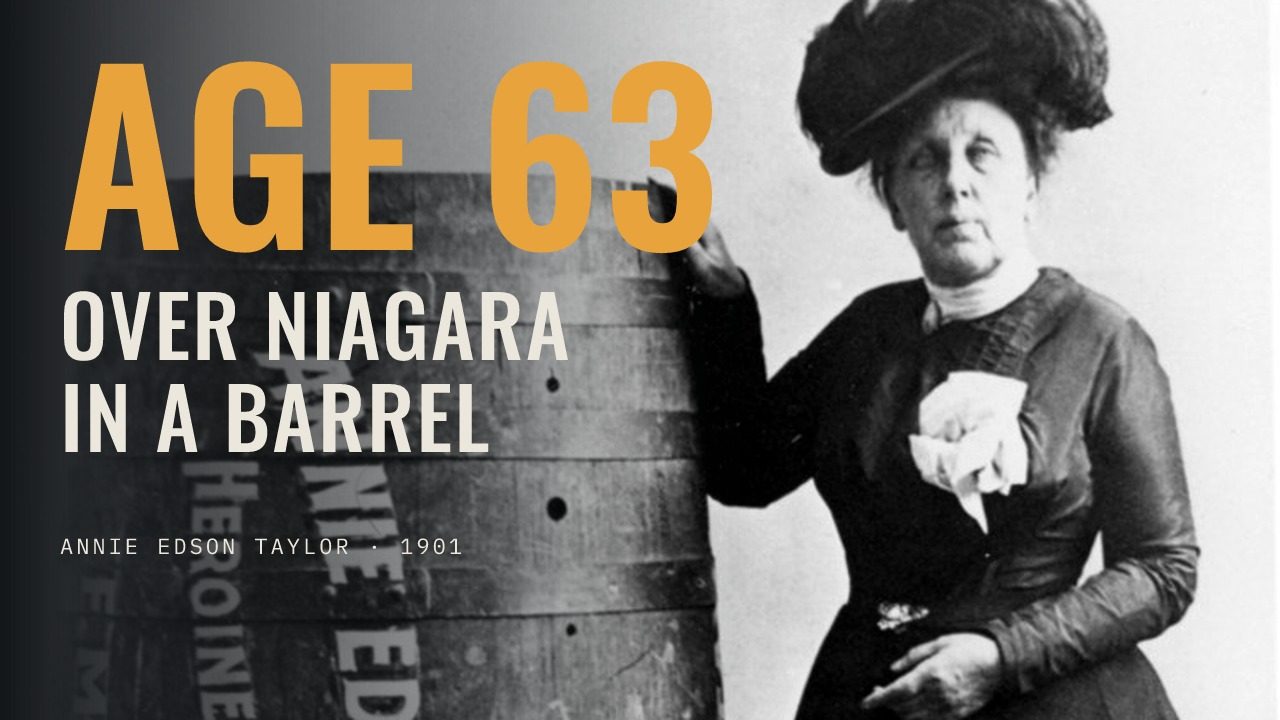
Annie Edson Taylor was the first person to go over Niagara Falls in a barrel and survive. On 24 October 1901 — her sixty-third birthday — the widowed schoolteacher climbed into an oak-and-iron barrel padded with a mattress, was set adrift above the Horseshoe Falls, and came out alive with only a small cut on her head. She had hoped the stunt would make her financially secure for the rest of her life. This is the true story of why she did it, the cat that went first, the manager who stole her barrel, and what happened to the "Queen of the Mist" afterwards.
▶ Full story, transcript and sources: https://fadedpin.vercel.app/stories/annie-edson-taylor-niagara-falls-barrel-1901
Chapters
- 0:00A barrel above the falls
- 0:43Who she was
- 1:27The plan
- 2:41The barrel and the cat
- 3:08Over the falls
- 4:05Alive
- 4:43Fame
- 5:01The stolen barrel
- 5:36The later years
- 6:06The end
- 6:44After her
- 6:53A single day
The full story
On the twenty-fourth of October, nineteen hundred and one, a barrel was floating down the Niagara River, toward the edge of the Horseshoe Falls.
Inside the barrel, curled up on a mattress, was a woman. A schoolteacher, a widow, with almost no money left in the world.
It was her birthday. She was sixty-three years old.
Nobody had ever gone over Niagara Falls in a barrel and lived. She was about to try.
Her name was Annie Edson Taylor. She was born in eighteen thirty-eight, in the state of New York. She trained as a teacher, and married a man named David Taylor.
Their only child, a son, died as a baby. Then her husband died too, while they were still young.
For the rest of her life, she supported herself. She taught school. She moved from town to town, and city to city, looking for work. In Bay City, in Michigan, she opened a school for dancing.
But by the year nineteen hundred, Annie Taylor was in her sixties, and she had very little money left. And she wanted, more than anything, to be sure of her old age.
So she came up with a plan.
Niagara Falls was one of the most famous sights in America. Every year, huge numbers of visitors came to see it. If someone could go over the falls and survive, Annie believed, people would pay to see that person, to hear the story, and to buy the pictures. She would never have to worry about money again.
And nineteen hundred and one was a busy year in that corner of New York. In Buffalo, about thirty kilometres from the falls, a great world's fair, the Pan-American Exposition, was open from May to November, and millions of people came to see it. In September, the President of the United States, William McKinley, was shot there, while shaking hands with visitors. He died eight days later. All year, the eyes of the country were on the region.
There was one problem with the plan, besides the obvious one. Annie believed that nobody would be interested in a woman in her sixties. So she told everyone she was in her forties. She claimed to be forty-two. The newspapers that covered her printed several different ages. None of them printed the real one.
She had a barrel made, of oak and iron, padded on the inside with a mattress.
Two days before her own attempt, the barrel went over the falls on a test run. Inside it was a cat.
The cat survived. It was found after the drop, with a bleeding head, but alive. A photograph taken the next year shows Annie Taylor sitting with a cat, very likely the same one.
On the twenty-fourth of October, nineteen hundred and one, her sixty-third birthday, Annie Taylor was rowed out into the Niagara River.
She climbed into the barrel, with a heart-shaped pillow. Her helpers closed the lid. With a bicycle pump, they pumped extra air into the barrel, then sealed the hole with a cork. Then they cut her loose, south of Goat Island, close to the American shore.
The current took the barrel. It was carried through the rapids, and toward the great curve of the Horseshoe Falls, on the Canadian side of the river. About twenty minutes after she was set adrift, the barrel reached the edge.
It went over, and fell about fifty metres, into the water at the bottom of the falls.
Below the falls, rescuers reached the barrel, and opened it.
Annie Taylor was alive.
She was shaken and battered, and she had a small cut on her head. But that was all. She had become the first person in history to go over Niagara Falls in a barrel and survive.
She is reported to have said that she felt as though she was being knocked to pieces. And afterwards, she gave a warning to anyone thinking of doing the same:
"If it was with my dying breath, I would caution anyone against attempting the feat."
For a short time, she was famous. Newspapers across America wrote about her. Photographers came. She began to give talks about her journey, and she wrote a short book about it.
But the money she had hoped for did not come. Her fame faded quickly.
And then her manager disappeared, and took the barrel with him.
Annie spent much of what she had earned on private detectives, to track it down. They found it in Chicago. But the barrel was later stolen again, and this time she never got it back.
Annie Taylor stayed at Niagara Falls. For years, she could be found at a souvenir stand near the falls, selling copies of her little book, and posing for photographs with tourists.
She tried other ways to earn a living. She tried to write a novel. She is said to have worked as a clairvoyant. At one point, she even talked about going over the falls a second time.
She never did. And she never became rich.
In nineteen twenty-one, old, poor, and almost blind, Annie Taylor moved into a public infirmary for the poor, in the town of Lockport, near the falls. Even then, according to the records, she still gave a younger age than her real one.
She died there on the twenty-ninth of April, nineteen twenty-one. She was eighty-two years old. She died without money, and her funeral was paid for by public donations.
She was buried in Oakwood Cemetery, in the city of Niagara Falls, not far from the river that had made her famous.
Others followed her. Ten years later, in nineteen eleven, a man named Bobby Leach went over the Horseshoe Falls in a steel barrel, and survived with serious injuries. Not everyone who tried was so lucky. Today, any attempt to go over the falls is against the law.
Annie Edson Taylor is usually remembered for a single day, and a single barrel. But the barrel was only a means to an end.
What she was really trying to do was something much more ordinary. She wanted to grow old without being afraid. To have enough money to live on, when she could no longer work.
She risked her life for it, on her sixty-third birthday. She survived the falls. But she never found the security she was looking for.
Sources and credits
Sources
- Guinness World Records, "Miraculous but tragic tale of the first person to survive a drop over Niagara Falls" (2026)
- History.com, "First barrel ride down Niagara Falls"
- Wikipedia, "Annie Edson Taylor" (and sources cited there)
- Newspaper reports, October 1901
Photographs
- Annie Edson Taylor and her barrel, 1901–1902 (public domain)
- Stereograph, 1901: "Mrs. Taylor the first human being to go over Falls and lives" — Library of Congress, public domain
- Niagara Falls views, c. 1900–1901 — Detroit Publishing Co. / Library of Congress, public domain
Related stories on Faded Pin:
- Mehran Karimi Nasseri: https://youtu.be/8kW9piaq2gg
- The Pilot Who Fell Through a Thunderstorm: https://youtu.be/VppoRULusbc
Related stories