The Pilot Who Fell Through a Thunderstorm — North Carolina, 1959
Watch on YouTube Subscribe to Faded Pin
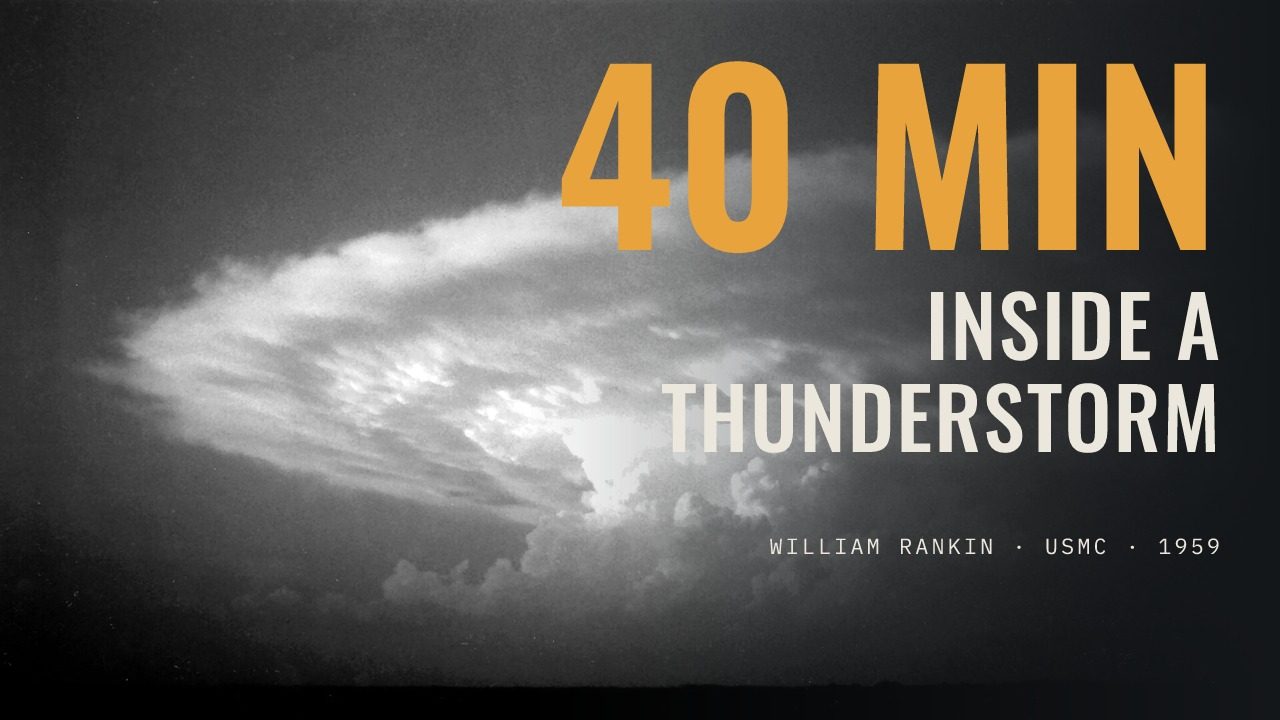
The pilot who fell through a thunderstorm: on 26 July 1959, Marine Lt. Col. William Rankin was flying an F8U Crusader at about 47,000 feet above a storm over the Carolina coast when his engine failed. He ejected without a pressure suit, into air at least fifty degrees below zero — and fell into the top of the storm. His parachute opened far too early, and for about forty minutes the updrafts carried him up and down inside the cloud, through hail, rain and lightning. This is the true story of "the man who rode the thunder", and of what a thunderstorm is really like inside.
▶ Full story, transcript and sources: https://fadedpin.vercel.app/stories/william-rankin-pilot-fell-through-thunderstorm-1959
Chapters
- 0:00Going up
- 0:47The pilot
- 1:10The Crusader
- 1:42The flight
- 2:21Engine failure
- 3:00Ejection
- 4:03The fall
- 4:37Inside the storm
- 6:03What is a thunderstorm?
- 6:54Down
- 7:26Help
- 8:03Afterwards
- 8:27Forty minutes
The full story
On a summer evening in nineteen fifty-nine, a man was hanging under a parachute, high above the coast of North Carolina.
He should have been coming down. Instead, he was going up.
He was inside a thunderstorm. All around him, the cloud was dark, and full of hail, rain and lightning. And the wind inside it was carrying him upward, thousands of feet at a time, like a leaf.
A normal parachute descent from that height takes a few minutes. His would take about forty.
His name was William Rankin. He was a lieutenant colonel in the United States Marine Corps, thirty-nine years old, and an experienced fighter pilot. He had flown in the Second World War, and again in Korea.
In the summer of nineteen fifty-nine, he was flying one of the fastest aircraft the Marines had.
It was the Vought F8U Crusader, a single-seat jet fighter built for the Navy and the Marine Corps. It was the first American jet fighter to fly faster than a thousand miles an hour. Two years earlier, a Marine pilot named John Glenn had flown one across the United States, coast to coast, in less than three and a half hours.
The Crusader could climb higher than most weather. And that was the plan on the twenty-sixth of July, nineteen fifty-nine.
Rankin and his wingman, a Navy lieutenant named Herbert Nolan, took off in two Crusaders from South Weymouth, near Boston. They were flying south, to the Marine air station at Beaufort, in South Carolina.
Over the Carolina coast, a thunderstorm stood in their way. Its top reached around forty-five thousand feet, more than thirteen kilometres. Rather than fly through it, they climbed over it.
Rankin levelled off at about forty-seven thousand feet. That is higher than an airliner flies today. Below him was the top of the storm.
Then, there was a bump, and a rumble from the engine. A fire warning light came on.
Rankin pulled back the throttle. The light went out. Then the engine stopped completely.
Without the engine, he was losing power to the controls. There was an emergency handle to release a small generator, to keep the vital systems running. He pulled it. It broke off in his hand.
The nose of the Crusader began to drop. Rankin called his wingman on the radio. According to Time magazine, his words were: "Power failure. May have to eject."
He was not wearing a pressure suit. At that height, without one, the human body is in serious danger.
Around six o'clock in the evening, he pulled the ejection handle.
The cold hit him first. Accounts of the temperature differ, but all of them put it at fifty degrees below zero, Celsius, or colder. He lost a glove on the way out, and his bare hand began to freeze almost at once.
Then came the decompression. At that height, the air pressure is so low that the gas inside the body expands. Rankin later told Time magazine that his stomach felt bloated to twice its size. He bled from his eyes, his ears, his nose and his mouth.
He managed to get his emergency oxygen working. And he began to fall.
Rankin knew what should happen next. His parachute had an automatic release, set to open when he reached ten thousand feet, about three kilometres. Until then, he would fall freely. The idea was to get down quickly, into thicker, warmer air.
He fell into the top of the storm.
Inside, the world went dark. The air was violent and full of water and ice. He was hit by hail. He tumbled and spun.
And then, much too early, his parachute opened.
The automatic release worked by measuring the air pressure. But inside a thunderstorm, the pressure jumps up and down. It seems the device was fooled, and opened the canopy high inside the cloud.
Now Rankin was hanging under a parachute, in the middle of the storm. And the storm took hold of him.
The air inside the cloud was rushing upward. It caught the parachute and carried him up, thousands of feet. Then it let go, and he dropped. Then it caught him again. According to his interview with Time, he was thrown up and down by as much as six thousand feet at a time.
Lightning was everywhere. He later wrote: "I saw lightning all around me, over, above, everywhere, and I saw it in every shape imaginable." The thunder was so loud that he said he did not hear it. He felt it, through his body.
The rain was so heavy that, he said, he had to hold his breath, so as not to drown, in mid-air. He was spun around until he was sick. Several times, the parachute nearly tangled around him.
To understand what was happening to him, it helps to look at what a thunderstorm actually is.
According to the American weather service, NOAA, a single thunderstorm can be around ten miles wide, and up to fifty thousand feet tall. Inside it, warm, wet air is rising fast. These upward winds, called updrafts, carry raindrops up into the freezing top of the cloud, where they turn to ice.
The ice falls, collects more water, and is carried up again. Round and round. It only falls out of the cloud when it becomes too heavy for the wind to hold. That is how hail is made.
For forty minutes, William Rankin was going through the same cycle as a hailstone. And a parachute is designed to catch the air.
At last, the storm began to weaken. The air became calmer, and warmer. The rain eased. Rankin drifted down, out of the bottom of the cloud, toward a forest.
A gust of wind threw him into the trees. His parachute caught in the branches, and he swung into a tree trunk, head first.
He looked at his watch. It was twenty minutes to seven. He had left the aircraft at around six o'clock. The whole journey down had taken about forty minutes.
He was bruised, frozen, swollen and covered in welts from the hail. But he could walk. He found his way to a back-country road, and stopped a passing car.
The driver took him to a small country store, where someone called an ambulance. He was taken to a hospital in the town of Ahoskie, in North Carolina.
The doctors treated him for frostbite, for the effects of decompression, and for the injuries from the hail and the fall. He spent some time in hospital. According to later accounts, he made a full recovery.
The story made national news. In August nineteen fifty-nine, Rankin told it to Time magazine. The next year, he wrote a book about it, called The Man Who Rode the Thunder.
He went back to duty in the Marine Corps, and served until nineteen sixty-four. He died in two thousand and nine, in Pennsylvania, at the age of eighty-eight.
Pilots are taught to respect thunderstorms, and to stay away from them. William Rankin did what he was taught. He climbed above the storm. He did not plan to go into it.
But for forty minutes, on a summer evening in nineteen fifty-nine, he saw the inside of one, from the top to the bottom, in a way almost no one else ever has. And he lived to describe it.
Sources and credits
Sources
- Time magazine, August 1959 (as quoted by Task & Purpose, James Clark, 2016)
- HistoryNet / Air Force Times, "Meet the Marine who 'rode the thunder' and lived to tell the tale" (2023)
- The Aviationist, Tom Demerly, "The Incredible Story of 'The Man Who Rode the Thunder'" (2020)
- William H. Rankin, The Man Who Rode the Thunder (Prentice Hall, 1960), as quoted in the sources above
- NOAA: Severe storms explainer; NSSL Severe Weather 101: Hail Basics
Photographs and maps
- U.S. Navy / U.S. Marine Corps photographs of the F8U Crusader (public domain)
- NOAA Photo Library: thunderstorms, lightning and hail (public domain) — illustrations, not Rankin's storm
- Map: U.S. Army Map Service, International Map of the World 1:1,000,000, NJ 18 Chesapeake Bay (compiled 1955), public domain, via University of Texas Libraries
Related stories on Faded Pin:
- Lady Be Good: https://youtu.be/Kc0KVc8lfbQ
- Poon Lim: https://youtu.be/F3-PmgTQoO4
Related stories