The Ertuğrul: A Shipwreck in Japan and a Rescue 95 Years Later
Watch on YouTube Subscribe to Faded Pin
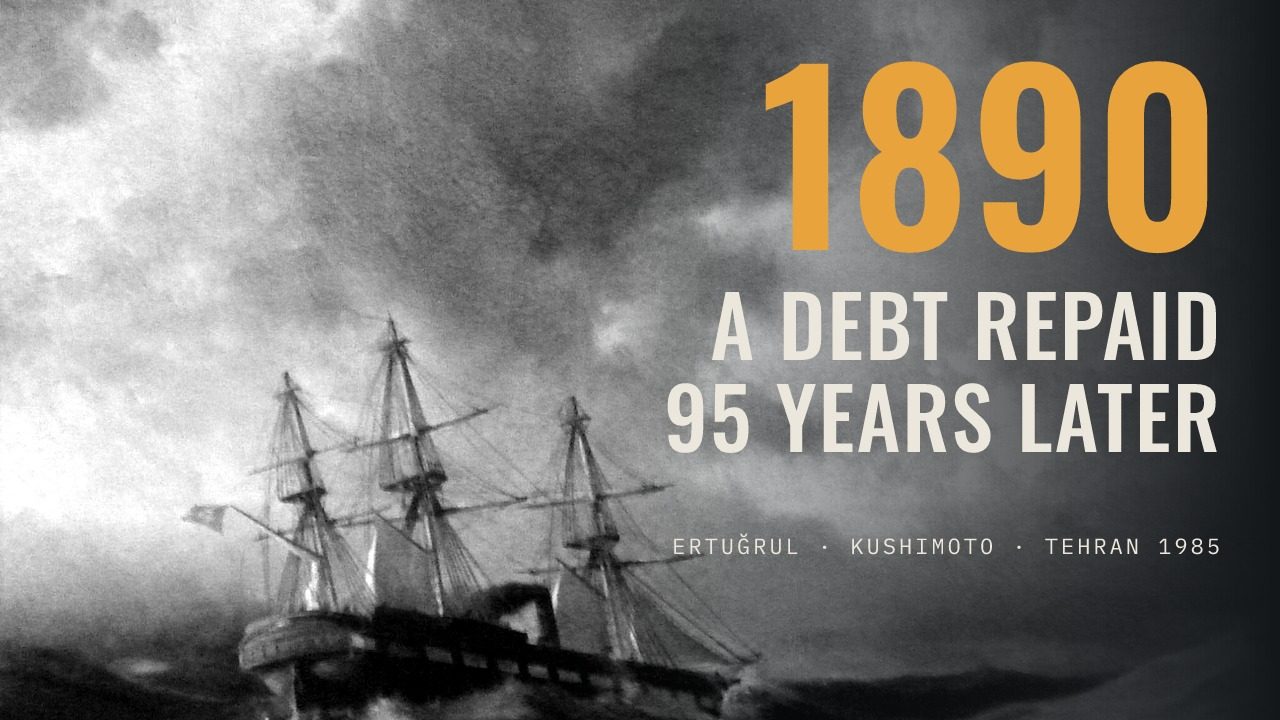
The Ottoman frigate Ertuğrul sank in a typhoon off Kushimoto, Japan, on the night of 16 September 1890, on her way home from a goodwill mission to Emperor Meiji. More than 500 sailors died; 69 survived, rescued by the people of Kii Ōshima island, who shared what little they had. Japanese warships carried the survivors home. Ninety-five years later, in March 1985, more than 200 Japanese were stranded in Tehran during the Iran–Iraq War — and two Turkish airliners flew in, hours before an Iraqi deadline, to bring 215 of them out. This is the true story of both events, and the friendship between them.
▶ Full story, transcript and sources: https://fadedpin.vercel.app/stories/ertugrul-frigate-1890-tehran-1985
Türkçe
Ertuğrul Fırkateyni: Japonya'da Bir Kaza ve 95 Yıl Sonraki Kurtarış
Osmanlı fırkateyni Ertuğrul, İmparator Meiji'ye yapılan iyi niyet ziyaretinden dönerken, 16 Eylül 1890 gecesi Japonya'nın Kushimoto açıklarında bir tayfunda battı. 500'den fazla denizci hayatını kaybetti; 69 kişi, ellerindekini paylaşan Kii Ōshima adası halkı tarafından kurtarıldı. Japon savaş gemileri kurtulanları İstanbul'a getirdi. 95 yıl sonra, Mart 1985'te, İran-Irak Savaşı sırasında Tahran'da mahsur kalan 200'den fazla Japon vardı. Irak'ın verdiği süre dolmadan birkaç saat önce iki Türk yolcu uçağı Tahran'a indi ve 215 Japon'u çıkardı. Bu video iki olayın ve aralarındaki dostluğun gerçek hikâyesini anlatıyor (anlatım İngilizce).
Chapters
- 0:00Tehran, 1985
- 0:51The mission
- 1:56The voyage
- 2:11The storm
- 3:04The island
- 3:47Home
- 4:11Remembered
- 4:51Tehran, March 1985
- 5:26The planes
- 5:52The debt
The full story
In March nineteen eighty-five, in the middle of the war between Iran and Iraq, more than two hundred Japanese people were stuck in Tehran.
Iraq had announced that, after a deadline, aircraft flying over Iran could be attacked. And no plane from Japan was coming to get them.
Then two aeroplanes arrived from Turkey.
When people asked why Turkey had done it, many in both countries gave the same answer. It went back ninety-five years, to a stormy night off the coast of Japan, and a wooden warship called the Ertuğrul.
In the eighteen-eighties, the Ottoman Empire and Japan were very far apart, but they were curious about each other. In eighteen eighty-seven, a Japanese prince, Komatsu Akihito, visited Istanbul and met Sultan Abdülhamid the Second.
The Sultan decided to send a mission in return: a ship that would sail all the way to Japan, carrying his greetings and gifts for the Emperor, Meiji.
The ship he chose was the Ertuğrul, an old wooden frigate with sails and a steam engine, built in Istanbul a quarter of a century earlier. Her commander was Ali Osman, a naval officer. In July eighteen eighty-nine, she left Istanbul with more than six hundred men on board.
It was a long and difficult voyage. The Ertuğrul was not built for such a journey. She ran aground in the Suez Canal, and had to stop for repairs on the way. She called at ports across the Indian Ocean and South-East Asia.
It took her about eleven months to reach Japan. In June eighteen ninety, she arrived at Yokohama. The Ottoman officers were received by Emperor Meiji, and presented the Sultan's gifts.
The Ertuğrul stayed in Japan for three months. By the time she was ready to sail home, it was September. Typhoon season.
On the fifteenth of September, eighteen ninety, she left Yokohama.
The next day, a typhoon caught her off the coast of Wakayama, south of Osaka. The old ship was battered by the wind and the waves. A mast came down. Water flooded in and put out one of the boiler fires.
That night, the sixteenth of September, the storm drove the Ertuğrul onto the rocks off a small island called Kii Ōshima, below a lighthouse at a place called Kashinozaki. She broke apart, and sank.
In the dark, a few men managed to climb out of the sea onto the rocks. Some of them struggled up the cliffs, toward the light at the top: the lighthouse.
The people of the island came out into the storm. They pulled sailors from the rocks and carried them up to safety. Kii Ōshima was a poor fishing island, and the islanders did not have much food. They shared what little they had with the strangers.
Sixty-nine men survived. More than five hundred died, among them Ali Osman Pasha, the commander.
The islanders also recovered the bodies of the dead. They were later buried near the lighthouse.
When news of the disaster reached Tokyo, Emperor Meiji sent doctors and nurses to care for the survivors.
And Japan did something more. Two ships of the Japanese navy, the Kongō and the Hiei, were sent to carry the sixty-nine survivors all the way home to the Ottoman Empire. They arrived in early eighteen ninety-one.
On the hill above the place where the Ertuğrul sank, a memorial was built for the sailors who died there. In nineteen seventy-four, a Turkish museum was opened in the town of Kushimoto.
In Turkey, the Ertuğrul was remembered, and so were the island villagers who had saved Ottoman sailors on the other side of the world.
Ninety-five years later, in March nineteen eighty-five, Iran and Iraq had been at war for four and a half years.
On the seventeenth of March, Iraq's leader, Saddam Hussein, announced that after a deadline, about forty-eight hours later, any aircraft in the airspace over Iran could be attacked.
More than two hundred Japanese were stranded in Tehran. Commercial airlines were unwilling to fly into the danger, and the Japanese government did not send aircraft of its own.
According to accounts of those involved, the Japanese ambassador in Tehran turned to his Turkish colleague for help. The request went to Ankara, to the Prime Minister, Turgut Özal.
Turkey agreed. On the nineteenth of March, Turkish airliners flew to Tehran, hours before the deadline. They brought out two hundred and fifteen Japanese citizens.
Most of the Turkish citizens in Iran at the time left the country by land.
Later, when people asked why Turkey had done it, Turkish officials gave an answer that went back almost a century. They spoke of the Ertuğrul, and of the island villagers who had saved the Ottoman sailors in eighteen ninety.
Today, the two events are remembered together. Every five years, a ceremony is held in Kushimoto, above the rocks where the Ertuğrul went down. Turks and Japanese stand side by side, to remember the sailors who died there, and the strangers who came out into the storm to help.
Sources and credits
Sources
- nippon.com, "The Sinking of the Ertuğrul: Japan and Turkey Mark the 125th Anniversary of the Tragedy" (2015)
- Cumhuriyet, "Milestone in Turkish-Japanese ties: the tragedy of the Ertuğrul frigate"
- Wikipedia, "Ottoman frigate Ertuğrul" (and the sources cited there)
- Accounts of the 1985 Tehran evacuation (Daily Sabah; Hürriyet Daily News; "The Turkish Rescue of Japanese Citizens From Tehran")
Photographs
- The Ertuğrul, Ali Osman Pasha, the funeral ceremony (1890), the Kongō (1878) and the Hiei in Istanbul (1891, Abdullah Frères) — public domain
- The Graphic, 21 March 1891 — public domain
- Painting of the Ertuğrul in a storm, Commodore Nuri — public domain
- Emperor Meiji (Takahashi Yuichi, 1880) and Sultan Abdülhamid II — public domain
- Kashinozaki lighthouse and memorial today — Wikimedia Commons, CC BY 4.0 / CC BY 2.0; Turkish Memorial and Museum, Kushimoto — CC BY 3.0; model in Mersin Naval Museum — CC0
Related stories on Faded Pin:
- TCG Dumlupınar: https://youtu.be/VcK_9K3m_Bw
- Kalabaliken i Bender: https://youtu.be/3d6v5fF5oCg
Related stories