Kalabaliken i Bender: The Swedish King Who Fought His Host — 1713
Watch on YouTube Subscribe to Faded Pin
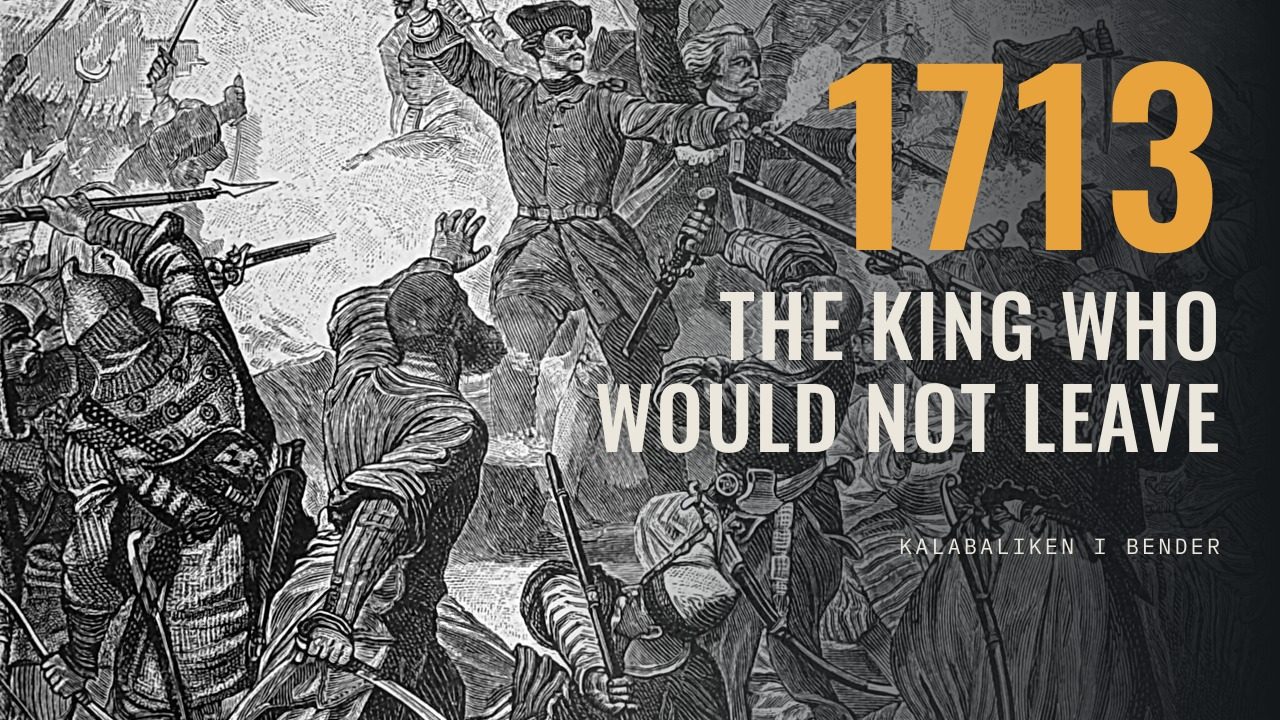
Kalabaliken i Bender — the day the King of Sweden fought the Sultan's army while he was the Sultan's guest. After his defeat at Poltava in 1709, Charles XII fled to the Ottoman Empire and lived near Bender for more than three years, at the Sultan's expense, refusing to leave. On 1 February 1713, janissaries and Crimean Tatars stormed his house at Varnitsa. This documentary tells the true story of the "kalabalik", the nickname "Demirbaş Şarl", the king who then stayed in bed for months, his famous ride home to Stralsund in disguise — and the Turkish word that became Swedish.
▶ Full story, transcript and sources: https://fadedpin.vercel.app/stories/kalabalik-bender-charles-xii-ottoman-empire-1713
På svenska
Kalabaliken i Bender: Kungen som inte ville gå hem — 1713
Kalabaliken i Bender – dagen då Sveriges kung slogs mot sultanens soldater medan han var sultanens gäst. Efter nederlaget vid Poltava 1709 flydde Karl XII till Osmanska riket och bodde vid Bender i mer än tre år, på sultanens bekostnad, utan att vilja åka hem. Den 1 februari 1713 stormade janitsjarer och krimtatarer hans hus i Varnitsa. Dokumentären berättar den sanna historien om kalabaliken, smeknamnet "Demirbaş Şarl", kungen som sedan låg till sängs i månader, den berömda ritten hem till Stralsund under falskt namn – och det turkiska ordet som blev svenskt.
Türkçe
Demirbaş Şarl ve Bender Kalabalığı: Gitmeyen İsveç Kralı — 1713
Bender Kalabalığı – İsveç Kralı XII. Karl'ın, misafiri olduğu Sultan'ın askerleriyle çatıştığı gün. 1709'daki Poltava yenilgisinden sonra Osmanlı topraklarına sığınan Karl, üç yılı aşkın süre Bender yakınlarında devletin misafiri olarak yaşadı ve bir türlü gitmedi. 1 Şubat 1713'te yeniçeriler ve Kırım Tatarları Varnitsa'daki evini kuşattı. Bu belgesel "kalabalık" olayını, "Demirbaş Şarl" lakabını, ardından aylarca yataktan kalkmayan kralı, sahte adla Stralsund'a yaptığı ünlü at yolculuğunu ve İsveççeye geçen Türkçe kelimeyi anlatıyor.
Chapters
- 0:00The house at Varnitsa
- 1:03The warrior king
- 2:04Guest of the Sultan
- 3:00The guest who would not leave
- 4:21The order
- 5:29The kalabalik
- 7:13The count
- 8:42The king in bed
- 9:54The ride
- 10:54What remained
- 12:16Two views
The full story
In the winter of seventeen thirteen, in a small village on the edge of the Ottoman Empire, a stone house was surrounded by thousands of soldiers.
Inside were a few dozen Swedes. And among them was a king. The King of Sweden, Charles the Twelfth.
The soldiers outside were Ottoman janissaries and Crimean Tatars. They had come to take him away. The strange thing was this: the king was not their enemy. He was the Sultan's guest. He had been living there, at the Sultan's expense, for three and a half years.
And he would not leave.
In Sweden, what happened next is still remembered with a Turkish word: kalabalik. In Turkey, the king is still remembered with a nickname: Demirbaş Şarl.
Charles the Twelfth became King of Sweden in sixteen ninety-seven. He was fifteen years old.
Three years later, Sweden's neighbours, Denmark, Saxony-Poland and Russia, attacked together. They thought the young king would be easy to beat. They were wrong. Charles turned out to be one of the most gifted, and most stubborn, soldiers of his age. For nine years he won battle after battle.
Then he marched into Russia.
On the twenty-seventh of June, seventeen-oh-nine, at Poltava, in what is now Ukraine, his army was destroyed by the army of Tsar Peter the Great. Three days later, most of what was left of it surrendered.
Charles himself escaped. With around fifteen hundred Swedish soldiers and about as many Cossack allies, he rode south, across the steppe, to the one place where the Russians could not follow him. The Ottoman Empire.
The Ottoman Sultan at that time was Ahmed the Third. He received the defeated king as an honoured guest.
Charles was given a place to stay near Bender, an Ottoman fortress on the river Dniester, in today's Moldova. The Ottomans had held it since fifteen thirty-eight.
The Sultan's government paid for the king and for hundreds of his men. A guest of the Sultan was a guest of the empire.
Charles had a plan. He wanted the Ottomans to go to war with Russia, and to help him march back north. And for a while, it almost worked. In seventeen eleven, an Ottoman army trapped Peter the Great and his army near the river Prut. But instead of destroying him, the Ottomans made peace and let the Tsar go home.
Charles was furious. He had no intention of giving up.
In the summer of seventeen eleven, he moved his camp a few kilometres north of Bender, to the village of Varnitsa. A stone house with thick walls was built for him there, with barracks for his soldiers. The Swedes started to call the camp "Karlopolis". Charles's city.
Months passed. Then years. The Ottomans began to hint, politely, that it might be time for the king to go home. Charles always had a reason to stay. The roads were not safe. The Russians were waiting. The Poles were hostile.
Meanwhile, he borrowed money. From the Sultan, and from merchants and bankers in the empire. According to Swedish historians, his debts grew to around two and a half million riksdaler. About half of what the whole Swedish state spent in a year.
In Turkey, he got a nickname that is still remembered today. Demirbaş Şarl. Demirbaş means something like "iron head", but it is also the word for a piece of furniture that belongs to a building. Something that never leaves. Turkish sources say the Ottomans gave him the name because he simply would not go. One Swedish account turns it around, and says it was Charles who called an Ottoman officer "Demirbaş", during the crisis. Either way, the name stuck.
By seventeen twelve, the patience in Istanbul was running out. Grand viziers came and went, and the new ones were less friendly to Charles. Even the Crimean Tatar khan, Devlet Giray, who had once been his ally, turned against him.
At last, the order came. The Swedish king was to be removed from Bender. By force, if necessary.
On the thirty-first of January, seventeen thirteen, by the Swedish calendar of the time, the Ottoman commander at Bender, Ismail Pasha, and the Tatar khan arrived outside the Swedish camp with soldiers and cannons. The first shots killed a Swedish trumpeter.
According to Swedish accounts, a group of janissary officers came forward carrying white staves, the sign of a safe conduct. They offered the king a peaceful way out.
Charles refused.
The next day, the first of February, the attack began. According to Swedish accounts, it started with Ottoman military music.
How many men attacked is not certain. Sources speak of several thousand Ottoman soldiers and Tatars, some say many more. In the Swedish camp there were a few hundred men at most, and many of them had no wish to fight. A reward of two hundred gold ducats had been promised to whoever brought the king out alive.
The Swedish defences outside were broken quickly. Charles was pulled back into his stone house. With him were perhaps forty to sixty men.
And then, for hours, the King of Sweden defended a house.
The Swedes fired from the windows. When the attackers broke into the building, the fighting went from room to room. Charles fought with his own sword. He was cut on the hand. According to witnesses, one of his officers, Axel Erik Roos, saved his life several times that day.
In the end, the attackers set the house on fire. Burning arrows and burning hay were thrown onto the roof. The defenders had to choose between the flames and the soldiers outside.
Charles decided to run for another building nearby. As he ran out into the courtyard, he tripped on his own long spurs, and fell.
One of his men, Olof Åberg, threw himself over the king, and took a sabre blow to the head.
Charles was overpowered. Before they could take it from him, he threw his sword away. He would not be disarmed by anyone.
The king was hurt, though not badly. A bullet had grazed his nose and his ear. His hand was cut. And, according to Swedish accounts, two bones in his foot were broken.
Between twelve and thirty-one Swedes were killed. How many Ottoman and Tatar soldiers died or were wounded, no one knows exactly. Estimates go from a few dozen to more than four hundred. The pasha himself is said to have told Charles that they had lost more than two hundred men.
Charles was taken, on foot, to the pasha's tent, and then to his residence in Bender. Witnesses said that even with his wounds, he behaved with calm dignity.
According to Swedish accounts, an order from the Sultan to avoid violence arrived the day after the fight. It was too late. In Istanbul, heads rolled, in the political sense. The grand vizier, the Tatar khan and Ismail Pasha all lost their positions.
Many of the captured Swedes had to buy their freedom, borrowing the money from Greek and Armenian merchants.
News of the fight spread across Europe, and grew in every telling. Some admired the king's courage. Others said he had provoked the Ottomans himself, and paid the price. Even his great enemy, Tsar Peter, is said to have reacted with a mixture of scorn and admiration.
Charles was not sent home. He was moved south, deeper into the empire. In March seventeen thirteen he arrived at Demotika, the town Turks call Dimetoka, near Edirne, in what is now Greece.
And there, the most active king in Europe did something no one expected. He went to bed. And he stayed there.
For months, Charles the Twelfth lay in bed and refused to get up. His own people were surprised. Some historians think he was exhausted, or depressed, after years of war, defeat and humiliation. Only at Christmas seventeen thirteen did he get up again, for the first time in almost a year.
Back in Sweden, the war continued without its king. In December seventeen thirteen, the Swedish parliament met, and sent an envoy to persuade him to come home.
In September seventeen fourteen, more than five years after Poltava, Charles finally left Demotika.
He travelled north to the border of the Ottoman lands. There, he did something very much in character. He decided to ride home himself, fast, and in disguise.
With false papers, under the name of "Captain Peter Frisk", he rode across Europe. Through the lands of the Habsburg emperor, and on through Germany.
On the eleventh of November, seventeen fourteen, a tired rider arrived at the Swedish fortress town of Stralsund, on the Baltic coast of Germany. He had ridden more than two thousand kilometres in about two weeks. The commandant of the town recognised him. It was his king.
He was not the only one who had travelled from the Ottoman Empire to the north. Charles's creditors followed him. They wanted their money back.
Charles the Twelfth never saw the Ottoman Empire again. Four years later, in November seventeen eighteen, he was killed by a bullet to the head while besieging a fortress in Norway. He was thirty-six.
But the winter of seventeen thirteen left something behind in two languages.
In Turkish, kalabalık simply means a crowd. Swedish soldiers brought the word home, and in Swedish and Finnish, kalabalik came to mean chaos, uproar, a great mess. Swedes still say it today, often without knowing that it began with a burning house near Bender.
And in Turkey, "Demirbaş Şarl" is still the name for the king who came as a guest, and would not leave.
The story also lived on in Swedish culture. The poet Esaias Tegnér wrote about it. A Swedish film comedy from nineteen eighty-three is called Kalabaliken i Bender. And the Swedish metal band Sabaton has a song about it.
There are other stories too. A popular one, told in both countries, says that the Swedes also brought home stuffed cabbage leaves, the Ottoman dolma, which became the Swedish kåldolmar. It is a nice story. Whether it is true, is much harder to prove.
Swedish painters later turned the kalabalik into a heroic scene. A king with a sword, alone against an army. Ottoman officials saw a guest who had overstayed his welcome for five years, run up enormous debts, and finally fought the soldiers of the man who had fed him.
Both views are, in a way, true.
Charles the Twelfth was a king who could not accept losing. Not at Poltava, not at Bender, not anywhere. It made him a legend. And it made him one of the most difficult guests in history.
Sources and credits
Sources
- Peter From, Kalabaliken i Bender. Karl XII:s turkiska äventyr (2009)
- Bengt Liljegren, Karl XII: en biografi (2000); Ragnhild Hatton, Charles XII of Sweden
- Anders Fryxell, Berättelser ur svenska historien (1856); Oscar Browning, Charles XII of Sweden (1899)
- Semavi Eyice, "Bender Kalesi", TDV İslâm Ansiklopedisi
- History Today, "The Kalabalik"
- Wikipedia: Skirmish at Bender / Kalabaliken i Bender
Paintings, maps and photographs
- Hauschild, Charles XII's battle with the janissaries at Varnitsa (c. 1894) — public domain
- Hjalmar Mörner, Kalabaliken i Bender (1837) — Uppsala University, CC0
- Carl XII captured at Varnitza (c. 1872); The Battle of Bender (1877) — public domain
- David von Krafft, portraits of Charles XII — public domain
- Pierre-Denis Martin, The Battle of Poltava (1726) — public domain
- Levnî, Sultan Ahmed III and the Ottoman military band (c. 1720), Topkapı Palace Museum — public domain
- Maps: Johann Baptist Homann, Europe (1724, Bibliothèque nationale de France) and Ukrania (1720) — public domain
- Bender (Tighina) fortress and Didymoteicho today — Wikimedia Commons, CC BY-SA 3.0 / 4.0
Related stories on Faded Pin:
- Adnan Menderes: https://youtu.be/9VVnHkV2wrM
- Why Didn't Hitler Invade Sweden? The Secret 1943 Plan: https://youtu.be/okFoMToNdic
Related stories