Adnan Menderes: The Prime Minister Who Walked Out of the Fog — Gatwick, 1959
Watch on YouTube Subscribe to Faded Pin
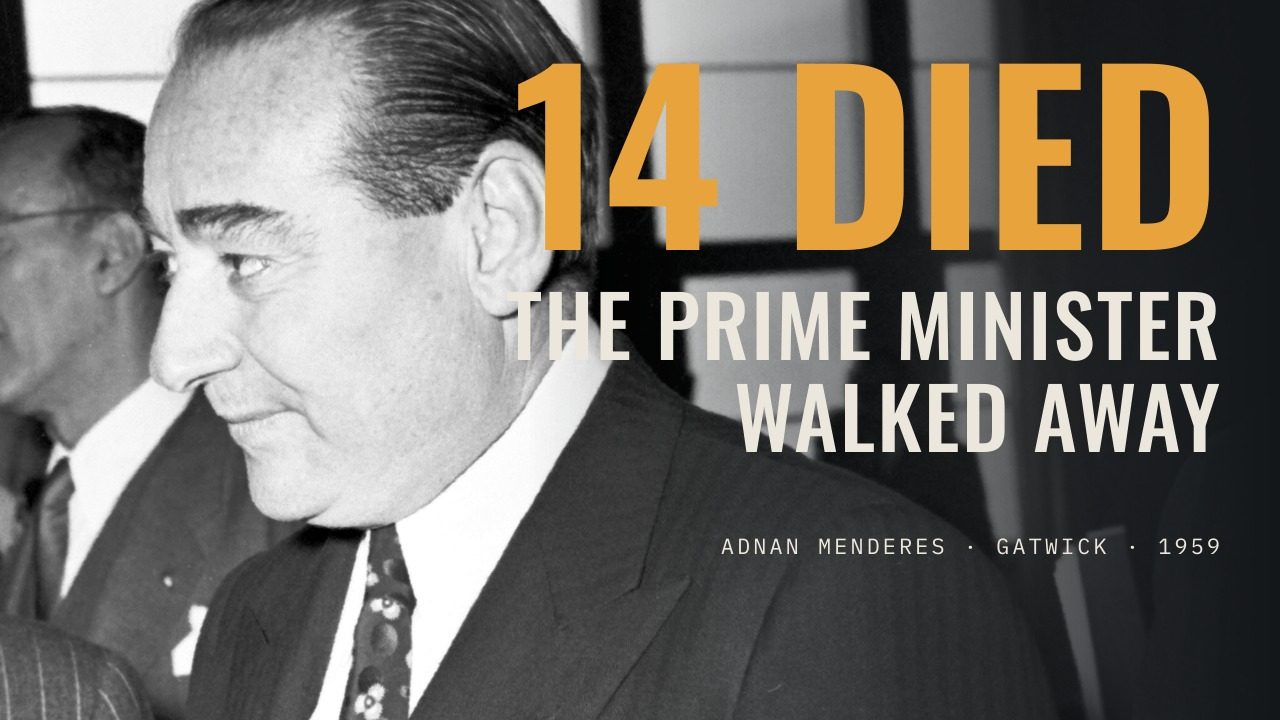
On 17 February 1959, a Turkish Airlines Vickers Viscount carrying Prime Minister Adnan Menderes to London — where he was to sign the agreement that created the Republic of Cyprus — was diverted from Heathrow to Gatwick in thick fog. About three miles short of the runway it flew into the trees of Jordan's Wood, near Newdigate in Surrey, and caught fire. Fourteen of the 24 people on board died. Menderes walked away with scratches, signed the treaty two days later, and returned home to huge crowds. Less than three years later, after a military coup, he was hanged on the island of İmralı.
▶ Full story, transcript and sources: https://fadedpin.vercel.app/stories/adnan-menderes-gatwick-plane-crash-1959
På svenska
Adnan Menderes: Premiärministern som klev ut ur dimman – Gatwick 1959
Den 17 februari 1959 var Turkiets premiärminister Adnan Menderes på väg till London för att skriva under avtalet som skapade Republiken Cypern. Hans plan, en Vickers Viscount från Turkish Airlines, leddes om från Heathrow till Gatwick i tät dimma och flög in i träden i Jordan's Wood nära Newdigate i Surrey. Fjorton av de 24 ombord omkom. Menderes klarade sig med skrapsår, skrev under avtalet två dagar senare – och mindre än tre år senare, efter en militärkupp, avrättades han på ön İmralı.
Türkçe
Adnan Menderes: Sisten Sağ Çıkan Başbakan — Gatwick Uçak Kazası, 1959
17 Şubat 1959'da Başbakan Adnan Menderes, Kıbrıs Cumhuriyeti'ni kuracak antlaşmayı imzalamak için Londra'ya gidiyordu. THY'nin Vickers Viscount uçağı yoğun sis yüzünden Heathrow'dan Gatwick'e yönlendirildi ve pistten yaklaşık üç mil önce, Surrey'deki Newdigate yakınında Jordan's Wood ormanındaki ağaçlara çarptı. Uçaktaki 24 kişiden 14'ü hayatını kaybetti. Menderes yüzünde birkaç sıyrıkla kurtuldu, iki gün sonra antlaşmayı imzaladı ve büyük kalabalıklarla karşılandı. Üç yıl geçmeden, 27 Mayıs darbesinin ardından İmralı'da idam edildi.
Chapters
- 0:00Into the fog
- 1:04Adnan Menderes
- 2:19Cyprus
- 3:18The flight
- 4:25The fog
- 5:22The crash
- 6:10The farmhouse
- 7:00The fourteen
- 8:38Why?
- 9:19The signing
- 9:44Home
- 10:49The fall
- 11:31İmralı
- 11:54After
- 12:28Jordan's Wood today
- 12:49Closing
The full story
On a February afternoon in nineteen fifty-nine, a small airliner was flying low over the English countryside, searching for a runway in thick fog.
On board was the prime minister of Turkey. He was on his way to London, to sign an agreement that would create a new country.
Minutes later, the plane hit the trees.
Fourteen people died. The prime minister climbed out of the wreckage with a few scratches on his face.
In Turkey, many people saw it as a miracle. A sign that he was protected by God. Less than three years later, he was dead. Not in an accident, but on a gallows.
This is the story of Adnan Menderes, and the plane that came down in the fog near Gatwick.
Adnan Menderes was born in eighteen ninety-nine, in the province of Aydın, in western Turkey, into a wealthy landowning family.
For most of the young Turkish Republic's history, there had been only one party in power. In nineteen forty-six, Menderes and a group of politicians founded a new one: the Democrat Party.
In nineteen fifty, Turkey held an election in which votes were cast in secret and counted in the open. The Democrat Party won by a landslide. Menderes became prime minister.
He was especially popular in the countryside. His government built roads and brought tractors and investment to the villages. Many farmers saw him as the first leader who spoke for them.
But by the late nineteen-fifties, the economy was struggling. And his government was becoming more and more authoritarian. Press freedom was restricted, and the opposition came under growing pressure. His critics accused him of trying to rule alone.
Turkey was deeply divided about Adnan Menderes. And it still is.
In early nineteen fifty-nine, he had a great diplomatic success within reach.
The island of Cyprus was a British colony. Most of its people were Greek Cypriots, and many of them wanted the island to join Greece. Turkish Cypriots, a large minority, were strongly opposed. Turkey and Greece were both deeply involved. For years, there had been violence on the island.
In February nineteen fifty-nine, the prime ministers of Turkey and Greece met in Zürich, and agreed on a compromise. Cyprus would become an independent republic. Power would be shared between the two communities. Britain, Greece and Turkey would guarantee the arrangement.
The final agreement was to be signed in London, at a conference with the British government and the leaders of both communities on the island.
Menderes would fly there himself.
On the seventeenth of February, nineteen fifty-nine, a Turkish Airlines Vickers Viscount took off from Ankara.
The Viscount was a modern aircraft for its time. It was British-built, with four turboprop engines, and was one of the most successful airliners of the nineteen-fifties.
It was a special flight for the prime minister and his delegation. Ministers, diplomats, advisers, journalists, and the general manager of Turkish Airlines himself.
There were twenty-four people on board. Eight crew and sixteen passengers.
The plane stopped on the way, and at two minutes past one in the afternoon, it left Rome on the last leg of the journey, to London.
It crossed Italy, the Alps and France. Just before four o'clock, over the town of Abbeville in northern France, the crew made contact with London air traffic control.
Everything seemed normal. In less than an hour, they would be on the ground.
London in winter was famous for its fog. And that afternoon, it was bad.
At twenty-one minutes past four, air traffic control told the crew that visibility at Heathrow, London's main airport, was too poor. They were sent instead to Gatwick, an airport south of the city.
But the fog was there too. Later, investigators found that in some places near the approach, people on the ground could see only thirty yards. That's less than thirty metres. In other places, around two hundred yards.
It was late afternoon in February. The light was already fading.
The crew began their approach to Gatwick. They were flying lower and lower, trying to see the runway.
At about twenty to five in the afternoon, the plane disappeared from the radar screen.
About three miles before the runway, near a village called Newdigate, in Surrey, the Viscount flew into the tops of the trees in a small wood, called Jordan's Wood.
It ploughed through the trees. Its wings were torn off. The engines were ripped away. The fuselage came down, turned over, and landed upside down. Then it caught fire.
In the rear of the cabin, by a window on the left side, sat Adnan Menderes.
When the plane stopped moving, he was hanging upside down in his seat. Around him there was smoke, and twisted metal.
He was alive. He had only scratches on his face. A member of his delegation helped free him, and they got out of the wreckage.
The first people to arrive were locals. Workers from nearby, who had heard the crash.
Then came a couple from a farm about two hundred yards away, Margaret and Tony Bailey. Margaret was a trained nurse. She had worked as one during the Second World War.
They took Menderes and two other survivors to their farmhouse and gave them first aid. And when the ambulances came, they helped guide them through the fog to the wreck.
The prime minister of Turkey, who had been on his way to sign an international treaty, was sitting in the kitchen of an English farmhouse.
Fourteen people died. Five of the eight crew, and nine of the sixteen passengers.
Among the crew was the captain, Münir Özbek, and a stewardess, Gönül Uygur.
Among the passengers was Server Somuncuoğlu, the Minister of Press and Tourism. Muzaffer Ersü, the prime minister's private secretary. Şerif Arzık, head of the Anadolu news agency. Abdullah Parla, general manager of Turkish Airlines. And Burhan Tan, a press photographer from the newspaper Akşam.
Ten people survived. Some were badly injured, and were taken to hospitals around the area.
It was the first fatal crash in the history of Turkish Airlines.
It was not, though, the first great disaster in Turkish civil aviation. Five years earlier, in April nineteen fifty-four, a Turkish State Airlines plane had exploded in the air shortly after leaving Adana. Twenty-five people died, among them the archaeologist and politician Remzi Oğuz Arık. We told that story in an earlier video on this channel.
The airline had changed its name since then. In nineteen fifty-five, Turkish State Airlines had become Turkish Airlines. Now, for the first time under its new name, it was mourning its own crew. And its own general manager.
Investigators from the British government examined the wreck and the evidence.
They knew the weather had been terrible. The plane had been flying too low in thick fog, and had hit high ground covered with trees.
But they could not establish exactly why it had come down so low. Their report said there was not enough evidence to determine the cause. And it found no sign that the aircraft had a technical failure, or that the airport's ground services had made a mistake.
To this day, nobody can say for certain what happened in that cockpit in the last minutes of the flight.
Menderes was taken to a hospital in London.
Two days later, on the nineteenth of February, the London agreement on Cyprus was signed at Lancaster House. Menderes, still recovering from the crash, signed it.
The Republic of Cyprus was to be born. It became independent the following year, in August nineteen sixty.
On the twenty-sixth of February, Menderes came home.
Huge crowds were waiting for him. Hundreds of thousands of people came out. And among those who welcomed him was his great political rival, İsmet İnönü, the leader of the opposition.
For many Turks, there was only one explanation for his survival. Fourteen people had died around him, and he had walked away. Surely, they said, God had protected him.
According to a Turkish newspaper columnist, Menderes himself made a vow after the crash: to replace the carpets of the Eyüp Sultan Mosque in Istanbul, one of the holiest places in the country.
For a while, his popularity rose again.
It did not last.
Turkey's political crisis grew worse. The economy was in trouble. The government clashed with the opposition, the press and the universities. In the spring of nineteen sixty, students took to the streets in protest.
On the twenty-seventh of May, nineteen sixty, the Turkish army took power in a coup.
Menderes was arrested, along with his ministers and many members of his party. They were put on trial on a small island in the Sea of Marmara, called Yassıada.
The trials went on for almost a year. Menderes was sentenced to death.
On the seventeenth of September, nineteen sixty-one, on the island of İmralı, Adnan Menderes was hanged. Two of his ministers, Fatin Rüştü Zorlu and Hasan Polatkan, had been executed the day before.
Two and a half years earlier, he had climbed out of a burning plane in an English forest.
Thirty years later, in nineteen ninety, the Turkish parliament officially restored his name. His remains were moved to a mausoleum in Istanbul. Today, the airport of İzmir carries his name.
And the agreement he signed in London? The Republic of Cyprus became independent in nineteen sixty. But the power-sharing between the communities broke down only three years later, in nineteen sixty-three. The island's problems were far from over. In many ways, they are not over today.
And Jordan's Wood, near the village of Newdigate?
Today, it's an ordinary patch of English woodland. Most people who walk there have no idea that, one foggy afternoon in nineteen fifty-nine, a plane carrying the prime minister of Turkey came down among those trees.
Fourteen people died that day. Most of them are forgotten now, even in Turkey. Their names were on the passenger list of a flight that history remembers for one man: the one who survived.
Adnan Menderes survived the fog. He did not survive the politics of his own country.
Sources and credits
Sources
- Wikipedia, "1959 Gatwick Turkish Airlines Viscount crash" (citing the UK accident report, BBC and Flight)
- Aviation Safety Network, wikibase 334060 (TC-SEV)
- İstiklal, "Menderes'in uçak kazası"
- Wikipedia, "Adnan Menderes", "1960 Turkish coup d'état", "London and Zürich Agreements", "Hasan Polatkan"
- International Commission of Jurists, "Execution of Turkish Ministers" (1961)
Photographs, maps and film
- Zürich conference, 10 February 1959; fog at Schiphol, 16 February 1959; Vickers Viscount, 1957 and 1959; İsmet İnönü, 1964 — Anefo / Nationaal Archief, CC0
- London in fog, 1950s — Van de Poll / Nationaal Archief, CC0
- Adnan Menderes and Fuat Köprülü — US National Archives, public domain
- Adnan Menderes, around 1960 — public domain
- İsmet İnönü with Roosevelt and Churchill, Cairo 1943 — Library of Congress, public domain
- Ankara, December 1959 — US Navy film, US National Archives, public domain
- TC-SEL, Turkish Airlines Viscount, 1967 — Christian Volpati, GFDL 1.2
- Jordan's Wood and the countryside near Newdigate — Geograph Britain and Ireland, CC BY-SA 2.0
- Nicosia, about 1958 — CC BY-SA 4.0; İmralı from the air — CC BY 4.0; Menderes Mausoleum — CC BY 2.5; Brookwood memorial — CC0 (all via Wikimedia Commons)
- Douglas DC-3, 1950 — U. A. Saarinen, Finnish Heritage Agency, CC BY 4.0
- Maps: "Mediterranean Basin", US government, 1950s (public domain); Ordnance Survey One-inch Sheet 170 London S.W., 1970 (Crown copyright expired). Route lines are schematic.
Related stories on Faded Pin:
- Remzi Oğuz Arık: https://youtu.be/aH_yqCVAPc4
- Nuri Killigil: https://youtu.be/JoY19CHB7VE
Related stories