Nuri Killigil: The 1949 Explosion That Killed Enver’s Brother
Watch on YouTube Subscribe to Faded Pin
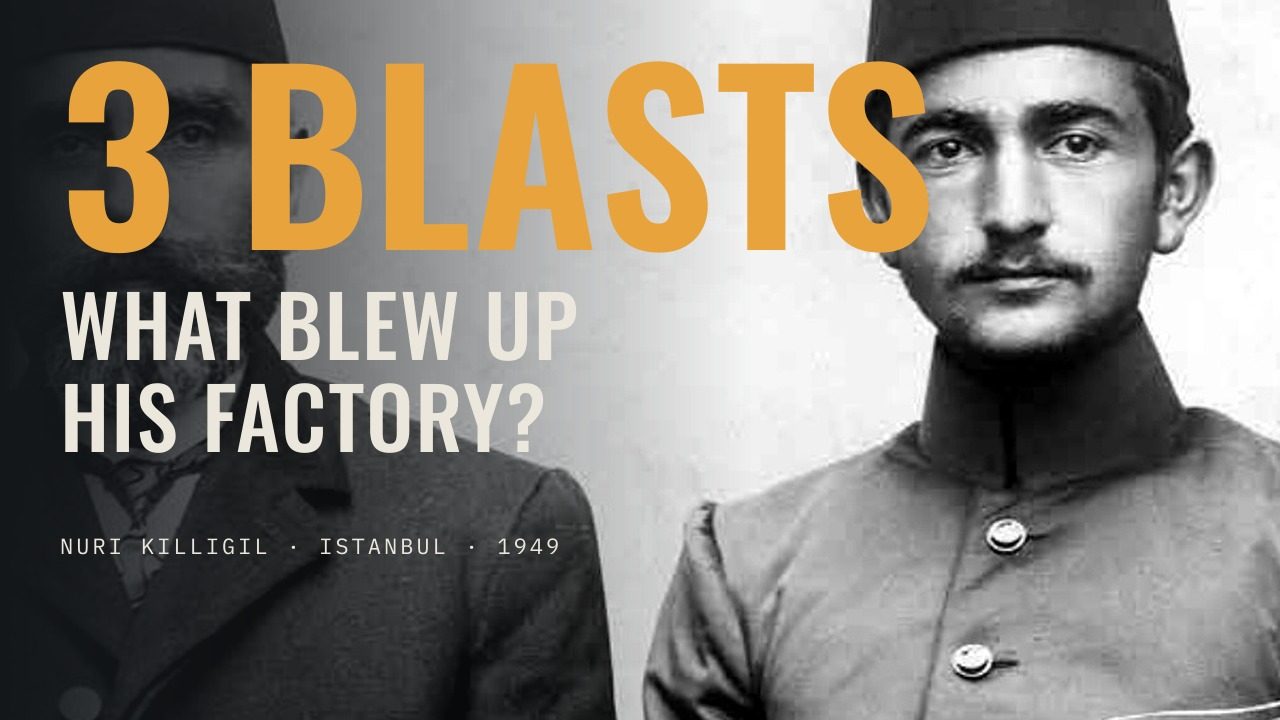
On 2 March 1949, three explosions tore through a weapons factory in Sütlüce, on the Golden Horn in Istanbul. Between 27 and 35 people died, depending on the source — workers, firefighters, and the owner himself: Nuri Killigil, the younger brother of Enver Pasha, a former Ottoman general who had fought in Libya, commanded the Islamic Army of the Caucasus that took Baku in 1918, and later became one of the first arms makers of the Turkish Republic. His body was never found. The cause of the explosion was never established.
▶ Full story, transcript and sources: https://fadedpin.vercel.app/stories/nuri-killigil-explosion-istanbul-1949
This video tries to tell all sides of his life: in Azerbaijan he is remembered as the "Conqueror of Baku"; in Armenian memory his name is tied to the September Days of 1918, when thousands of Armenian civilians were killed. Theories of sabotage are presented as theories — no evidence for them has ever been made public.
På svenska
Nuri Killigil: Explosionen 1949 som dödade Envers bror
Den 2 mars 1949 skakades en vapenfabrik i Sütlüce vid Gyllene hornet i Istanbul av tre explosioner. Mellan 27 och 35 människor dog, beroende på källa – arbetare, brandmän och ägaren själv: Nuri Killigil, Enver pashas yngre bror, en före detta osmansk general som stridit i Libyen, lett den islamiska Kaukasusarmén som intog Baku 1918 och senare blev en av den turkiska republikens första vapentillverkare. Hans kropp hittades aldrig, och orsaken till explosionen fastställdes aldrig.
Türkçe
Nuri Killigil: Enver Paşa’nın Kardeşini Öldüren 1949 Patlaması
2 Mart 1949'da İstanbul'da, Haliç kıyısındaki Sütlüce'de bir silah fabrikası art arda üç patlamayla yıkıldı. Kaynağa göre 27 ile 35 arasında kişi hayatını kaybetti: işçiler, itfaiyeciler ve fabrikanın sahibi Nuri Killigil. Enver Paşa'nın kardeşi olan Nuri Paşa Libya'da savaşmış, 1918'de Bakü'yü alan Kafkas İslam Ordusu'na komuta etmiş, Cumhuriyet döneminde ise ilk silah üreticilerinden biri olmuştu. Cesedi hiç bulunamadı, patlamanın nedeni de hiçbir zaman kesin olarak belirlenemedi.
Chapters
- 0:00Three explosions
- 1:02Enver's brother
- 1:35Libya
- 2:23The Caucasus
- 3:13The September Days
- 4:05Arrest and escape
- 4:59The businessman
- 5:54The Second World War
- 6:30Sütlüce
- 6:56The explosion
- 7:42The empty coffin
- 8:27What happened?
- 9:19The theories
- 10:112016
- 10:44Three memories
- 11:23Closing
The full story
On the afternoon of the second of March, nineteen forty-nine, people along the Golden Horn in Istanbul heard an explosion.
Then a second one. Then a third.
Across the water, in the district of Sütlüce, a factory was burning. It was not an ordinary factory. It made weapons. Mortars, shells, aircraft bombs.
When the fire was finally out, dozens of people were dead. Among them was the owner, a former Ottoman general. His body was never found.
His name was Nuri Killigil. In Azerbaijan, he is remembered as a liberator. In Armenia, very differently. And in Turkey, people still argue about who, or what, blew up his factory.
Nuri was born in Manastır, a city in the Ottoman Balkans. Today it is Bitola, in North Macedonia.
He came from a military family. And his brother was one of the most powerful men the late Ottoman Empire ever produced: Enver Pasha.
Enver was one of the three leaders who ran the empire during the First World War. He was Minister of War. And he brought his younger brother with him, into the empire's last great wars.
Nuri's first war was in North Africa.
In nineteen eleven, Italy invaded Libya, then an Ottoman province. The empire could not send a large army across the sea. Instead, it sent officers, many of them young, to organise the local tribes and fight a guerrilla war. Nuri was one of them.
A few years later, during the First World War, he went back. From nineteen fifteen, he worked with local forces in Libya against the Italians and the British. By nineteen seventeen, he was in command of all the Ottoman groups in Africa.
It was a hard, remote war, far from the main battlefields. But it made him an experienced commander.
In nineteen eighteen, the Russian Empire collapsed in revolution. Suddenly, the Caucasus, between the Black Sea and the Caspian, was open.
Enver gave his brother a new army: the Islamic Army of the Caucasus. Its goal was the city of Baku, on the Caspian Sea, the centre of one of the richest oil regions in the world. It was held by a mix of Bolshevik, Armenian and, at the end, British forces.
On the fifteenth of September, nineteen eighteen, Nuri's army took Baku.
In Azerbaijan, this is remembered as a liberation. Baku became the capital of the new Azerbaijani republic, and to this day, Nuri is honoured there as the Conqueror of Baku.
But there is another side to that day.
Earlier in nineteen eighteen, in the so-called March Days, thousands of Muslims and Azerbaijanis had been killed in Baku by Bolshevik and Armenian forces.
When the Ottoman army entered the city in September, the violence turned the other way. In the days that followed, Armenian civilians were massacred. Historians estimate that between ten thousand and thirty thousand people were killed. Local irregular fighters carried out much of the killing, but Ottoman regular troops took part too.
Nuri was the commander of the army that took the city. In Azerbaijan, he is a hero. For Armenians, his name is tied to one of the darkest days in Baku's history.
Only weeks later, the Ottoman Empire lost the war.
Nuri was arrested by the British, who held him as a prisoner for his role in the war. But in August nineteen nineteen, with the help of supporters, he escaped. He made his way to Erzurum, in eastern Anatolia.
There, the next war had already begun: the Turkish War of Independence. Nuri joined the forces on the eastern front.
In nineteen twenty-nine, the new Republic of Turkey awarded him the Medal of Independence.
His brother Enver was not so lucky. He had fled to Central Asia, and was killed there in nineteen twenty-two.
After the wars, Nuri did something unusual for a former general. He became an industrialist.
In the nineteen-thirties, he bought a coke and coal company in Zeytinburnu, on the shore of the Sea of Marmara, just outside the old walls of Istanbul. He turned it into a metal works.
At first, it made ordinary things. Iron rods. Water canteens. Metal goods.
But Nuri knew war, and he knew weapons. Soon, the factory was also making ammunition. Then pistols.
He designed a nine-millimetre pistol, often called the Nuri pistol. It was one of the first handguns developed in the Turkish Republic. Only a small number were made. One of them can still be seen today in the Military Museum in Istanbul.
During the Second World War, Turkey stayed neutral. But Nuri had his own plans.
Like his brother before him, he dreamed of uniting the Turkic peoples of the Soviet Union, in the Caucasus and Central Asia. And during the war, he made contact with Nazi Germany, which was then fighting the Soviet Union.
He put these ideas to German diplomats and officials, and spent time in Germany during the war. In the end, nothing came of these plans. And after the war, Nuri went back to his factory.
In nineteen forty-six, he expanded. He moved his production to a larger site in Sütlüce, on the northern shore of the Golden Horn, in the middle of Istanbul.
Now the factory made heavier weapons. Mortars. Mortar shells. Artillery ammunition. Aircraft bombs.
A weapons factory, full of explosives, in a crowded city.
On Wednesday, the second of March, nineteen forty-nine, in the late afternoon, the first explosion went off.
It was followed by two more. Three huge explosions, one after the other. A fire spread through the factory, and through the stores of explosives and ammunition.
In the neighbourhood around the factory, people panicked. Smoke rose over the Golden Horn.
Firefighters rushed to the scene.
When it was over, the factory was destroyed. The number of dead differs from source to source, between twenty-seven and thirty-five people. Workers. According to one account, firefighters too. And Nuri Killigil himself.
Nuri's body was never found.
He was buried in the Edirnekapı Martyrs' Cemetery in Istanbul, next to the old city walls. But the coffin was symbolic. As far as anyone knows, it was empty.
A man who had survived Libya, the Caucasus, a British prison and the Turkish War of Independence, had been killed in his own factory, in the middle of Istanbul, in peacetime.
So what caused the explosion?
The honest answer is: nobody knows. The official investigation never established a cause. It went into the records as an explosion of unknown origin.
There were other questions too. Years later, the investigative journalist Uğur Mumcu wrote about the factory in his research on the nineteen-forties. According to his account, the company had told the state insurance agency that it would not produce war material. After the explosion, it became clear that grenades and mortars had been made there.
So, was it an accident? A weapons factory, full of explosives, handled in a hurry, in a crowded city? Accidents like that have happened many times, all over the world.
Or was it something else?
Nuri had enemies. He was the brother of Enver Pasha. He had fought the British, the Russians and the Armenians. He sold weapons abroad. And during the war, he had dealt with Nazi Germany.
In Turkey, rumours of sabotage began almost immediately. Some claimed that foreign intelligence services had planted a bomb. One theory, still repeated in Turkish newspapers today, points to Israel. Turkey officially recognised the new State of Israel only weeks after the explosion, in March nineteen forty-nine.
But it's important to be clear. No evidence has ever been presented that the explosion was sabotage. Not by Israel, and not by anyone else. It remains a theory.
For decades, Nuri Killigil was largely forgotten in Turkey.
That changed in the twenty-first century. In twenty sixteen, his grave in Istanbul was restored, and a funeral prayer was finally held for him, sixty-seven years after his death. Turkish and Azerbaijani officials came to the ceremony.
In recent years, his name has even appeared in speeches by Turkey's president, as a pioneer of the Turkish defence industry.
So who was Nuri Killigil?
In Azerbaijan, he is the general who took Baku, and helped create the first Azerbaijani republic.
In Armenian memory, he is the commander of the army that entered Baku in September nineteen eighteen, when thousands of Armenian civilians were killed.
In Turkey, he is a war hero, the brother of Enver Pasha, and the man who tried to build weapons in Istanbul long before the country had a real defence industry.
All of these are part of the same life.
Today, the shore at Sütlüce looks very different. Few of the people who pass by know that a weapons factory once stood there, or that one March afternoon in nineteen forty-nine, it exploded three times.
The fire took the factory, the workers, the firefighters, and the general. And it took the answer to the question everyone still asks.
What really happened that day on the Golden Horn?
Sources and credits
Sources
- Wikipedia, "Nuri Killigil" (English and Turkish), "September Days", "Enver Pasha's Rebellion", "Israel–Turkey relations"
- Küre Ansiklopedi, "Nuri Killigil"
- Milliyet, "İlk silah fabrikasını kurdu ama mezarı boş!"
- Bianet, "Tarihte bugün" (2 March), citing Uğur Mumcu, "40'ların Cadı Kazanı"
- Alp Yenen, "Killigil, Nuri", 1914-1918-online. International Encyclopedia of the First World War
- Sanayi Gazetesi; Sözcü
Photographs and maps
- Enver, Ahmet and Nuri, 1909; Nuri Pasha, Yeni Kafkasya 1924; Islamic Army of the Caucasus, 1918; Baku oil fields, 1910s — public domain
- Enver Pasha, 1915 — C. Pietzner, public domain
- Italo-Turkish War, 1911 — Agence Rol and press photographs, Bibliothèque nationale de France (Gallica), public domain; Western Cyrenaica sketch map, 1913 — public domain
- Franz von Papen, 1936 — Bundesarchiv, Bild 183-S00017, CC BY-SA 3.0 DE
- Golden Horn, Sütlüce, Edirnekapı Martyrs' Cemetery and the Military Museum today — Wikimedia Commons contributors, CC BY-SA 3.0 / 4.0
- Maps: "Mediterranean Basin", US government, 1950s (public domain); "Istanbul-Constantinople", Service Topo du C.O.F.C., July 1922 (Gallica, public domain). Route lines are schematic.
Related stories on Faded Pin:
- Adnan Menderes: https://youtu.be/9VVnHkV2wrM
- Remzi Oğuz Arık: https://youtu.be/aH_yqCVAPc4
Related stories