TCG Dumlupınar: The Voice from the Buoy — Dardanelles, 1953
Watch on YouTube Subscribe to Faded Pin
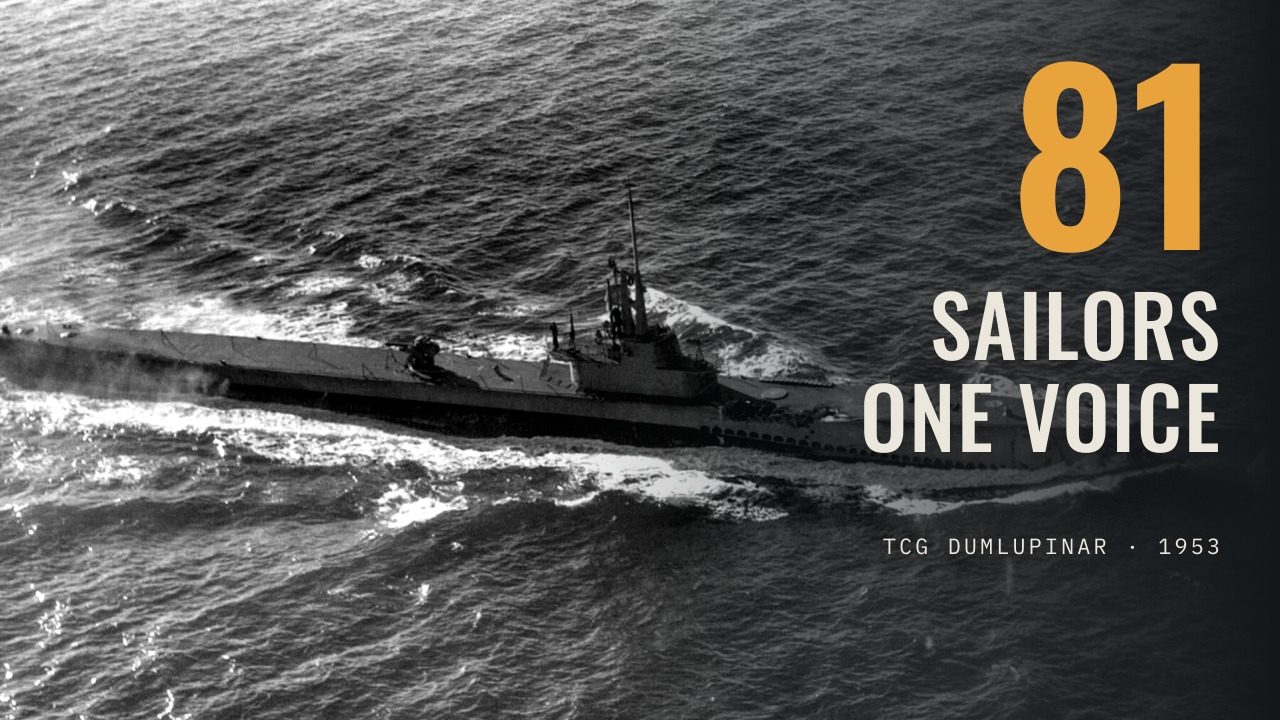
TCG Dumlupınar was a Turkish submarine — the former USS Blower — returning from a NATO exercise when, a little after two in the morning on 4 April 1953, the Swedish cargo ship Naboland struck her in the Dardanelles, off Nara Burnu. Five men on deck survived. Twenty-two men were alive in the rear torpedo room, and released a telephone buoy. In the morning, a customs boat engineer lifted the receiver — and a calm voice answered from the seabed. This documentary tells the true story of the voice from the buoy, the rescue attempts, "Vatan sağ olsun", and how Turkey still remembers the 81 sailors every 4 April.
▶ Full story, transcript and sources: https://fadedpin.vercel.app/stories/tcg-dumlupinar-submarine-disaster-1953
På svenska
Ubåten Dumlupınar: Rösten från bojen — Dardanellerna, 1953
TCG Dumlupınar var en turkisk ubåt – tidigare USS Blower – på väg hem från en Natoövning när det svenska lastfartyget Naboland kolliderade med henne i Dardanellerna, vid Nara Burnu, strax efter klockan två på natten den 4 april 1953. Fem män på däck överlevde. Tjugotvå män levde i det aktre torpedrummet och släppte upp en telefonboj. På morgonen lyfte en maskinist på en tullbåt luren – och en lugn röst svarade från havsbotten. Dokumentären berättar om rösten från bojen, räddningsförsöken och hur Turkiet än i dag minns de 81 sjömännen varje 4 april.
Türkçe
Dumlupınar Denizaltısı: Şamandıradan Gelen Ses — Çanakkale, 1953
TCG Dumlupınar, NATO tatbikatından dönen bir Türk denizaltısıydı (eski USS Blower). 4 Nisan 1953 gecesi saat ikiyi biraz geçe, Çanakkale Boğazı'nda Nara Burnu açıklarında İsveç bandıralı yük gemisi Naboland ile çarpıştı. Güvertedeki beş kişi kurtuldu. Kıç torpido dairesinde hayatta kalan 22 denizci telefon şamandırasını yüzeye bıraktı. Sabah bir gümrük motorunun çarkçısı telefonu açtı ve deniz dibinden sakin bir ses cevap verdi. Bu belgesel şamandıradan gelen sesi, kurtarma çabalarını, "Vatan sağ olsun" sözünü ve 81 denizcinin her 4 Nisan'da nasıl anıldığını anlatıyor.
Chapters
- 0:00The buoy
- 0:48The submarine
- 2:27The strait
- 3:12The collision
- 4:32The rear torpedo room
- 5:20The voice
- 6:15The rescue
- 7:11Waiting
- 7:50"Vatan sağ olsun"
- 8:45Sweden
- 10:32Remembrance
- 11:48A voice
The full story
On the morning of the fourth of April, nineteen fifty-three, a small customs boat in the Dardanelles found a strange object floating in the water. A buoy, painted and marked, with a cover on top.
A note on the buoy asked whoever found it to open the cover.
Inside was a telephone.
The engineer of the customs boat lifted the receiver and said: "Hello?"
And a calm voice answered him. From a submarine lying on the seabed, more than eighty metres below.
The submarine was called Dumlupınar. She had been built in the United States during the Second World War, as the USS Blower, and had made three war patrols in the waters of South-East Asia.
Her war record was modest. In February nineteen forty-five she fired six torpedoes at a Japanese battleship and two cruisers. Her crew believed they had scored hits, but Japanese records show no damage. In July, she fired at a Japanese submarine, and her crew heard only duds.
In the autumn of nineteen fifty, a Turkish crew came to the American submarine base at New London, in Connecticut, to learn how to run her. In November, under an American military aid programme, she was handed over to Turkey. A month later, she arrived in her new home waters. She was given the name of a famous battle from the Turkish War of Independence. Dumlupınar.
In the spring of nineteen fifty-three, Dumlupınar took part in a large NATO exercise in the Mediterranean, together with the American Sixth Fleet. Turkey had joined NATO only a year before. For a young submarine crew, it was an important moment.
At the beginning of April, the exercise was over. Dumlupınar and her sister submarine, Birinci İnönü, set course for home. Home was the naval base at Gölcük, on the Sea of Marmara. To get there, they had to pass through the Dardanelles.
The Dardanelles is a narrow strait, sixty kilometres long, between Europe and Asia. Its most dangerous point is a sharp bend near the town of Çanakkale, at a cape called Nara Burnu. There, the strait is little more than a kilometre wide, and the current is strong.
On the night of the third of April, Dumlupınar was travelling on the surface. A little after two in the morning, she entered the strait and approached Nara.
It was dark. There was fog. On the submarine's bridge, a lookout saw the lights of a ship ahead. The officers could not see it.
Coming the other way, out of the strait, was a Swedish cargo ship. Her name was Naboland.
According to the Turkish historian Mithat Atabay, there was confusion on the submarine's bridge in the last moments. Different steering orders were given. Then the commander, Sabri Çelebioğlu, shouted that they were about to be hit, and ordered full speed astern.
It was too late. The bow of the Naboland struck Dumlupınar on her right side, near the front torpedo room. The cargo ship pushed the submarine down and passed over her.
Water rushed into the front of the submarine. An explosion and a fire in the control room cut all electric power. Within seconds, Dumlupınar went down, bow first.
Eight men had been standing on deck and on the bridge. They were thrown into the sea. Two were killed by the ship's propeller. One, Petty Officer Şaban Mutlu, was carried away by the current and drowned.
Five survived. The commander, Sabri Çelebioğlu. Two lieutenants, Kemal Ünver and Hasan Yumuk. And two navigation petty officers, Hüseyin İnkaya and Hüseyin Akış.
Everyone else was inside the submarine.
In the dark, the men below tried to reach the back of the boat, away from the water. Many did not make it.
Twenty-two of them reached the rear torpedo room and sealed themselves in. The submarine lay on the bottom, tilted to one side, at a depth of about eighty-five metres.
Submarines like Dumlupınar carried a special rescue buoy, connected to the boat by a long cable, with a telephone inside. The men in the torpedo room released it. It rose to the surface, and floated there, in the current, waiting for someone to find it.
On the shore at Eceabat, a customs officer named Hakkı Vural had seen something from his window: the lights, the collision. He raised the alarm. Boats went out into the dark, and heard voices in the water.
At about eight in the morning, the customs launch found the buoy. Its second engineer, Selim Yoludüz, opened the cover, lifted the telephone, and spoke.
The voice that answered belonged to Petty Officer Selami Özben.
He reported, clearly and calmly, what had happened below. The submarine was lying on her side, leaning about fifteen degrees. There was no electricity. And twenty-two men were alive in the rear torpedo room.
Soon, officers from the naval command in Çanakkale came out and took the phone, and spoke to the men below themselves.
The navy's rescue ship, Kurtaran, arrived at around eleven in the morning. Destroyers and smaller boats gathered above the wreck. The admiral and the governor of Çanakkale came to oversee the work.
But the conditions were brutal. The water was deep, and the current at Nara is one of the strongest in the strait. Divers went down again and again. According to Atabay, they made eleven dives. They could not attach the rescue bell to the submarine.
The last diver reached about eighty-seven metres. He lost consciousness, and had to be pulled up. He survived only after many hours in a pressure chamber.
And then, in the afternoon, the line went dead. The cable that held the buoy to the submarine broke. From that moment, nobody on the surface could hear the men below.
The rescue did not stop. The United States offered help, and American specialists with deep-diving equipment flew in. They studied the situation. But at that depth, in that current, with the technology of nineteen fifty-three, there was little anyone could do.
The men in the torpedo room had air for a limited time. As the hours passed, the carbon dioxide in the sealed compartment would rise.
On the seventh of April, three days after the collision, the navy announced that there was no longer any hope. All eighty-one men who had not come up were declared dead.
In Turkey, one phrase from the telephone conversations became part of the national memory. According to the reports, among the last words from the submarine were: "Vatan sağ olsun."
It is hard to translate. Literally, it means: "May the homeland be well." Turks say it about a sacrifice. It means something like: "It was worth it, as long as the country lives."
Whether those were exactly the last words, nobody can know. But the people on the surface remembered the voice of Selami Özben as steady, without fear, to the end.
For Sweden, too, this was a tragedy. The Swedish ambassador in Ankara, Adolf Croneborg, sent his government's condolences.
A few days later, a memorial ceremony was held at sea, aboard the warship Başaran, above the place where Dumlupınar lay. Naval officers, students and journalists stood on the deck.
The commander of the Turkish submarine flotilla, Fahri Korutürk, spoke to the men below. "This is my last message to you," he said. Twenty years later, the same man would become President of Turkey. The Swedish ambassador was there too. According to Atabay, he spoke in Turkish.
The captain of the Naboland, Oscar Lorentzon, said that in the darkness he had seen two lights, and thought they belonged to a small motorboat. He said he turned only seconds before the collision.
He also said that his crew had sent out a distress call, turned on their searchlights, thrown life jackets into the water and lowered their boats. One of the men pulled out of the water that night was, according to Turkish sources, the submarine's commander, rescued by a lifeboat from the Naboland.
According to Turkish sources, he was put on trial in Turkey. The court found him negligent and convicted him, but reduced his sentence, and he was sent home to Sweden. For many families in Turkey, the punishment felt far too light.
The disaster also changed the strait. The authorities pushed for ships to take local pilots when passing through at night, and the warning systems in the Dardanelles were improved.
The Turkish parliament declared the eighty-one men martyrs who had died on duty. Their families received pensions.
The fourth of April became the Day of Remembrance for Naval Martyrs in Turkey. Every year, on that day, ships gather at Nara. Wreaths are laid on the water, and a moment of silence is held, while the sirens sound.
They also remember another submarine, the Atılay, which was lost near the Dardanelles in nineteen forty-two. Two crews, two names, in the same waters.
On the shore at Nara Burnu, there is a monument. It carries the eighty-one names, and a copy of the telephone buoy. In the naval museum in Istanbul, there is another buoy like it.
The submarine was never raised. She still lies at the bottom of the Dardanelles, at about eighty-five to ninety metres, with her crew inside. A war grave, in a strait where ships pass every day.
Two of the five survivors, the navigation petty officers Hüseyin İnkaya and Hüseyin Akış, lived into old age. For decades, they were the last living witnesses of that night.
Many disasters at sea are remembered by a number. A date. A list of names.
Dumlupınar is remembered by a voice. A young petty officer, on a telephone at the bottom of the sea, telling the people above what had happened, and how many were still alive, and that they were waiting.
Up on the surface, they did everything they could. It was not enough.
On the fourth of April every year, in the Dardanelles, Turkey still listens.
Sources and credits
Sources
- Dr. Mithat Atabay, "Çanakkale Boğazı'nda Bir Kaza: Dumlupınar Faciası"
- Küre Ansiklopedisi, "Dumlupınar Submarine Disaster" (incl. F. Batur 2023; Y. Semiz; TRT; Anadolu Ajansı)
- Devrim Yaylalı, "Lest We Forget: TCG Dumlupınar"
- Türkiye Gazetesi, Milliyet, Hürriyet, TRT Haber, Hürriyet Daily News
Photographs and maps
- USS Blower (SS-325), 1944 — U.S. Navy, public domain
- Rear Admiral Fahri Korutürk, c. 1950 — public domain
- Submarine telephone buoys: HMS Nordkaparen, Gothenburg Maritime Museum (CC BY-SA 3.0); Hanko Front Museum (public domain)
- Inside a similar submarine: USS Cod (Wikimedia Commons, CC BY 2.0)
- The Dardanelles near Eceabat — Wikimedia Commons, CC BY 3.0
- Map: U.S. Army Map Service, Turkey 1:200,000, Sheet C 2 Canakkale (1943), public domain, via University of Texas Libraries
Related stories on Faded Pin:
- Kalabaliken i Bender: https://youtu.be/3d6v5fF5oCg
- The Catalina Affair: https://youtu.be/G5SFJw4qk_I
Related stories