Remzi Oğuz Arık: The Archaeologist Who Never Landed — Adana, 1954
Watch on YouTube Subscribe to Faded Pin
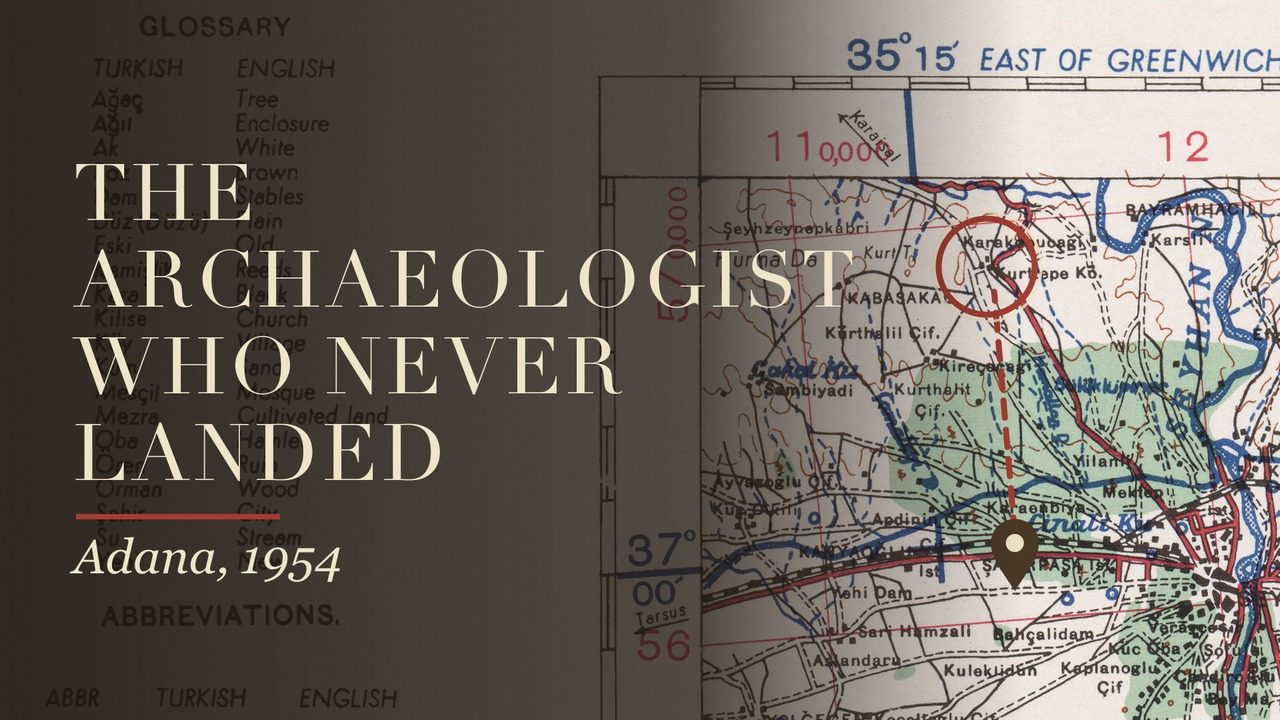
In 1935, archaeologist Remzi Oğuz Arık led the first national excavation at Alacahöyük in central Anatolia. Nineteen years later — now a member of parliament and the founder of the Turkish Villagers' Party — he boarded a Turkish State Airlines (Devlet Hava Yolları) DC-3 in Adana, bound for Ankara. Less than ten minutes after takeoff, near the village of Kurttepe, the aircraft exploded in mid-air. All 25 people on board were killed. The cause was never determined.
▶ Full story, transcript and sources: https://fadedpin.vercel.app/stories/remzi-oguz-arik-adana-plane-crash-1954
Content note: describes a fatal air accident and names people who died in it. No graphic imagery.
På svenska
Remzi Oğuz Arık: Arkeologen som aldrig landade — Adana, 1954
År 1935 ledde arkeologen Remzi Oğuz Arık den första nationella utgrävningen vid Alacahöyük i centrala Anatolien. Nitton år senare, nu riksdagsledamot och grundare av Turkiska bondepartiet, steg han ombord på ett DC-3-plan från Turkiets statliga flygbolag (Devlet Hava Yolları) i Adana, på väg till Ankara. Mindre än tio minuter efter starten exploderade planet i luften nära byn Kurttepe. Alla 25 ombord omkom. Orsaken fastställdes aldrig.
Türkçe
Remzi Oğuz Arık: Hiç İnemeyen Arkeolog — Adana, 1954
1935'te arkeolog Remzi Oğuz Arık, Orta Anadolu'da Alacahöyük'teki ilk millî kazıyı yönetti. On dokuz yıl sonra, artık milletvekili ve Türkiye Köylü Partisi'nin kurucusuyken, Adana'da Ankara'ya gidecek bir Devlet Hava Yolları DC-3'üne bindi. Kalkıştan on dakika geçmeden, Kurttepe köyü yakınlarında uçak havada infilak etti. İçindeki 25 kişinin hepsi hayatını kaybetti. Kazanın nedeni hiçbir zaman belirlenemedi.
Chapters
- 0:00Alacahöyük, 1935
- 0:29From Kozan to Paris
- 0:53The excavations
- 1:16Parliament and a new party
- 1:48April 3, 1954
- 2:09The flight
- 2:31No survivors
- 2:47The election
- 2:56Kozan – Kurttepe
The full story
In the summer of 1935, on a low mound in central Anatolia called Alacahöyük, a Turkish archaeologist began to dig.
His name was Remzi Oğuz Arık. That season, he led the first national excavation at the site — a dig the young Turkish Republic wanted the world to see.
Nineteen years later, he boarded a plane that never reached Ankara.
Arık was born in 1899, in Kabaktepe, a village near Kozan, in the province of Adana.
In 1926, he went to Paris. For five years, he studied archaeology and art history. When he came home in 1931, Turkey had very few archaeologists of its own. He became one of the first.
He dug at Karalar, near Ankara. At Göllüdağ. And at Alacahöyük — a site that would go on to yield some of Anatolia's most famous Bronze Age treasures.
He founded a museum in Manisa. He taught at Ankara University. And in the nineteen-forties, he ran the city's archaeology and ethnography museums.
Then, in 1950, he left the university for politics. His home province, then called Seyhan, elected him to parliament for the Democrat Party.
Two years later, he broke away. In May 1952, he founded a party of his own: the Turkish Villagers' Party.
By the spring of 1954, a general election was only weeks away. And Arık was campaigning in Adana, the region where he was born.
On Saturday, April 3rd, 1954, he boarded a flight back to Ankara.
The aircraft was a Douglas DC-3 of Devlet Hava Yolları, Turkey's State Airlines — the company that would be renamed Turkish Airlines a year later. Registration: TC-ARK.
It left Adana at 1:40 in the afternoon, with twenty-five people on board.
Less than ten minutes later, still climbing, it exploded in mid-air.
The wreckage came down near the village of Kurttepe, just northwest of the city, scattered across some fifteen kilometers.
There were no survivors. Three crew. Twenty-two passengers.
What caused the explosion was never determined. Not then. Not since.
It was the first major disaster in Turkish civil aviation.
Four weeks later, Turkey went to the polls. Without its founder, the Turkish Villagers' Party did not win a single seat.
Remzi Oğuz Arık was buried in Ankara. His gravestone records where his life began — Kozan, Kabaktepe. And where it ended — Adana, Kurttepe. April 3rd, 1954.
Today, schools in Adana carry his name. So does a neighborhood in Ankara.
He spent his life uncovering Anatolia's past. His own story ended in a field outside Adana, not far from where it began.
Sources and credits
Sources
- TDV İslâm Ansiklopedisi, "Arık, Remzi Oğuz"
- Türk Edebiyatı İsimler Sözlüğü, "Arık, Remzi Oğuz"
- Republic of Türkiye Ministry of Culture and Tourism — Remzi Oğuz Arık; Alacahöyük
- Bureau of Aircraft Accidents Archives — TC-ARK, 3 April 1954
- Turkish Airlines corporate history (Devlet Hava Yolları → Türk Hava Yolları, 1955)
- Wikipedia: Turkish Villagers' Party; 1954 Turkish general election; Alaca Höyük; Adana Şakirpaşa Airport
Maps
- Adana and Çorum sheets, 1:200,000, U.S. Army Map Service, 1943 — University of Texas Libraries (Perry-Castañeda Library Map Collection)
- Locator map: Faded Pin · Natural Earth
Photos
- Alacahöyük, 1993 — Mark Landon, CC BY 4.0
- Alacahöyük, 2005 — Stipich Béla, CC BY 2.5
- The Sorbonne, 1920 — Agence Rol, Bibliothèque nationale de France (public domain)
- Courtyard behind the Sorbonne — Eugène Atget (public domain)
- Ankara, 1930s–1950s — Turkey in Photographs, DGPI Archive (no known copyright restrictions)
- Douglas DC-3, 1950 (same aircraft type, not the accident aircraft) — U. A. Saarinen, Finnish Heritage Agency, CC BY 4.0
- Grave of Remzi Oğuz Arık — Geraslan06, Wikimedia Commons, CC0
- Ankara — Hüseyin Öcal, CC BY 3.0
Related stories on Faded Pin:
- Adnan Menderes: https://youtu.be/9VVnHkV2wrM
- Nuri Killigil: https://youtu.be/JoY19CHB7VE
Related stories