Why Didn't Hitler Invade Sweden? The Secret 1943 Plan
Watch on YouTube Subscribe to Faded Pin
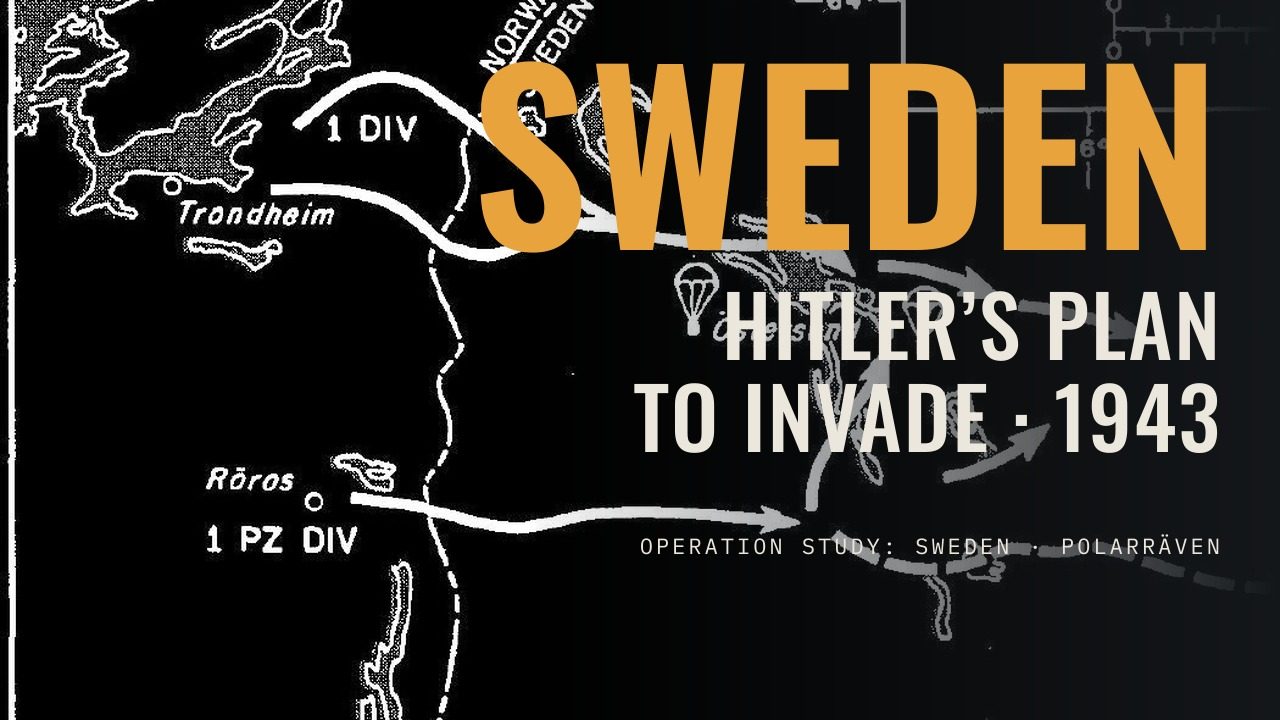
Why didn't Hitler invade Sweden? In 1943, the German army in Norway secretly prepared "Operative Studie Schweden" – a plan to attack neutral Sweden from Trondheim and Røros toward Östersund and the Gulf of Bothnia, and through Värmland and Dalarna toward Stockholm. In Sweden it is known as Operation Polar Fox – Polarräven. This documentary tells the story of the plan, the general who wrote it, and why it was never carried out.
▶ Full story, transcript and sources: https://fadedpin.vercel.app/stories/operation-polarfuchs-hitler-plan-invade-sweden-1943
Built on the original German records as summarised by the US Army historian Earl F. Ziemke (1959) and by Paolo Pozzato and Martin Samuels (2022).
På svenska
Därför anföll Hitler aldrig Sverige – planen från 1943
Varför anföll Hitler aldrig Sverige? Våren 1943 utarbetade den tyska armén i Norge i hemlighet "Operative Studie Schweden" – en plan för anfall mot Sverige från Trondheim och Røros mot Östersund och Bottenviken, och genom Värmland och Dalarna mot Stockholm. I Sverige är den känd som Polarräven. Dokumentären berättar om planen, generalen som skrev den och varför den aldrig genomfördes.
Chapters
- 0:00A revelation in 1946
- 0:55The useful neutral
- 1:55The tide turns
- 2:45An order
- 3:35The general from Fort Benning
- 4:25The plan
- 5:39Too few troops
- 7:00The panzers leave
- 7:58The wrong name
- 9:06Why Sweden was spared
The full story
In June nineteen forty-six, a year after the war ended, the Soviet army newspaper Red Star published a sensational article.
Its source was a German general, now a prisoner of the Soviets. He revealed that in nineteen forty-three, Nazi Germany had prepared a plan to invade neutral Sweden.
The article was soon translated, and reprinted abroad.
Sweden had stayed out of the war. Most Swedes believed they had been lucky. Now they learned how close the war may have come.
So why didn't Hitler invade Sweden? The answer is in the plan itself.
When Germany occupied Denmark and Norway in April nineteen forty, Sweden was left alone in the middle of Scandinavia.
For Hitler, a neutral Sweden was useful. Sweden sold Germany iron ore from its northern mines. It sold ball bearings, a vital part of every tank, plane and truck. And it allowed German soldiers and equipment to travel by train across Swedish territory.
In the summer of nineteen forty-one, a whole German infantry division crossed Sweden by rail, from Norway to Finland.
But Sweden was also listening. Many German messages passed through Swedish telegraph lines. And Swedish mathematicians had broken the German code machine. Stockholm could read much of what Germany said about its troops in Norway.
Neutrality was a balancing act. And by nineteen forty-three, the balance was shifting.
At the end of nineteen forty-two, Germany's luck ran out. The Western Allies landed in North Africa. Rommel was beaten at El Alamein. A whole German army was trapped at Stalingrad.
Swedish leaders could see where the war was heading. Sweden began to move, carefully, toward the Allies.
In Berlin, Hitler worried about the north. He was convinced that Britain and America would land in Norway. And if they did, he feared that Sweden might open its borders to them, or even join them.
Churchill did dream of invading Norway. But his generals refused, again and again. Still, Hitler believed it. And when Hitler believed something, his generals had to plan for it.
Germany's army in Norway was commanded by General Nikolaus von Falkenhorst. His chief of staff was General Rudolf Bamler.
On the tenth of February, nineteen forty-three, the Army of Norway sent a top secret order to one man: General Adolf von Schell, commander of the new twenty-fifth Panzer Division.
The order was clear. If the British and Americans landed in Scandinavia and pushed into Sweden, and if Sweden could not, or would not, defend itself, Germany had to be ready to strike first, and fast.
Schell's division had been built in Norway for exactly that kind of task. It was the armoured fist that would lead an attack on Sweden.
Schell had an unusual past. In nineteen thirty, as a young German officer, he was sent to study at the United States Army's infantry school at Fort Benning, in Georgia.
There he became friends with its assistant commandant, George C. Marshall. Marshall later became America's top general in the Second World War.
Marshall admired Schell's experience so much that he had him lecture American officers. Those lectures were published as a book, Battle Leadership. It is still in print today.
Now this same officer was asked to plan the invasion of Sweden.
Schell finished his plan on the thirty-first of March, nineteen forty-three. He called it Operative Studie Schweden. Operation Study: Sweden.
In the north, the target was Östersund, in the province of Jämtland. One infantry division would cross the mountains from Trondheim, in Norway. A panzer division would come in from Røros, further south. Once Östersund had fallen, the troops would push on to the Gulf of Bothnia.
That would cut Sweden in two. It would separate the north, with its iron mines, from the Swedish army in the south.
In the south, a second operation would cross the border into the long river valleys of Värmland and Dalarna, and race toward Stockholm. Small parachute drops and landings from the sea would distract the Swedish defenders.
Schell's idea was speed. Tanks and infantry would leapfrog each other, so that fresh units could keep the advance going day and night.
And he was confident. The Swedish army, he wrote, was unaccustomed to battle, and would not be able to hold against such an attack.
But the plan had a problem. It needed far more troops than Germany had in Norway.
Most of the German divisions there were static units, made to guard the coast. They had neither the vehicles nor the training for a fast war of movement. Even the officers who reviewed Schell's study wrote that a quick occupation of Sweden would need both operations at once, and forces adequate for the purpose.
Hitler promised more. Through the spring of nineteen forty-three, new units and new tanks arrived in Norway. By the summer, the twenty-fifth Panzer Division had grown from a collection of old French and German tanks into a real armoured division.
And Sweden was changing too. In nineteen forty, its army had been weak. By nineteen forty-three, it had trained hard, and Swedish factories were building tanks, guns and aircraft.
In August nineteen forty-three, Sweden ended the German troop transit through its territory.
But the attack never came.
In the summer of nineteen forty-three, the war turned against Germany again. The great tank battle at Kursk failed. The Allies landed in Sicily. Italy was about to leave the war. The German high command now feared an invasion across the English Channel far more than one in Norway.
In the middle of August, Hitler ordered the twenty-fifth Panzer Division out of Norway, to the Channel coast, at top speed.
The Army of Norway noted that its autumn exercises had become, in part, purposeless.
Without its tanks, the plan was dead. Operation Study: Sweden went back into the files.
That December, Bamler himself told his officers that with only two divisions in reserve, an invasion of Sweden would be certain to bog down.
After the war, it was Bamler who revealed the plan to the world, in that Soviet newspaper in nineteen forty-six. He called it Operation Polar Fox. In Sweden, it is still known by that name, Polarräven.
But the name Polar Fox does not appear in the German records. And the Army of Norway had already used it, in nineteen forty-one, for an offensive in Finland. The name most likely came from the article itself.
For decades, historians argued. Some said the plan was only a staff exercise, a way to train a new panzer division. Others believed Hitler really meant to attack.
The original German study survived, in captured German records. And in twenty twenty-two, two historians, Paolo Pozzato and Martin Samuels, compared all the sources.
Their conclusion: the plan was serious, made out of a real fear of an Allied landing. But Germany simply did not have the forces to carry it out.
Today, the road from Trondheim into Jämtland is a quiet tourist route. Hikers and skiers cross the mountains where German tanks were meant to roll.
So why didn't Hitler invade Sweden?
Partly because a neutral Sweden was worth more to Germany than an occupied one. Partly because Sweden grew stronger every year. And partly because, in the summer of nineteen forty-three, Hitler's tanks were needed everywhere at once.
The plan was real. The fear was real. But time had run out for Germany.
Sometimes history is decided not by the battles that happen, but by the ones that never do.
Sources and credits
Sources
- Earl F. Ziemke, The German Northern Theater of Operations 1940–1945, DA Pamphlet 20-271 (US Army, 1959), pp. 253–263 and Map 20
- Paolo Pozzato & Martin Samuels, "German Plans for an Invasion of Sweden in 1943: A Serious Endeavour?", Nuova Antologia Militare 12 (2022)
- Wikipedia, "25th Panzer Division (Wehrmacht)", "Adolf von Schell", "Operation Weserübung's effects on Sweden", "Operation Arctic Fox"
- Svenska militärhistoriska sällskapet (on Schell's plan and the Östersund axis)
Photographs and maps
- Map 20, "Study for an Operation Against Sweden, 1943" — US Army (Ziemke, 1959), public domain
- Adolf von Schell and Nikolaus von Falkenhorst, 1940 — Bundesarchiv, Bild 146-2006-0096 and Bild 183-2006-0529-501, CC BY-SA 3.0 DE
- Åreskutan around 1930; Östersund, 1940s and around 1950; miners in Kiruna, around 1950 — no known copyright restrictions / public domain
- Swedish anti-aircraft gunners, December 1943 — Wikimedia Commons
- Storlien and Åreskutan today — Wikimedia Commons, CC BY 3.0
Related stories on Faded Pin:
- Folke Bernadotte: https://youtu.be/Y1dZuuVdJ-E
- Whiskey on the Rocks: https://youtu.be/0bQj8mZV8sI
Related stories