The Ghost Ship That Drifted the Arctic for 38 Years — SS Baychimo
Watch on YouTube Subscribe to Faded Pin
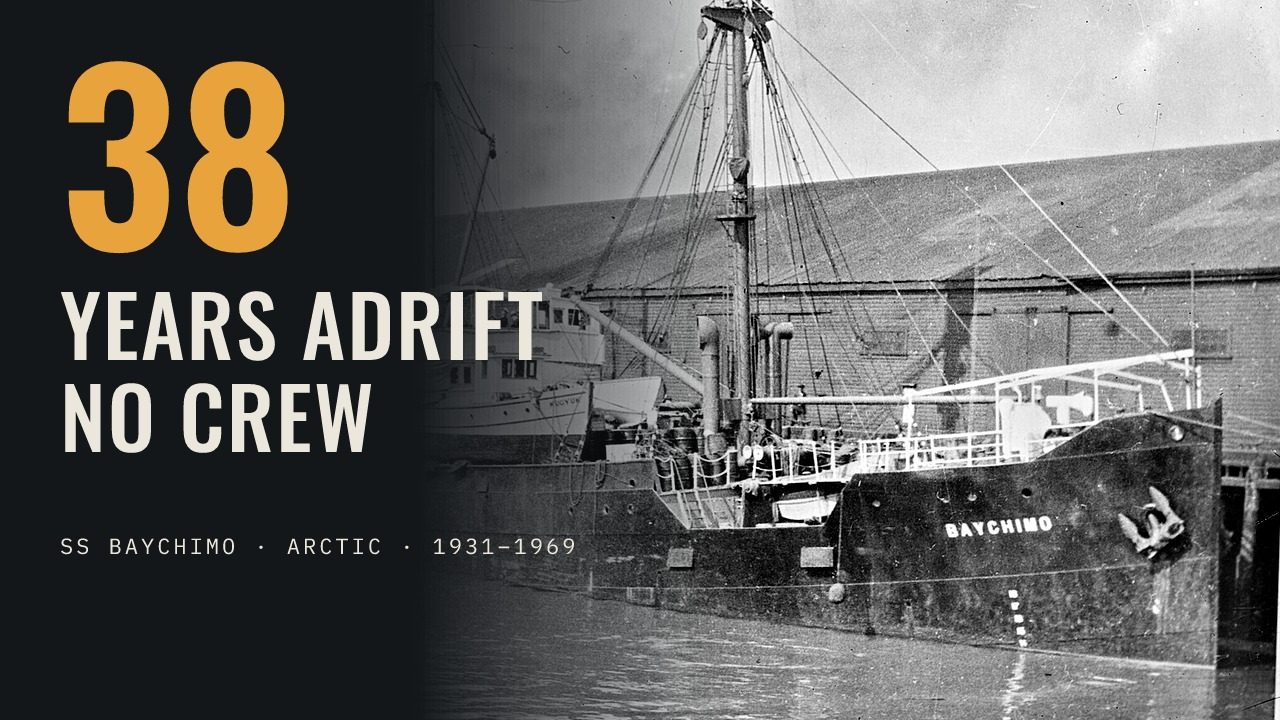
How did a ship with no crew stay afloat in the Arctic for 38 years? In November 1931, the SS Baychimo, a Swedish-built cargo steamer of the Hudson's Bay Company, vanished from the ice off northern Alaska in a three-day blizzard, and her crew believed she had sunk. She hadn't. For decades she was seen again and again, drifting along the coast, boarded by Iñupiat hunters, traders and a Scottish botanist, and never brought home. The last sighting was in 1969. This is the true story of the Baychimo, from a shipyard in Gothenburg to the top of the world — and why the "ghost ship" never sank.
▶ Full story, transcript and sources: https://fadedpin.vercel.app/stories/ss-baychimo-arctic-ghost-ship-1931
Chapters
- 0:00The ship that vanished
- 0:43Built in Gothenburg
- 1:33The Arctic run
- 2:15Trapped in the ice, 1931
- 2:59The blizzard
- 3:5438 years of sightings
- 5:04Why she didn't sink
- 5:50Still out there
The full story
On the twenty-fourth of November, nineteen thirty-one, a blizzard swept across the ice off the northern coast of Alaska. It lasted three days.
When it was over, fifteen men came out of their shelter to look for their ship. She had been frozen into the ice not far away for weeks. Now she was gone.
They assumed she had sunk. It was the obvious answer. But the ship had not sunk. For the next thirty-eight years, people kept seeing her.
The ship's story began far from the Arctic. She was built in nineteen fourteen at a shipyard in Gothenburg, in Sweden, for a company in Hamburg. She was a steel cargo steamer, about seventy metres long, named after a Swedish river: Ångermanelfven.
For her first years, she carried cargo across the Baltic, between Germany and Sweden. Then came the First World War, and Germany's defeat. Under the peace treaty, Germany had to hand over merchant ships to the countries that had lost theirs. The Swedish-built steamer was given to Britain.
In nineteen twenty-one, she was bought by the Hudson's Bay Company, the old fur-trading company of northern Canada. They gave her a new name: Baychimo.
Every summer, the Baychimo sailed from Vancouver, north through the Bering Strait, and along the Arctic coast. She brought food, tools and supplies to the company's trading posts, and came back with a hold full of furs.
It was a race against the ice. The Arctic sea is only open for a few weeks of the year, and her captain, Sidney Cornwell, knew the risks. He wrote to the company that the Baychimo was not strong enough to work through heavy Arctic ice without damage.
In nineteen thirty-one, the season went badly. The ship was late. A blade of her propeller broke. She was running short of coal. And on the way home, near the settlement of Barrow, on the northern tip of Alaska, the ice closed around her.
At the start of October, the Baychimo was frozen in. The crew built a shelter on land, partly from pieces of the ship, and waited for the ice to let her go. It did not.
In the middle of October, the company sent aircraft. Twenty-two people were flown out. Captain Cornwell and fourteen men stayed behind. They planned to spend the winter there, watch over the ship, and free her in the spring.
Then came the storm of the twenty-fourth of November.
When the men could finally go out on the ice again, there was no ship where the Baychimo had been. They believed she had broken up and gone to the bottom.
About a week later, word reached them that she had been seen, still afloat, dozens of miles away. The men made their way to her, took off the most valuable furs, and left her. The company decided she was not worth saving. In February, Cornwell and his men were flown home.
The Baychimo was abandoned. But she had not finished with the Arctic.
The following year, a group of Iñupiat men found the ship and climbed aboard. A storm came up, and the drifting ship carried them away from the shore. They were trapped on board for days before they could get back.
In August nineteen thirty-three, a small trading schooner found the Baychimo locked in the ice near the village of Wainwright. One of its passengers was Isobel Hutchison, a Scottish botanist travelling in the Arctic. She went aboard. Furs and belongings were still on the ship, as if her crew had only just left.
Again and again, people found her. Sometimes they boarded her. Some tried to tow her to shore, or to salvage what was left. Every time, the ice or the weather stopped them.
The sightings grew rarer. One was reported in nineteen sixty-two. And in nineteen sixty-nine, a group of Iñupiat saw a rusting ship frozen into the pack ice, between Icy Cape and Point Barrow. That was thirty-eight years after she had been abandoned. It was the last time anyone reported seeing the Baychimo.
There is no mystery about how a ship with no crew could survive for so long. The Baychimo was a solid steel ship, and the Arctic is a cold, quiet place for a hull. In winter she was frozen into the ice, held almost like a ship in a dry dock. In summer the ice broke up, and the winds and currents carried her along the coast, until the ice froze around her again.
What no one knows is how it ended. She may have been crushed by the ice at last, and sunk. She may have drifted far out into the Arctic Ocean. In two thousand and six, the State of Alaska began a project to locate ships lost off its coast, and the Baychimo was among them. She has never been found.
A cargo ship built in Sweden, to carry cargo across the Baltic, ended up drifting alone along the top of the world for almost four decades.
Her crew left her for dead in nineteen thirty-one. She outlived the company's plans for her, the men who tried to salvage her, and very nearly the century.
Somewhere off the coast of Alaska, on the seabed or under the ice, the Baychimo is still out there.
Sources and credits
Sources
- Anchorage Daily News, "The mysterious fate of the Baychimo, the ghost ship that haunted the Arctic for decades" (29 October 2023), citing the Daily Alaska Empire and Anchorage Daily Times (1932–1934)
- Anthony Dalton, Baychimo: Arctic Ghost Ship (Heritage House, 2006)
- Amelia Fay, "Baychimo: The Adventures of the Ghost Ship of the Arctic", Manitoba Museum (2020)
- Isobel Wylie Hutchison, North to the Rime-Ringed Sun (1934)
- Wikipedia, "SS Baychimo" (and the sources cited there)
- ExplorersWeb, "Exploration Mysteries: The SS Baychimo, 38 Years as a Ghost Ship"
Photographs
- The Baychimo, Agence Rol press photo, 1932 — public domain (Bibliothèque nationale de France, via Wikimedia Commons)
- The Baychimo in the ice; bow (1933), stern and unloading — Hudson's Bay Company collection, Manitoba Museum; public domain in Canada (Wikimedia Commons)
Related stories on Faded Pin:
- Andrée's Balloon Expedition: https://youtu.be/oS-D0zTAv4A
- Ada Blackjack: https://youtu.be/yLBXEk9v_1s
Related stories