Andrée's Balloon Expedition: The Photos That Waited 33 Years in the Ice (1897)
Watch on YouTube Subscribe to Faded Pin
In July 1897, three Swedes — Salomon August Andrée, Nils Strindberg and Knut Frænkel — set out from Svalbard to fly a hydrogen balloon over the North Pole. Within minutes, the plan began to fall apart. They came down on the pack ice, walked for nearly three months, and reached a remote island they would never leave. Thirty-three years later, a Norwegian ship found their last camp — and a box of film that was still waiting to be developed.
▶ Full story, transcript and sources: https://fadedpin.vercel.app/stories/andree-arctic-balloon-expedition-1897
På svenska
Andrées polarexpedition: Bilderna som väntade 33 år i isen (1897)
I juli 1897 lyfte tre svenskar – Salomon August Andrée, Nils Strindberg och Knut Frænkel – från Svalbard i vätgasballongen Örnen för att flyga över Nordpolen. Redan efter några minuter började planen falla sönder. De landade på packisen, vandrade i nästan tre månader och nådde till slut Vitön, en ö de aldrig skulle lämna. Trettiotre år senare hittade ett norskt fartyg deras sista läger – och en låda med film som fortfarande väntade på att framkallas.
Chapters
- 0:00The photographs in the ice
- 0:54A balloon to the North Pole
- 2:18The Eagle
- 3:52Three men
- 4:4411 July 1897
- 6:10Sixty-five hours
- 7:04On the ice
- 9:08The drift
- 10:17White Island
- 10:39Thirty-three years
- 11:33The discovery, 1930
- 12:36The film
- 13:33Homecoming
- 14:11How did they die?
- 14:58Anna
The full story
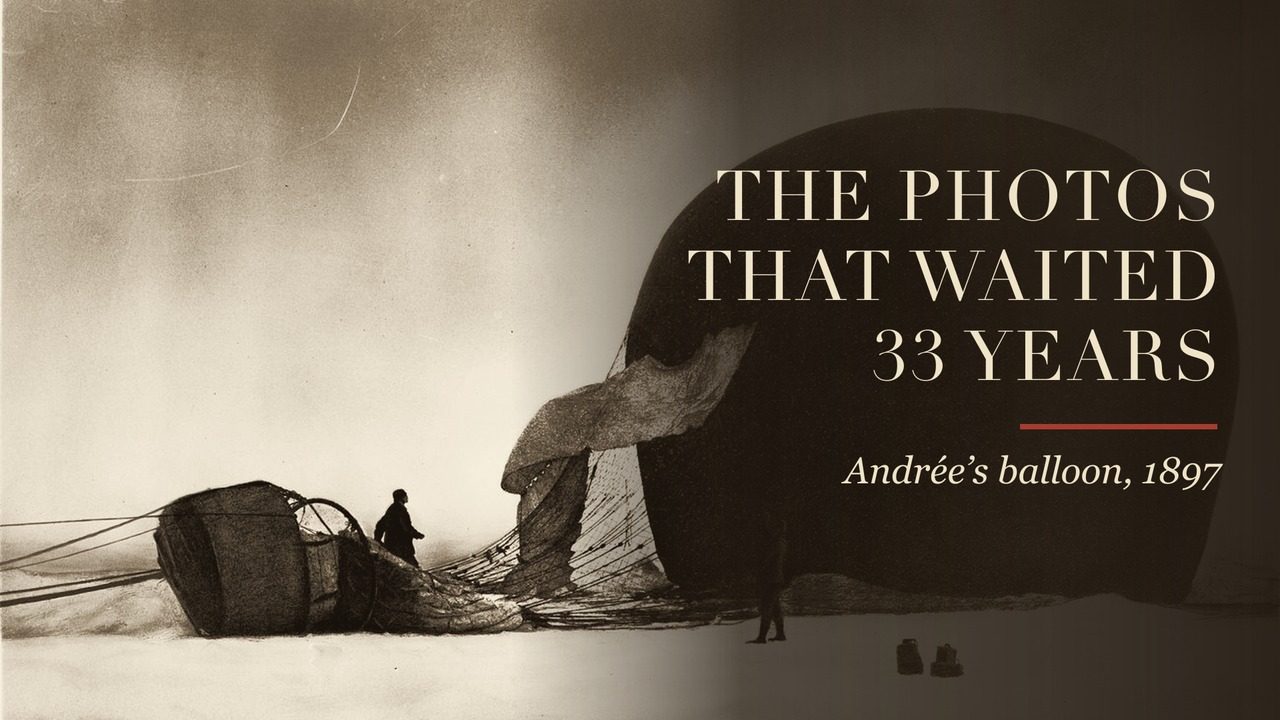
The photograph shows a balloon lying on the ice. Two men stand beside it. One of them looks at the camera.
The man who took this picture died more than a hundred and twenty years ago. And for thirty-three of those years, nobody knew this photograph existed.
It lay in a metal box, under snow and ice, on one of the most remote islands in the Arctic. Beside the bodies of the men who had taken it.
This is the story of three Swedes who tried to fly to the North Pole in a balloon. Of what happened to them on the ice. And of the film that waited thirty-three years to be developed.
In the eighteen-nineties, the North Pole was the great empty place on the map. Ships had tried to reach it and been crushed by the ice. Men had tried to reach it on foot, and turned back, or died.
Salomon August Andrée had a different idea. Why walk across the ice, he asked, when you could fly over it?
Andrée was an engineer. He was born in eighteen fifty-four, in the small town of Gränna, on the shore of Lake Vättern. He worked at the Patent Office in Stockholm. He was practical, confident, and fascinated by balloons.
His plan was simple to describe. Build a large hydrogen balloon. Take it to Svalbard, the islands far north of Norway. Wait for a steady wind from the south. And let that wind carry three men over the Pole, and on to Russia, Canada or Alaska.
It sounded like a novel by Jules Verne. But Andrée gave serious lectures about it, with calculations and drawings. And people believed him.
The money came quickly. The king of Sweden, Oscar the Second, supported the expedition. So did Alfred Nobel, the inventor of dynamite. For Sweden, it was a chance to win glory in the Arctic, where its neighbour Norway had been doing so well.
The balloon was made in Paris. It was about twenty metres across, sewn from three layers of silk and varnished to keep the gas inside. Andrée named it Örnen. The Eagle.
Underneath hung a basket with room for three men, food for months, scientific instruments, and cameras.
And there was one more idea, Andrée's own. Long, heavy ropes would hang from the basket and drag along the ice below. The friction, he believed, would slow the balloon down, and with a sail, he could steer it. Not perfectly. But enough.
Nobody had ever tested this over the Arctic Ocean.
In the summer of eighteen ninety-six, the expedition sailed to Danes Island, on the northwest corner of Svalbard. They built a tall wooden shed to protect the balloon and filled it with hydrogen.
And then they waited. The wind they needed, from the south, never came. Week after week, it blew from the wrong direction.
There was a worse problem. The expedition's meteorologist, Nils Ekholm, had been measuring the balloon. It was losing gas, more than it should. He warned Andrée that the Eagle might not stay in the air long enough to reach the other side.
At the end of the summer, they gave up and sailed home. Ekholm told Andrée he would not go again unless the balloon was improved. He did not go again.
For the second attempt, in eighteen ninety-seven, Andrée chose a new crew.
Knut Frænkel was twenty-seven, an engineer and a strong athlete who loved climbing mountains. He would handle the weather observations.
And Nils Strindberg was twenty-four. He was a physicist from Stockholm, a gifted photographer, and he had built some of his own camera equipment. His job was to photograph the Arctic from the air.
Andrée himself was forty-two.
Strindberg had something the others did not. In October of eighteen ninety-six, just after the first failed attempt, he had become engaged. Her name was Anna Charlier. She was a governess and a pianist.
They planned to marry when he came home.
On the eleventh of July, eighteen ninety-seven, the wind finally turned. It blew from the south-west, steady and strong.
The men tore down the front of the wooden shed. They climbed into the basket. Andrée sent his last telegrams, including one to the king. Then the ropes holding the balloon were cut.
The Eagle rose. And within minutes, everything went wrong.
The long drag ropes, the ones Andrée was going to steer with, caught on the ground and twisted. As the balloon pulled away, most of them came loose from the basket and fell away. Around five hundred and thirty kilograms of rope, lost.
At the same moment, the basket dipped down and touched the water. To lift it clear, the men threw out two hundred and ten kilograms of sand.
In just a few minutes, the Eagle had lost seven hundred and forty kilograms of weight. It shot upward, far higher than planned.
The men watching from the island saw the balloon grow smaller over the sea, and disappear to the north.
The balloon that was meant to be steered could no longer be steered. It was now simply a balloon, going wherever the wind wanted.
And high up, where the air is thinner, the hydrogen leaked out faster.
The expedition carried homing pigeons. Messages could be tied to them and sent back to Norway.
One of those pigeons was found. Its message, dated the thirteenth of July, was cheerful. Good journey eastwards. All goes well on board.
It was not true. The Eagle was losing gas and getting lower. It sank, bumped against the frozen sea, rose again, and sank. The men threw out everything they could spare.
After about sixty-five hours, on the fourteenth of July, they gave up. The balloon came down, softly, on the pack ice.
Nobody was hurt. Their equipment was undamaged. But they were hundreds of kilometres from any land, standing on ice that was itself moving.
And no one in the world knew where they were.
Strindberg took out his camera.
The pictures he took over the next weeks are some of the most extraordinary photographs ever made in the Arctic. The fallen balloon. The three men loading their sledges. A tent. A dead polar bear. Frænkel and Andrée pulling the sledge over a ridge of ice.
They spent a week at the landing place, sorting what to take. Then they started to walk.
Their maps showed two places where supplies had been left for emergencies. One was to the east, in Franz Josef Land. The other was to the south, on a group of islands called the Seven Islands. They chose the east.
Each man pulled a heavily loaded sledge. The ice was not flat. It was broken into ridges, cracks and pools of freezing water. Sometimes they had to unload everything, carry it over a ridge, and go back for the sledge.
Their clothes were wool, not fur. They were wet almost all the time.
And after days of walking east, they made a terrible discovery. The ice beneath them was drifting. It was carrying them west, faster than they could walk east.
On the fourth of August, they turned around, and headed for the Seven Islands instead.
They lived on what they could shoot. Seals. Walruses. And polar bears. The bears came to them, curious, and they killed them for meat.
Andrée kept a detailed diary. Frænkel kept the weather log.
Strindberg kept a diary too. But much of it was written for one reader. It took the form of messages to Anna, written in shorthand. He wrote to her about the ice, about their small daily problems, about the day they would see each other again.
The ice kept moving. Week after week, the wind and the current pushed them away from the Seven Islands, no matter how hard they walked.
By September, the sun was setting again. The days were growing shorter. The men were exhausted, sick with stomach pains, and their feet hurt.
They decided they could not reach land before winter. Instead, they would let the ice carry them, and spend the winter on it.
On a large ice floe, they built a hut from blocks of snow, with walls strengthened by water that froze solid.
And the floe drifted south, toward a small island covered almost entirely by a glacier. Its name was White Island. In Norwegian: Kvitøya.
On the second of October, the floe they were living on cracked, right beneath their hut.
The men had to escape onto the island itself. Over the next days, they carried their supplies onto land.
For the first time in nearly three months, they were standing on solid ground.
Andrée wrote that it felt good to sleep on firm land, instead of the drifting ice, where they had heard the constant cracking and grinding all night.
They talked about collecting driftwood and whale bones for a winter house.
And then, in the second week of October, eighteen ninety-seven, the diaries stop.
In Sweden, people waited. Months passed, then years.
Newspapers printed rumours. Sightings that weren't real. Messages that weren't real. People claimed to have seen the balloon. Others claimed to have heard of three white men somewhere in Siberia.
None of it was true. The Arctic had simply swallowed them.
Anna Charlier waited too. Years went by. In nineteen ten, she moved to the United States, and later she married an Englishman, Gilbert Hawtrey.
Thirty-three years passed.
In the summer of nineteen thirty, the Arctic was unusually warm. The sea ice around White Island, which normally made it almost impossible to land, had melted away.
A Norwegian ship, the Bratvaag, was in the area, on a scientific and sealing trip. In August, some of its crew went ashore on White Island to look for fresh water.
Near a small stream, half buried in snow, they found a boat. It was made of canvas over a wooden frame.
Inside was a boathook marked with the words: Andrée's Polar Expedition.
They had found the camp.
There were sledges, tools, clothing. There were the remains of two men, Andrée and Strindberg. There were diaries.
A few weeks later, a second ship came, with journalists on board. Its crew found the body of Frænkel. And they found something else: a small box holding Strindberg's rolls of film.
The rolls had been lying in the ice and water for thirty-three years. Nobody expected anything to survive.
The film was taken to Stockholm, to John Hertzberg, a photography scientist at the Royal Institute of Technology.
Hertzberg worked with extreme care. Of roughly two hundred and forty pictures on the film, he managed to save ninety-three.
And there they were. The balloon, lying on the ice. The men with their sledges. Their tent. A man standing over a polar bear. The ice stretching away in every direction.
Three men who had been dead for a generation, alive again, walking across the frozen sea.
Hertzberg retouched some of the pictures to make them clearer. Those are the versions most people have seen. But the original negatives still exist.
On the fifth of October, nineteen thirty, the three men came home to Stockholm.
The city came to a stop. Huge crowds lined the streets as the coffins passed. It was one of the largest public mournings Sweden had ever seen.
Their diaries were published, together with the photographs. Their bodies were cremated, and buried together in Stockholm's Northern Cemetery.
Anna learned what had happened to the man she had been engaged to, thirty-four years earlier. And she was given the messages he had written to her on the ice.
There is still one question no one can answer. How did they die?
They had food. They had ammunition. They had fuel. And they died within days of reaching land.
Some researchers believe they were poisoned by parasites in undercooked polar bear meat, a disease called trichinosis. Others point to the simplest answer: cold, exhaustion, and wet clothes, after three months on the ice.
There are other theories. Carbon monoxide from their stove. Bad food from their tins. A polar bear attack. None of them has been proven.
The men left no explanation. Only an empty page, where the next diary entry should have been.
Anna Charlier died in nineteen forty-nine, in England.
She had made one last request. Her body was buried in England, beside the husband she had lived with for most of her life.
But her heart was removed and cremated separately. It was placed in a small silver box, sent to Sweden, and buried in Stockholm, next to Nils Strindberg.
The Eagle was meant to show the world the North Pole from the air. It never reached it.
What it left behind was something else. Ninety-three photographs of three men walking across the ice, toward an island they would never leave.
They were taken in eighteen ninety-seven. And they were seen for the first time in nineteen thirty.
Sources and credits
Sources
- Wikipedia: Andrée's Arctic balloon expedition; S. A. Andrée; Nils Strindberg; Anna Charlier; Bratvaag Expedition
- Amusing Planet, "Salomon Andrée's Ill-Fated Arctic Balloon Expedition"
- Moderna Museet, Strindberg photographs and John Hertzberg's work ("Written in Light")
- Grenna Museum – Andrée Expedition Polar Centre
- Canterbury Christ Church University library blog, "The music of the spheres: Anna, Nils and their new worlds"
- HistoryNet, "Arctic Tragedy Revealed"; Smithsonian Air & Space; history.com; Primus, "33 years in the ice"
- Chalmers research, "Could the members of the 1897 Andrée balloon expedition have survived?"
Photographs
- Nils Strindberg's photographs from the ice, 1897 — scans by Tekniska museet, CC BY 2.0 (originals public domain)
- 360° panorama of the landing site, Nils Strindberg, 1897 — public domain
- Launch of the Eagle, 11 July 1897 — Alexis Machuron, public domain
- Andrée's station on Danes Island — Detroit Publishing Co. and Library of Congress (public domain); colour photochrom via oliver beige, CC BY 2.0
- Portraits by Gösta Florman / Gösta Flormans ateljé (Nordiska museet), 1896–97 — public domain
- Göteborgs stadsmuseum (1896, 1897), Sjöfartsmuseet Akvariet (1896) — public domain
- Funeral, Stockholm 1930 — Tekniska museet, CC0; public domain press photograph
- Bratvaag crew, 1930 — Gunnar Horn, public domain
- White Island, 2011 — Richard Neill, CC0 / public domain
- Documents: Andrée's telegram to Alfred Nobel (1896), Nils Ekholm's letter to Nobel (1896), the balloon blueprint, Strindberg's shorthand letter and diary (1897) — public domain
- Sea ice near Svalbard — satellite animation, NOAA / CIRA, public domain
- Map: Faded Pin · Natural Earth
Related stories on Faded Pin:
- Ada Blackjack: https://youtu.be/yLBXEk9v_1s
- Folke Bernadotte: https://youtu.be/Y1dZuuVdJ-E
Related stories